

In 2025, electric cars crossed from emerging technology into the mainstream. The International Energy Agency reports that global electric car sales grew by 20%, exceeded 20 million units, and represented roughly one in four new cars sold worldwide. That changes the buying question. You're no longer deciding whether EVs are viable. You're deciding which electric car fits your driving, climate, charging access, and budget without being misled by a single range figure or a low monthly payment. Start the price sort from the cheapest electric cars leaderboard.
The right electric car buying guide starts with your routine, not a dealership search. Evaluate usable winter range, highway charging performance, public-charging dependence, depreciation, energy, insurance, maintenance, and taxes as one ownership picture. Do that, and the best EV often becomes obvious before you compare badges.
Table of Contents
- Why 2026 Is the Best Time to Buy an Electric Car
- Assessing Your Driving Needs Before Browsing Models
- Understanding Real-World Range Beyond the Brochure
- Planning Your Charging Strategy With or Without Home Access
- Calculating the True Cost of EV Ownership
- Test Driving an EV Like an Informed Buyer
- Finalizing Your Purchase With Incentives and a Comparison Checklist
Why 2026 Is the Best Time to Buy an Electric Car
More than 20 million electric cars were sold globally in 2025, and roughly one in four new cars sold worldwide was electric, according to the IEA Global EV Outlook 2026 executive summary. Sales also rose 35% year on year in the first quarter of 2025, showing sustained demand rather than a late-year surge. Europe recorded 28% of total sales as electric-car sales increased by more than 30% in 2025, supported by tighter European Union CO2 standards.
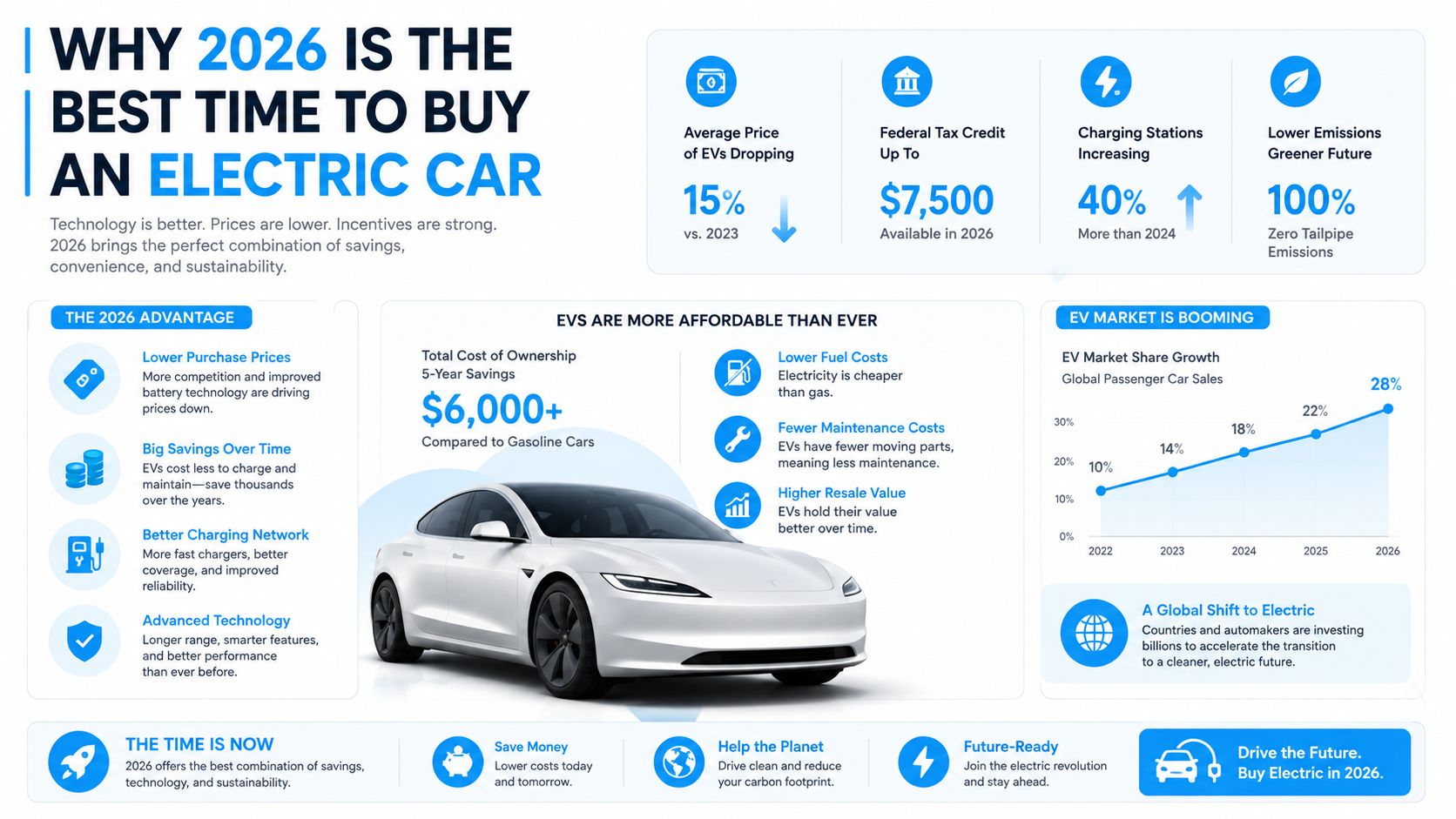
That scale changes the buying decision. Manufacturers now offer EVs across more body styles, price bands, battery capacities, and performance levels. Compact city cars, family crossovers, luxury sedans, pickup trucks, and performance models are all available. Buyers have more choice, but also more specifications to evaluate.
More choice creates a research problem
A larger market does not make every comparison useful. One EV may advertise strong range but charge slowly during road trips. Another may cost more upfront while reducing energy and maintenance spending. A third may look appealing until cold weather or public-charging prices reveal its practical drawbacks.
The European Environment Agency's registration data illustrates the depth of Europe's market. In 2024, more than 1.4 million new battery-electric vehicles were registered in the EU, representing 13.6% of new car registrations. Plug-in hybrids added about 800,000 registrations, or 7.3%. Together, roughly 2.2 million new electric cars entered the European market in one year, compared with around 400,000 in 2019.
Use standardized data to compare candidates. Check real-world range, winter usability, charging speed, ownership cost, space, and software quality. For road trips, examine charging performance and public-charging dependence. For ownership cost, include energy, maintenance, insurance, taxes, and expected depreciation rather than relying on the sticker price.
The best EV is not the one with the biggest battery. It is the one that handles your normal week and difficult trips without costly workarounds.
Practical rule: Rank vehicles by how well they fit your routine, winter conditions, charging access, and total ownership cost before comparing brand reputation or headline specifications.
Assessing Your Driving Needs Before Browsing Models
Most buyers begin with a budget and a range number. Reverse that order. First, document how you use a car, because a city commuter, a family driver, and a frequent highway traveler need different EV strengths.
Build a personal usage profile
Start with your ordinary week. Note your daily driving, recurring errands, school or work runs, and the trips that regularly require a highway. Separate routine driving from exceptional journeys. A vehicle that easily covers your weekday use may still frustrate you if every weekend involves long-distance travel and unreliable charging locations.
Then answer five questions:
How predictable is your driving? A consistent commute favors efficient vehicles with moderate batteries. An unpredictable schedule increases the value of extra usable range and dependable fast charging.
Where can you charge? Identify a garage, driveway, workplace, apartment facility, or nearby public location. Charging access should shape the shortlist before exterior design or acceleration.
What roads do you use? City traffic rewards efficiency and easy maneuverability. Frequent highway driving raises the importance of aerodynamic design, stable high-speed consumption, and charging performance.
Who and what travels with you? Test rear-seat comfort with the passengers who'll use the car. Measure cargo needs with strollers, sports equipment, work tools, luggage, or pets rather than relying on a generous-looking trunk opening.
What climate do you face? Heat, cold, hills, snow tires, and cabin heating all affect usable range. Cold-weather buyers should treat winter performance as a primary filter, not a footnote.
Match the vehicle to the driver
A city commuter should prioritize efficiency, compact dimensions, visibility, easy parking, and convenient overnight charging. A mixed-use driver needs balanced range, useful rear space, and charging that supports occasional longer trips. A frequent road-tripper should put fast-charging consistency, charging-network coverage, route planning, and winter highway performance ahead of maximum acceleration or luxury trim.
Use a simple screening score before opening model pages. Give each candidate a pass or fail for home or workplace charging, winter suitability, cargo and passenger fit, highway range, and charging speed. Any model that fails an essential requirement leaves the list, regardless of its other advantages.
Write down your answers. Buyers who skip this step tend to shop emotionally, then rationalize a vehicle that doesn't fit. A needs profile turns a huge catalog into a manageable shortlist and gives you clear reasons to reject attractive but unsuitable options.
Understanding Real-World Range Beyond the Brochure
The advertised range is a laboratory reference, not a promise about every journey. Official WLTP and EPA figures help compare vehicles tested under a common procedure, but they don't tell you how much distance remains after a cold start, a fast highway run, heavy cabin heating, steep terrain, or winter tires.
The Cars.com EV buying guidance summarizes the issue clearly: modern EVs commonly lose about 20% of range at 32°F, and roughly 20% to 40% in sub-freezing conditions. Some buyer guidance recommends assuming only 60% to 75% of rated EPA range on cold days. That isn't a reason to reject electric driving. It is a reason to buy enough practical margin for your climate and route.
Use a winter and highway test
For a cold-weather shortlist, ask four questions:
- How much range remains on a winter highway trip? Look for independent testing that reflects sustained speed rather than urban averaging.
- How quickly does the vehicle charge when the battery is cold? A vehicle may have a strong peak charging figure but take longer to reach useful power in winter.
- Does preconditioning work reliably? Battery and cabin preconditioning can improve departure comfort and charging readiness, but only if the software makes the feature easy to schedule.
- What happens with heating and winter tires? Cabin heat and higher rolling resistance can materially change consumption, so don't compare summer figures with winter expectations.
Battery size matters, but usable capacity, efficiency, thermal management, and charging behavior matter just as much. For a technical explanation of what the battery figures mean, use this EV battery capacity guide, then compare models using consistent units rather than mixing gross capacity, usable capacity, and marketing terminology.
Think in distance between useful charging stops
Road-trip usability depends on more than the distance between full charges. A vehicle with strong range but slow charging may spend more time stopped than a vehicle with less range and a faster, more consistent charging curve. Evaluate the combination of usable highway range and time needed to restore the next practical segment.
Ask a dealer to let you inspect the route planner, charging-stop recommendations, and battery percentage display. If possible, drive the vehicle at your normal highway speed and monitor consumption instead of trusting the projected range alone. Your target shouldn't be the largest brochure number. It should be enough reserve for your coldest normal conditions, plus charging performance that keeps long trips manageable.
Planning Your Charging Strategy With or Without Home Access
Charging access determines whether an EV feels effortless or inconvenient. Buyers with a garage and buyers who depend on public stations are making different ownership decisions, even if they choose the same model.
Home charging is usually the simplest option. A regular outlet can work for light use, while a dedicated Level 2 installation suits drivers who want faster overnight replenishment and more flexibility. The right choice depends on daily driving, electrical capacity, parking location, and the cost of installation. Don't approve an EV purchase until you know where the cable will reach and who controls that parking space.
Public charging can work, but it demands more planning. Confirm the networks near home, work, shopping, and the highways you regularly use. Test their apps, payment process, station availability, connector compatibility, and reliability before committing. Charging-level guidance for EV buyers can help you distinguish the equipment types and understand why a connector label alone doesn't guarantee a fast session.
Compare the charging options
The following figures come from Recharged's 2025 first-EV buying guide. Actual results vary by vehicle, charger, battery temperature, and state of charge, so use them as planning references rather than guarantees.
| Charging Type | Miles Added Per Hour | Typical Cost Per kWh | Best For |
|---|---|---|---|
| Level 1 | About 3 to 5 | Varies by electricity tariff | Light daily use and overnight top-ups |
| Level 2 | About 20 to 40 | Varies by electricity tariff and site | Regular home or workplace charging |
| DC fast charging | Commonly 150 to 200 miles in 20 to 40 minutes on newer EVs | Varies by network and pricing model | Road trips and urgent replenishment |
The table shows why public-only ownership requires a different budget. Level 1 may be too slow for frequent driving. Level 2 is convenient when available, but apartment residents may need permission, dedicated parking, or a shared facility. DC fast charging saves time on longer journeys, but repeated dependence can make weekly routines more expensive and less predictable than home charging.
Make public charging your real-world test
Map your actual week, not an imaginary road trip. Identify where you would charge after work, during grocery shopping, at the office, and on your most common longer route. Visit those sites at the times you expect to use them. A station that looks close on a map may be poorly lit, occupied, out of service, or awkwardly located.
Charging decision: If you can't charge at home, buy the network and routine first, then choose the car that works with them.
Fleet operators should also model dwell time, driver schedules, depot power, and backup locations. Private buyers should ask whether a public session fits naturally into an existing stop. If charging requires a special weekly detour, treat that time as a real ownership cost.
Calculating the True Cost of EV Ownership
Sticker price is only one line in the purchase decision. A proper total-cost-of-ownership calculation includes depreciation, energy, insurance, maintenance, and taxes over a fixed period. Without that structure, buyers can overpay for a cheap-to-run car or dismiss an EV whose operating savings offset a higher initial price.
A 2024 consumer-focused TCO study from BEUC estimated that a battery-electric vehicle bought new in 2025 would cost about €2,600 less to own over the first ownership period than a petrol car, and about €2,500 less than a diesel car. Those findings don't make every EV cheaper in every market. They show why a purchase-price comparison is incomplete.
Build the calculation in layers
Start with the vehicle's full transaction cost, including delivery charges, options, registration, and any charger installation. Then estimate how much value the car may lose over your intended ownership period. Depreciation often dominates the result, especially when model prices, battery technology, and incentives change quickly.
Add energy using your real charging mix. Separate home, workplace, and public charging rather than applying one blended assumption. Public charging dependence can materially change the result, particularly for drivers who can't access lower-cost residential electricity.
Insurance deserves its own quote. Repair complexity, vehicle value, coverage requirements, and local insurer pricing can produce a different result from the general expectation that EVs cost less to operate. Maintenance should include scheduled servicing, tires, inspections, and likely wear items. Taxes and registration charges can either favor or weaken the EV case depending on your jurisdiction.
Treat plug-in hybrids as a usage decision
The BEUC study also found that plug-in-hybrid ownership costs can swing by around €4,000 depending on charging behavior, and even high charging use left PHEVs costing more than a BEV by over €1,000 in that analysis. The lesson is direct: a PHEV only makes economic sense if you will charge it consistently and use its electric capability as intended.
Use a calculator for electric car cost per mile to test your own energy assumptions, then compare the result against equivalent petrol, diesel, and hybrid vehicles. Run conservative and favorable scenarios. If the decision only works under perfect charging access, unusually low energy prices, or optimistic resale assumptions, the vehicle isn't affordable for your situation.
Test Driving an EV Like an Informed Buyer
An EV test drive should answer questions that a specification sheet can't. Don't spend the entire appointment accelerating from traffic lights. Recreate the conditions that determine whether you'll enjoy the vehicle every day.
Test the driving experience
Begin with a normal city route. Adjust regenerative braking from its strongest setting to its lightest setting, then test one-pedal driving in traffic. Some drivers love aggressive lift-off deceleration, while others prefer a more familiar coasting response. Check whether the brake pedal transition feels smooth when friction braking joins regenerative braking.
Move onto a faster road and listen carefully. Electric motors are quiet, so tire and wind noise become easier to notice. Test the seats, steering position, visibility, mirrors, adaptive cruise control, lane-centering behavior, and driver-assistance alerts. A vehicle that feels impressive for a short showroom loop may become tiring on a longer commute.
Inspect the practical details
Open the charging port and connect the cable yourself. Check whether the port is easy to reach, whether the door interferes with a wall or neighboring vehicle, and whether the supplied cable has a sensible storage location. Ask to see the navigation system's charger search, route planning, battery-conditioning controls, and estimated arrival percentage.
Use this checklist before you leave:
- Controls: Can you adjust climate, mirrors, wipers, and drive modes without hunting through menus?
- Software: Ask how updates arrive, what functions require a phone app, and whether the vehicle remains usable when connectivity is poor.
- Warranty: Request the written battery warranty terms, including coverage conditions and exclusions.
- Space: Install a child seat, load your normal equipment, and sit in the rear seats behind your preferred driving position.
- Charging: Confirm the maximum AC and DC input rates, cable options, and any included network access.
- Comfort: Spend enough time in the driver's seat to detect pressure points, poor visibility, or an awkward screen layout.
Test-drive standard: If the salesperson won't let you examine charging, storage, software, and rear-seat practicality, you haven't completed the test drive.
Take a second drive in a different trim if wheels, tires, suspension, or seating change. Compare the vehicles on the same route and write down observations immediately. Memory favors the newest car you drove, not necessarily the one that best fits your life.
Finalizing Your Purchase With Incentives and a Comparison Checklist
Before signing, verify incentives through the relevant government, state, local, and utility sources. Check eligibility, income or vehicle restrictions, purchase or lease rules, income-tax treatment, application deadlines, and whether the benefit arrives at purchase or later. Never subtract an incentive from your budget until the responsible agency or utility confirms that you qualify.
Put your finalists in a side-by-side sheet and compare:
- Real-world range: Use independent results that resemble your roads and weather.
- Winter range retention: Check cold-weather performance, heating impact, and preconditioning.
- Charging speed: Compare useful charging time, not just peak power.
- Total ownership cost: Include depreciation, energy, insurance, maintenance, taxes, and charger expenses.
- Space and usability: Verify passenger comfort, cargo capacity, towing needs, and visibility.
- Software ecosystem: Evaluate route planning, charging information, updates, app quality, and controls.
Get insurance quotes before negotiating. Ask for the complete out-the-door price, including accessories, delivery, registration, and dealer-installed products. Compare financing and leasing separately, and don't accept a low monthly payment without reviewing the total amount paid.
Use competing vehicles and available inventory to negotiate a better price, but don't trade away the requirements that made the shortlist. The right deal is the one that still works after winter range, public charging, and ownership costs are included.
EV Stats gives you structured electric-vehicle specifications, side-by-side model comparisons, real-world range context, charging analysis, and ownership-cost tools for the decisions covered in this guide. Visit EV Stats to compare suitable models, simulate charging needs, and build a shortlist based on how you drive.