

Most advice about AC fast charging EVs starts with the wallbox. That's the wrong place to start. The box on the wall can advertise a high output, but your car's onboard charger, the available electrical phases, and the battery's charging limits decide how much power reaches the pack.
That distinction changes what “fast” means. AC charging isn't the highway sprint associated with DC fast charging. It's the practical charging layer for homes, workplaces, hotels, retail destinations, and fleet depots, where a vehicle sits long enough for steady, efficient energy transfer. The right question isn't, “How powerful is the charger?” It's, “How much AC power can my car accept, and how long will it be parked?”
Table of Contents
- Why AC Fast Charging EV Is a Misleading Label
- How AC and DC EV Charging Differ
- Single-Phase vs Three-Phase AC Power Explained
- The Onboard Charger That Sets Your Real Speed Limit
- Realistic Charge Speeds You Can Expect
- Where AC Fast Charging Makes More Sense Than DC
- An Overnight AC Charging Scenario Step by Step
- Choosing the Right AC Charger for Your Situation
Why AC Fast Charging EV Is a Misleading Label
AC Fast Charging sounds like a promise of rapid turnaround. Usually, it means the quicker end of AC Level 2, not the experience drivers expect from a high-power DC station. The U.S. Department of Energy's Alternative Fuels Data Center reported that, as of 2023, nearly 80% of public EV charging ports were Level 2, while less than 1% were Level 1. That distribution reflects how often cars sit at homes, workplaces, hotels, and other destinations. The EV charging standards overview explains that Level 2 commonly operates at 240 V and delivers 3.3 to 19.2 kW.
The wallbox is only one part of the speed limit. Your vehicle's onboard charger determines how much incoming AC it can convert, while the available electrical phases and the battery system set further limits. A high-rated wallbox cannot make a car accept more power than its onboard hardware supports.
A Level 2 session can be fast beside a household outlet, yet slow beside DC charging. The comparison below uses a 75 kWh battery and the specified example figures. Actual sessions vary because the vehicle may reduce power, conversion losses consume energy, and charging usually slows as the battery fills.
| Charger Type | Power Output | Time to 80% |
|---|---|---|
| AC Level 2 | 7 kW | About 8 to 11 hours |
| DC fast charger | 150 kW | About 25 to 35 minutes |
The first row fits overnight charging. The second fits a road-trip stop. Calling both “fast” without explaining the parking time and power path creates the wrong expectation.
Fast within AC, not fast in every context
AC charging spans basic outlet charging through higher-power three-phase systems. SAE J1772 defines AC Level 1 at 120 V with up to 1.44 to 1.92 kW, and AC Level 2 at 208 or 240 V with 5.0 to 19.2 kW, according to this technical reference on IEC 61851 and EV charging levels. A 7 kW or 11 kW wallbox can therefore shorten charging substantially compared with Level 1, while remaining far below DC charging power.
AC works best as a long-dwell charging system. A car parked overnight does not need a 20-minute refill. It needs enough energy by morning without the equipment and electrical capacity required for high-power DC. Public AC Level 2 remains important for that use, with 172,911 public AC Level 2 ports recorded in the United States on January 1, 2026, up 11.5% year over year, according to the U.S. Department of Transportation EV charging basics.
Practical rule: Compare an AC charger with your vehicle's onboard charger and parking time, not with a DC station's advertised power.
How AC and DC EV Charging Differ
AC and DC charging differ mainly in where the conversion takes place. With AC, power enters the vehicle through the onboard charger, which converts alternating current into DC before the battery can store it. That component, rather than the wallbox alone, often sets the practical charging limit.
DC charging moves the conversion equipment outside the vehicle. The station converts grid power into battery-ready DC, then supplies it directly to the battery pack. Because the station houses the larger power electronics and cooling hardware, the vehicle's onboard AC charger is not the main gate for that energy path.
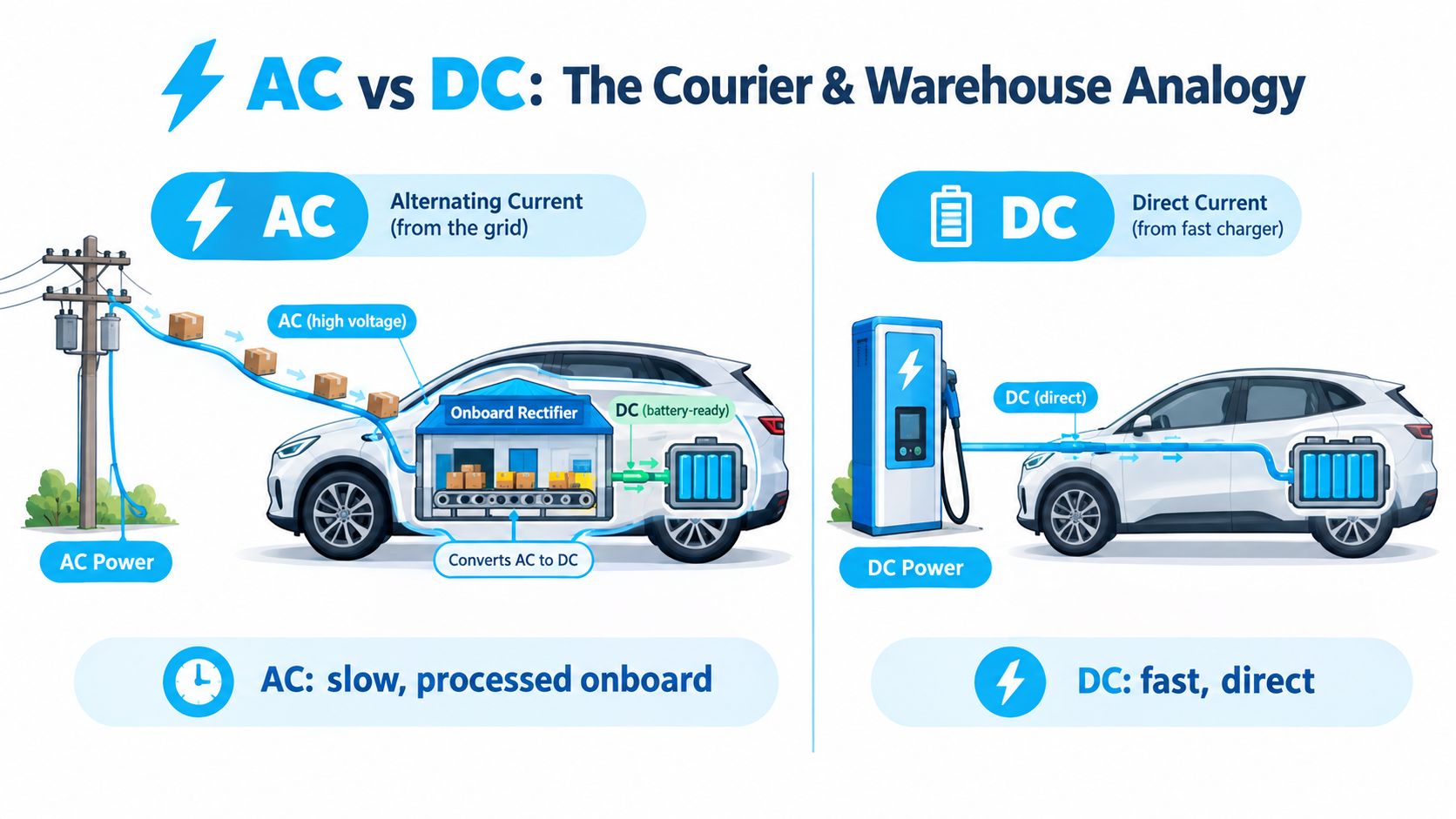
The two power paths
An AC session follows this sequence:
- The grid supplies alternating current.
- The EVSE communicates with the car and provides the available AC supply.
- The onboard charger converts AC to DC.
- The battery management system controls the permitted charging power.
- The battery stores the DC energy.
During DC charging, the external station performs the conversion before power reaches the vehicle. The battery management system still controls the session and can reduce the output when temperature, state of charge, or other conditions require it.
The EV charging levels guide outlines the differences between these charging categories. The key distinction is that the wallbox isn't the complete charger in an AC session. It provides a controlled connection between the electrical supply and the vehicle, while the AC-to-DC conversion hardware remains inside the car.
That onboard hardware must fit within the vehicle, work with its thermal system, and match the model's electrical design. Software can schedule charging, balance household demand, or pause a session. It cannot make the vehicle accept more AC power than the onboard charger is designed to handle.
As a result, a high-output AC wallbox may deliver less than its advertised capacity to a particular EV. The available supply, electrical installation, wallbox, and vehicle must support the same operating point.
DC charging bypasses the vehicle's AC conversion limit, but the battery still determines how much power it can accept at any moment. AC keeps the main conversion constraint inside the car. DC places it in the external station, while battery conditions and vehicle software continue to shape the result.
Single-Phase vs Three-Phase AC Power Explained
The wallbox does not decide AC charging speed by itself. Phase architecture sets the upstream ceiling, so neither the vehicle nor the wallbox can create three-phase power at a site supplied with only single-phase service.
Single-phase AC is common in homes across North America and other markets. Three-phase supply is more common in European residential and commercial environments. It spreads the load across three electrical phases instead of concentrating it on one, which helps explain why 11 kW and 22 kW AC charging are common in Type 2 markets, while 22 kW is less common in North America.
The basic relationship is:
Power in kW = voltage × current ÷ 1,000
The following representative configurations come from the charging standards and connector limits described in the IEC 62196 Type 2 technical reference.
| Supply Type | Voltage | Current | Max Power |
|---|---|---|---|
| AC Level 1, single-phase | 120 V | Standard Level 1 range | 1.44 to 1.92 kW |
| AC Level 2, single-phase | 208 or 240 V | Up to the vehicle and circuit limit | 5.0 to 19.2 kW |
| Type 2, three-phase | About 400 V system | 32 A | 22 kW |
| AC Level 3, three-phase | 208 to 600 V | Standard-defined range | 22.7 to 166 kW |
Why the same wallbox behaves differently by region
A European Type 2 installation can use three-phase current to reach 22 kW at 400 V and 32 A, a common upper-end public AC rate. Type 2 supports three-phase AC charging up to 63 A at voltages up to 480 V AC, though the vehicle, site, cable, and operating rules determine the rate the car can use.
North American homes generally rely on single-phase service. A single-phase J1772 or Type 1 installation can provide effective home and workplace charging, but it cannot provide the same three-phase throughput as a 22 kW Type 2 setup. If the supply has less capacity, a high-rated wallbox operates below its label.
Phase count also affects the vehicle's side of the connection. An EV with an 11 kW three-phase onboard charger can use an 11 kW three-phase supply effectively. A car with a single-phase onboard charger may draw power from only one phase, even when connected to a three-phase wallbox.
The connector doesn't determine the whole session. Phase count, current, voltage, site wiring, and the vehicle's onboard charger work together.
For fleet managers, the vehicle specification deserves as much attention as depot hardware. Where three-phase power is available, vehicles with 11 kW or 22 kW onboard chargers can make better use of parked charging time than models with lower AC acceptance.
The Onboard Charger That Sets Your Real Speed Limit
The wallbox rating is often not the speed limit. The vehicle's onboard charger usually decides how much AC power can enter the battery. The power path works like a funnel: the narrowest point controls the flow, even when the equipment upstream has more capacity.
A wallbox rated at 22 kW paired with a vehicle whose onboard charger accepts 11 kW will normally deliver no more than 11 kW over that AC connection. The unused capacity stays available in the wallbox, but the car cannot draw it.
Read the vehicle specification first
EVs accept different amounts of AC power, commonly around 3.7 kW, 7.4 kW, 11 kW, or 22 kW. The limit depends on the onboard charger and its phase design. A single-phase vehicle connected to a three-phase supply may draw from only one phase, leaving part of the site's capacity unused.
Common mismatches include:
- A 22 kW wallbox with an 11 kW OBC: The vehicle remains limited to 11 kW.
- An 11 kW wallbox with a 7.4 kW OBC: The vehicle draws only what its onboard charger accepts.
- A three-phase site with a single-phase vehicle: The vehicle may use only one phase.
- A lower-power installation with a high-rated EV: The electrical supply becomes the limit.
The guide to how EV charging works describes the same general rule: the session follows the lowest capability in the power path. That point can be the supply, wallbox, connector, vehicle's onboard charger, or battery condition.
Phase architecture matters as much as the wallbox label. Two cars plugged into the same charger can therefore charge at different rates, because one may accept three-phase AC while the other uses only single-phase power.
Why the wallbox still matters
A wallbox still provides dedicated wiring, charging controls, load management, scheduling, and compatibility with the site's electrical system. It can make a lower-power vehicle easy to charge reliably during daily parking.
Extra AC capacity does not automatically shorten the session. A 22 kW unit paired with a 7.4 kW vehicle leaves much of that rating unused. The higher-rated unit may still suit an owner planning to switch vehicles, provided the site can support the installation.
Check the vehicle manual for maximum AC input power and single-phase or three-phase compatibility. A dealer's broad “fast AC” description does not replace those specifications.
Realistic Charge Speeds You Can Expect
An AC charger's kW rating is only the starting point. It describes electrical power, not driving range. Range added per hour varies with vehicle efficiency, weather, battery temperature, auxiliary consumption, and the charging curve. A more efficient EV can travel farther from the same AC input than a less efficient one.
Use these figures as planning bands, not promises. They also show why an EV charging speed comparison needs to account for both power and vehicle efficiency.
| Power Level | Approx. Range Added per Hour | Approx. Time for 60 kWh Battery | Common Source |
|---|---|---|---|
| 3.7 kW | About 12 to 20 miles, or 20 to 35 km | About 16.2 hours before losses | Lower-power AC supply |
| 7.4 kW | About 25 to 40 miles, or 40 to 65 km | About 8.1 hours before losses | Single-phase home or workplace AC |
| 11 kW | About 35 to 55 miles, or 55 to 90 km | About 5.5 hours before losses | Three-phase AC and compatible OBC |
| 22 kW | About 60 to 90 miles, or 95 to 145 km | About 2.7 hours before losses | High-power three-phase Type 2 AC |
The 60 kWh battery times are theoretical minimums, calculated by dividing battery energy by charging power. Real sessions take longer because conversion losses reduce the energy reaching the battery. Charging can also taper as the battery approaches a high state of charge, while cold conditions may lower the rate until the battery warms.
Slow charging can carry a hidden efficiency penalty
Charging losses come from more than the conversion electronics. The vehicle may keep control electronics, thermal management, and other charging-ready systems active throughout the session. Research on AC charging efficiency at low charging power identifies onboard charger inefficiency, auxiliary systems, and battery electrochemistry as important sources of loss. It also reports that onboard chargers are typically near their optimal efficiency from roughly 50% to 100% of nominal power.
A lower rate can still be the right choice. Load management, electricity tariffs, solar production, and battery-care preferences may all support slower charging. Deliberately setting AC power far below the vehicle's rating, however, can keep fixed loads active longer and reduce grid-to-battery efficiency.
An 11 kW vehicle charging at 7.4 kW may finish comfortably overnight. Higher AC capacity becomes worthwhile when the current setup regularly fails to restore the required energy before departure, or when workplace and depot vehicles have shorter parking windows.
Where AC Fast Charging Makes More Sense Than DC
The quickest charger is not always the most useful one. AC Level 2 often fits daily driving better because the vehicle is parked for hours, while DC fast charging earns its place when a short stop must add substantial range.
The deciding factor is the car's dwell time and its charging hardware. An AC wallbox supplies alternating current, but the vehicle's onboard charger converts it to battery-ready direct current. Its power rating, along with the available single-phase or three-phase supply, can limit charging speed before the wallbox reaches its own maximum.
Match charging technology to parking time
Home charging is the clearest AC use case. After returning, the driver plugs in and can schedule charging around household electricity use. If the car remains parked overnight, a moderate AC rate can restore the required energy without using a public high-power station.
Workplace charging makes use of a long parking period. A vehicle that stays at the office through most of a shift does not need a rapid turnaround. Managed AC charging can share site capacity among several vehicles, rather than directing the available power to a small number of DC dispensers.
Hotels, apartments, and destination venues suit AC for the same practical reason. Guests and visitors may leave their vehicles for several hours, allowing the car to add energy while the driver is occupied. Level 2 is widely used for residential and workplace charging, as described in the Department of Energy charging guidance.
The onboard charger still determines how much of the supplied AC power the car can use. A higher-rated wallbox may provide more headroom for vehicles with suitable hardware, but it cannot make a lower-rated onboard charger accept energy faster.
Fleet depots can use AC when vehicles return on predictable schedules and remain parked between assignments. Fleet managers can set charging windows, coordinate site loads, and give priority to vehicles leaving earlier.
Where DC remains the better tool
Road trips demand a different arrangement. Drivers have a limited stop window, and DC charging sends direct current to the battery without passing through the vehicle's onboard AC conversion stage. That allows a compatible high-power station to add energy much faster than ordinary AC equipment.
The practical choice is parked time versus required turnaround. Choose AC when the vehicle can wait. Choose DC when the next departure cannot.
The better charger is the one that fits the vehicle's dwell time. Extra speed adds little value when the car is already parked until morning.
An Overnight AC Charging Scenario Step by Step
Consider a 60 kWh EV with an 11 kW onboard charger connected to a 16 A three-phase wallbox. At 18:30, the battery is at 25%, and the driver plugs in after arriving home. The wallbox and vehicle first complete their safety checks. Around 19:00, the onboard charger converts AC to DC, and the car can draw close to its available 11 kW while the battery is in a receptive part of its charging curve.
A practical planning timeline looks like this:
- 18:30: Plug in. The battery holds 25% of its 60 kWh capacity.
- 19:00: Charging begins. The OBC converts AC and draws approximately 11 kW.
- 22:30: The battery reaches about 80%, after roughly four hours of charging.
- 02:00: The battery reaches 100%, after approximately 7.5 hours total.
- 06:30: The vehicle remains fully charged and ready for the morning journey.
These times illustrate the process rather than promise an exact result. Conversion losses, battery temperature, vehicle settings, and charging tapering can change the duration. The car may finish before the driver wakes, then remain connected without drawing power until departure.
Small controls improve the result
Scheduling can shift charging away from an expensive peak period when the electricity tariff supports time-based use. It can also delay charging after arrival, provided the vehicle still has enough time to reach the desired state of charge.
Cabin preconditioning uses another useful part of the connection. Heating or cooling the interior while the vehicle remains plugged in can preserve battery energy that would otherwise power the first part of the drive. The benefit varies with the vehicle, weather, and climate settings. The principle stays the same: use grid energy for preparation while the car is connected.
AC charging fits naturally into an overnight routine. The driver does not need to monitor the session, move the vehicle after a short stop, or arrange the day around a public station. Charging takes place during parked time that was already available, while the vehicle's onboard charger and battery manage the actual energy flow.
Choosing the Right AC Charger for Your Situation
The right wallbox is determined by two limits, the property's electrical supply and the vehicle's onboard charger. Check both before paying for higher output. A charger cannot make a single-phase car accept three-phase power, and it cannot make an electrical installation carry more current than it supports.
Confirm the electrical supply
Ask an electrician to verify:
- Phase type: Confirm whether the property has single-phase or three-phase service.
- Circuit capacity: Check voltage, current, breaker headroom, cable routing, and available continuous load.
- Load management: Decide whether the charger should reduce power when major appliances operate.
- Installation environment: Confirm weather protection, cable placement, and suitable mounting conditions.
A 22 kW wallbox requires an electrical system and vehicle that can use its operating capacity. If the property has a lower-rated supply, a 7.4 kW or 11 kW unit may fit the site better. The wallbox is the tap, while the supply pipe and the car's charger determine how much water can pass.
Confirm what the EV can accept
Check the manufacturer's specification for the car's maximum AC charging rate and phase configuration. A high-output wallbox will not raise a 7.4 kW vehicle to 11 kW or 22 kW.
Choose the connector standard used by the vehicle and local infrastructure, such as Type 1, Type 2, J1772, or NACS. Then choose between a tethered cable for convenience and an untethered socket for flexibility. Smart charging, solar integration, scheduled charging, load balancing, OCPP support, and weather protection may matter more than headline power.
For model comparisons, the catalog lists the specs it stores, including peak DC charge kW. It does not store onboard AC kilowatts. What that converter is, and why the charge column is a different number, is in what an onboard charger is. Side-by-side rows are in the comparison tool, and session minutes are in the charging simulator.
A portable EVSE can suit occasional charging. A fixed wallbox is more practical for regular home or workplace use. Before ordering, match the site supply, vehicle OBC, connector, installation conditions, and daily parking window. This prevents paying for wallbox capacity that the car cannot use in an AC fast charging EV setup.