

DC fast charging is public charging that delivers direct current at roughly 50 kW or more, bypassing the car's onboard AC charger to feed the battery more directly. The International Energy Agency classifies chargers above 22 kW up to 150 kW as fast and chargers at 150 kW or above as ultra-fast, so the name covers a broad range of high-power equipment.
You're likely asking because you're standing beside an unfamiliar charging stall, looking at a connector, a percentage, and a kW figure that keeps changing. The important idea is simple: the number printed on the charger is only its ceiling. Your car's battery voltage, temperature, state of charge, and software determine how much power it can accept.
That one distinction explains nearly everything else, from why one EV charges quickly at a 150 kW station while another barely reaches its limit, to why a session slows sharply near a full battery.
Table of Contents
- Why DC Fast Charging Matters on the Road
- How DC Power Actually Reaches the Battery
- The Main Connector Standards Compared
- Why Charging Curves Beat Headline kW
- Typical Session Times and Real Use Cases
- Common Myths About Battery Wear
- Putting It All Together at the Charging Bay
Why DC Fast Charging Matters on the Road
You pull into a highway service plaza with the battery lower than planned. After plugging in, the screen climbs past 150 kW, and the car begins adding useful range while you stretch your legs. That experience is the practical answer to what is DC fast charging: it's high-power public charging designed to reduce a long recharge into a manageable travel stop.
A Level 2 AC charger sends alternating current to the vehicle, where the onboard charger converts it to the direct current the battery stores. A DC fast charger performs that conversion inside the charging equipment, then sends DC power through the vehicle's charging system. Because the station isn't limited by the relatively small onboard AC charger, it can deliver substantially higher power.
The difference matters most when you're traveling beyond your normal routine.
- At home, AC charging can replenish the battery while the car is parked overnight.
- At work or during shopping, AC charging can add energy during a longer dwell time.
- On a highway, DC charging fills the gap when you can't leave the vehicle parked for hours.
Practical rule: Use AC charging for parked time and DC fast charging for time-sensitive travel.
The network is also becoming part of long-distance planning. The IEA reported 2 million fast chargers worldwide in 2024, while ultra-fast units grew by more than 50% during that year. Its description of European Union AFIR requirements also specifies DC fast charging of at least 150 kW every 60 km along the TEN-T network from 2025 onward, making high-power charging increasingly relevant to cross-country driving in Europe. The IEA's Global EV Outlook material provides that infrastructure context.
You don't need DC fast charging for every trip. Daily driving usually fits comfortably around home or workplace charging. On a road trip, however, the ability to stop, charge, and continue turns the EV from a vehicle that needs long parking breaks into one that can follow a normal travel rhythm.
How DC Power Actually Reaches the Battery
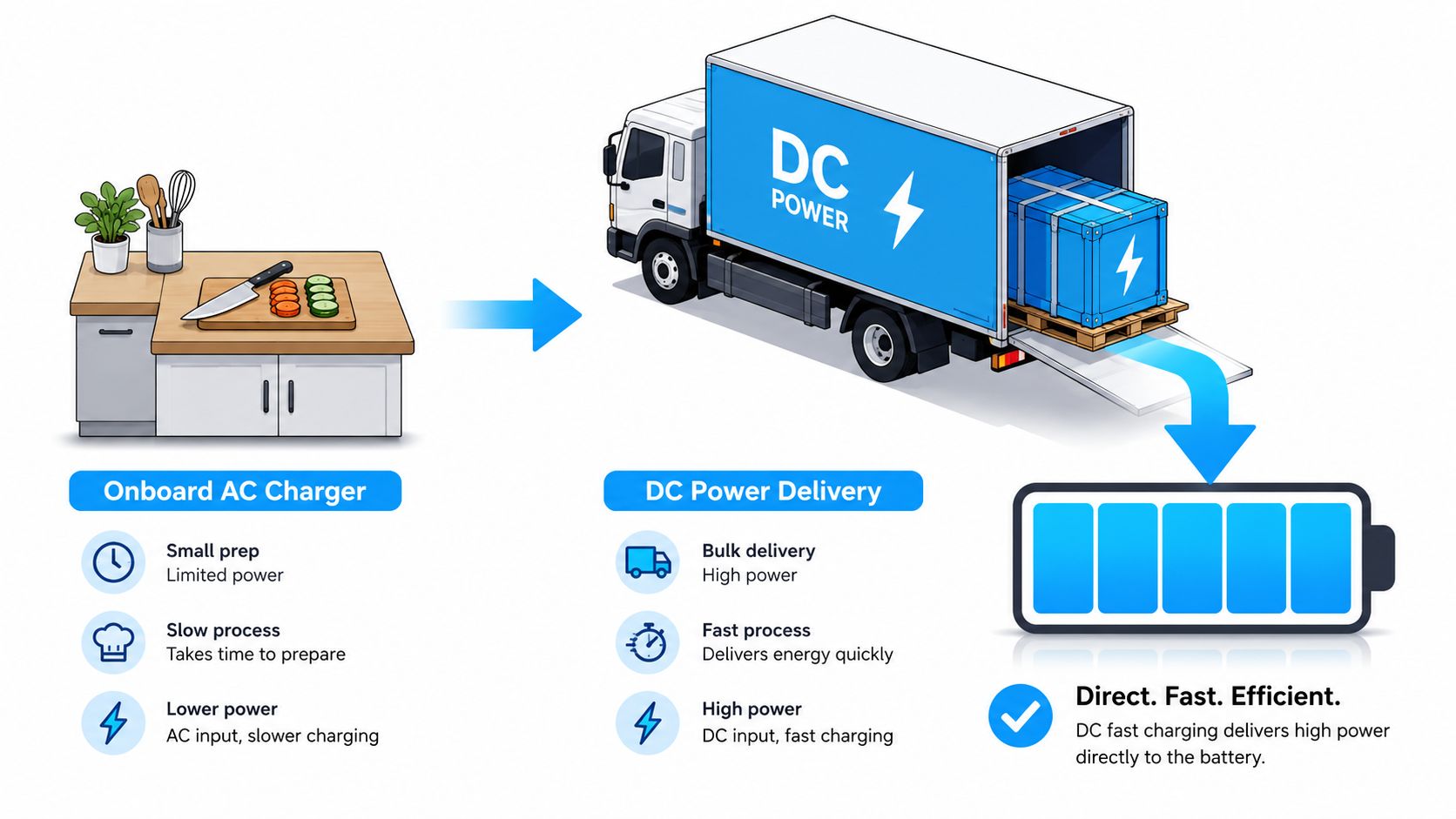
Think of charging as moving supplies into a kitchen. With AC charging, the grid delivers ingredients to a small prep station inside the car. That onboard AC charger has a defined capacity, so the vehicle must convert the electricity before the battery can use it.
A DC fast charger works more like a delivery truck arriving at the back door. The large station cabinet converts grid power outside the car and delivers the prepared DC supply through the charging cable. The battery receives energy without routing the full high-power conversion through the onboard AC charger.
Reading the power rating
Charging power is measured in kilowatts, or kW. Commercial DC systems commonly span roughly 50 kW to 350 kW, according to the U.S. Department of Transportation's EV charging basics. A 50 kW unit can be useful for older vehicles and shorter stops, while a 150 kW station can support much quicker charging for compatible cars. A 350 kW stall has a higher ceiling, but it won't force every vehicle to charge at 350 kW.
The vehicle sets the practical limit. If its battery and charging software accept less power, a more powerful station has unused capacity. Power can also be shared when multiple stalls draw from a common cabinet, so the station's advertised maximum isn't always the output available at that moment.
For a broader explanation of how AC, DC, and charging levels fit together, see this guide to EV charging levels.
Voltage makes the difference
Electrical power depends on voltage and current. Major DC deployments typically operate around 400 V to 1000 V, and that range helps explain why two vehicles with similar batteries can have different charging behavior. An 800 V architecture can reach a given power level with less current than a 400 V architecture.
Lower current can ease the demands placed on cables, connectors, busbars, and thermal-management systems. It doesn't guarantee that the car will always charge faster, because the battery cells, software, and station still impose limits. It does, however, give engineers more room to design a high-power charging system.
You can think of voltage as water pressure and current as the amount of water flowing. High power needs enough of both. The charger and car continuously negotiate a safe operating point rather than sending a fixed stream into the battery.
The Main Connector Standards Compared
The connector is the physical handshake between the station and the car. It carries power, but it also supports communication, so the vehicle can tell the charger what voltage and current it can safely accept.
CCS1 is widely associated with North America. It combines the familiar J1772-shaped AC portion with two larger DC pins below it. CCS2 serves a similar role in Europe, using the Type 2 AC interface with the additional DC contacts. The two systems aren't interchangeable because both use the CCS name, so the vehicle's market and port design matter.
CHAdeMO was an early high-power DC standard, particularly important for Japanese vehicles. Its early specification delivered up to 62.5 kW at 500 V and 125 A, enough to add about 120 km in 30 minutes under the conditions described in the ABB presentation on the technology's development. Later revisions reached 200 kW in 2017 and up to 400 kW in the second-generation specification. The ABB presentation on DC charging history documents that progression.
NACS, associated first with Tesla's North American charging hardware, uses a compact connector for both AC and DC charging. Its practical availability depends on the vehicle, model year, adapter approval, and network access. For the inlet comparison and live catalog port counts, see NACS vs CCS. A CCS-equipped vehicle may need a manufacturer-approved NACS adapter, while a Tesla vehicle may need an adapter for another network.
DC fast charging connector standards at a glance
| Standard | Max Power | Pack Voltage | Primary Region | Typical Vehicles |
|---|---|---|---|---|
| CCS1 | Vehicle and station dependent | Commonly within about 200 V to 1000 V DC | North America | Many non-Tesla North American EVs |
| CCS2 | Vehicle and station dependent | Commonly within about 200 V to 1000 V DC | Europe and other markets | Many European and international EVs |
| CHAdeMO | Up to 62.5 kW in the early specification, later revisions higher | Early specification used 500 V | Japan and selected legacy deployments | Earlier Nissan and Mitsubishi EVs |
| NACS | Vehicle and network dependent | Vehicle specific | North America | Tesla and newer compatible EVs |
The table needs one qualification: connector capability isn't the same as vehicle capability. The IEC 62196-3 discussion in the charging-system lecture material describes support up to 1500 V DC and 800 A for emerging megawatt-class use cases, but your car may accept far less. Always match the station plug to the port shown in the vehicle manual or charging app.
Why Charging Curves Beat Headline kW
A charger's maximum output is like the top speed printed on a car brochure. It tells you what the equipment may deliver under suitable conditions, not what you'll receive for the entire session.
A vehicle capable of using a 350 kW stall may reach a high rate only when the battery is at a favorable state of charge and temperature. The battery management system may then reduce power as the pack fills. That reduction is called tapering, and it's normal.
The shape of a session
A typical fast-charging curve has several phases:
- Initial ramp: The car begins conservatively while it checks temperature, voltage, and available station power.
- High-power region: The vehicle may approach its strongest rate once the pack reaches a suitable operating condition.
- Taper: As cell voltage rises and the battery fills, the system gradually reduces current.
- Slow finish: The final portion takes disproportionately longer because the car prioritizes cell protection over maximum speed.
The battery management system controls this process. Higher current creates more heat through internal resistance, and the vehicle must also manage the risk of unwanted lithium deposition when charging conditions are unsuitable. Cell voltage limits provide another reason to reduce current near the top of the pack.
Why the average matters
Suppose a vehicle reaches 150 kW for part of a session, then spends a long period below that level. Its session average could be much lower than the headline peak. The same vehicle may show different results on a cold morning, after a long climb, or when the battery arrives nearly full.
That's why a charging specification should include more than peak kW. Look for the vehicle's charging curve, usable battery capacity, thermal behavior, and time between meaningful state-of-charge points. The EV Stats charging research tools can help compare those practical charging characteristics, but the station display remains the final authority during a live session.
Stopping around 80% is often efficient for travel because the vehicle typically has more charging work to do as tapering becomes stronger. If you need the extra range, charging beyond that point can still make sense. The decision should reflect the next reliable station, road conditions, and how much energy your route requires, not a blanket promise that every car reaches a particular percentage at a particular speed.
Typical Session Times and Real Use Cases
The right charging session depends on why you stopped. A driver replacing energy during a short errand needs a different plan from someone crossing a country.
Daily top-up
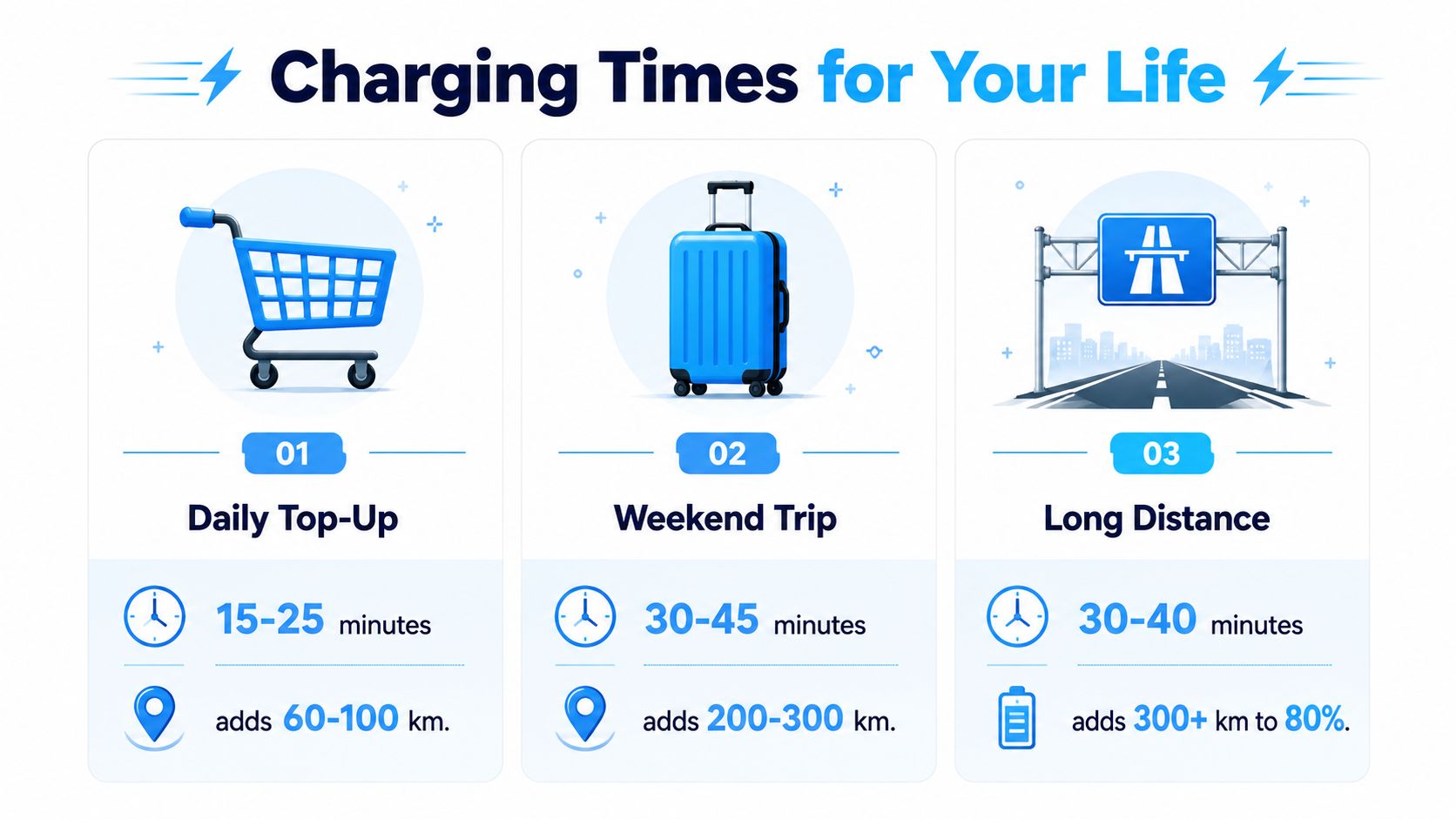
A 15 to 25 minute stop at a 150 kW stall may add 60 to 100 km of range for a compatible vehicle and favorable conditions. Those figures are the practical scenario specified for this use case, not a guarantee. Your car's efficiency, battery temperature, starting state of charge, and charging curve can all change the result.
For routine commuting, this is usually unnecessary if you can charge at home. DC fast charging becomes useful when you lack a dependable overnight outlet, return from an unexpected trip with a low battery, or need a quick energy boost before another appointment.
Weekend errands and travel
A 30 to 40 minute stop at a 50 kW to 150 kW station can fit naturally beside a meal or longer shopping visit. The slower 50 kW equipment may work well when the car will remain parked anyway, while a higher-power stall is more valuable when every minute matters.
You'll find a useful overview of vehicle compatibility and fast-charging capability in this guide to cars that support DC fast charging.
Road-trip planning
For a road-trip leg, the stated scenario is 18 to 25 minutes from 10% to 80% at a 250 kW to 350 kW station, followed by roughly 200 to 300 km of driving. Treat that as an illustrative target for a vehicle designed to use those rates, rather than a universal promise.
Arrival state of charge affects both speed and flexibility. Arriving very low may produce a slow initial ramp, while arriving too high leaves less room for the charger's strongest operating region. You also need a backup plan for occupied or unavailable stalls.
Road-trip habit: Choose the next stop based on the range you need, not on the station's largest number.
Public DC charging can carry higher usage costs than charging at home, and some networks apply idle fees after charging ends. Move the vehicle when the session is complete, especially at busy highway sites. For regular city driving, AC charging remains the calmer and usually more convenient choice.
Common Myths About Battery Wear
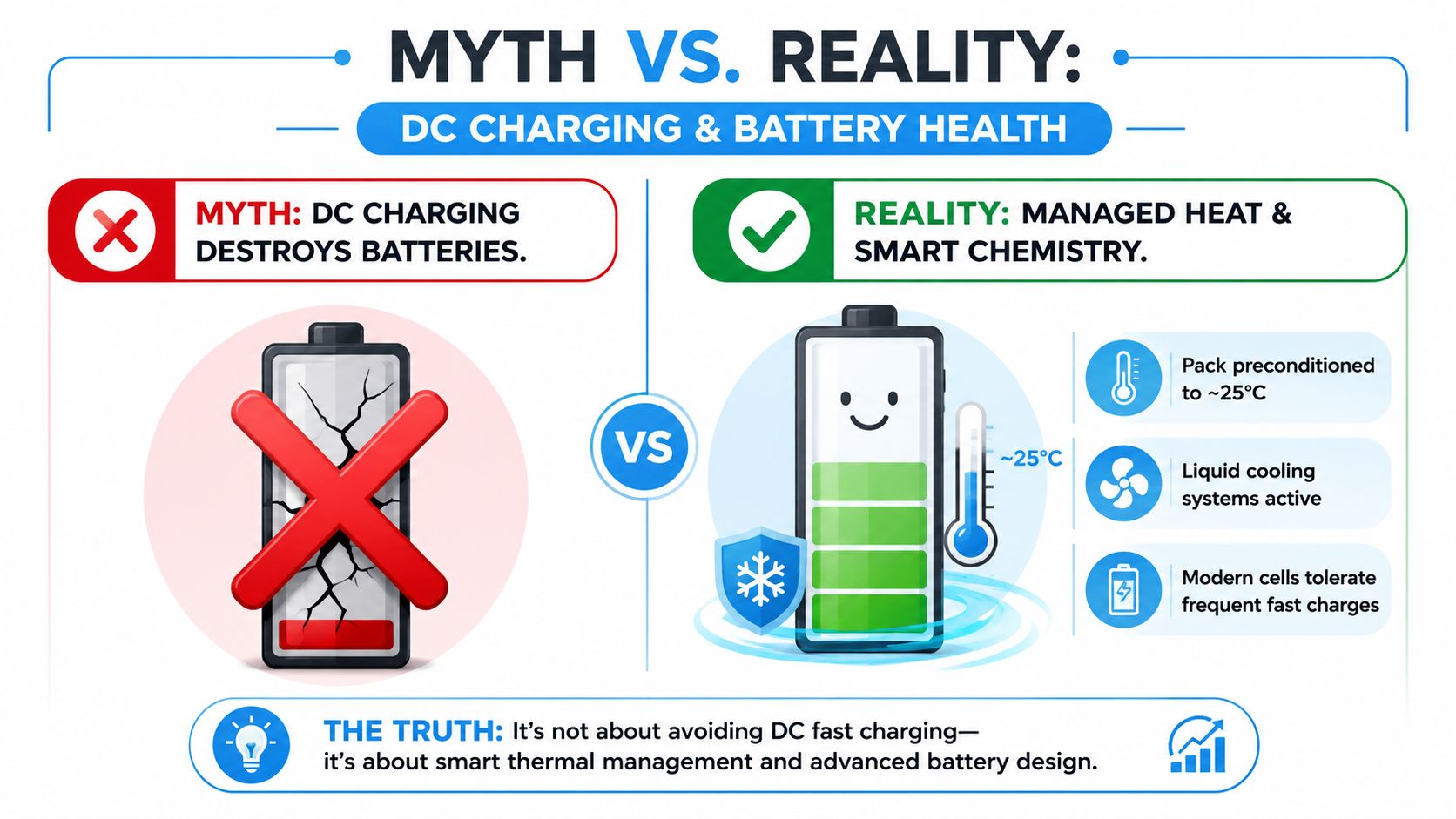
The statement that DC fast charging automatically destroys an EV battery is too simple to be useful. Fast charging does place greater thermal and electrical demands on the pack, but modern vehicles use sensors, cooling hardware, and software limits to keep the cells within their allowed operating window.
The car doesn't blindly accept every watt the station can offer. Its battery management system monitors cell voltage and temperature, communicates a request to the charger, and reduces power when conditions require it.
What actually raises concern
Battery aging depends on several interacting conditions. Repeated exposure to high state of charge, high temperature without effective cooling, and charging at very low temperatures can all create more challenging conditions than an occasional fast-charge stop.
Modern pack designs also differ from one another. Lithium iron phosphate, or LFP, and newer nickel-manganese-cobalt, or NMC, cells have different operating characteristics and charging recommendations. Your owner's manual should take priority over generic internet advice.
A vehicle may precondition its battery before a planned fast-charge stop. That means the thermal system brings the pack toward a suitable temperature before high-power charging begins. The exact target varies by vehicle, weather, and software, so don't treat a single temperature as universal.
Better habits for owners
- Use the charge window intelligently: For ordinary fast-charge stops, ending near the point where taper becomes pronounced can save time.
- Precondition before arrival: Use the vehicle's navigation system to route to the charger when the car supports automatic battery preparation.
- Respect the manual: Some models encourage different limits for different battery chemistries and use cases.
- Avoid extremes when possible: Don't make a very hot, very cold, nearly full, or depleted pack your normal charging pattern.
The useful question isn't whether DC charging is “bad.” Ask whether the vehicle's thermal system, software, and battery chemistry can manage the planned use. For more context on capacity loss and ownership habits, read this guide to EV battery degradation.
Putting It All Together at the Charging Bay
A successful charging stop rests on three checks: the connector must fit, the car must be able to use the station's power, and the planned session must match the trip. A 350 kW stall is irrelevant if the port is incompatible or the vehicle accepts a lower rate. A compatible 150 kW station may be the better choice if it's available, well placed, and sufficient for the next leg.
Four decisions before you plug in
First, verify the connector. Check whether your vehicle uses CCS1, CCS2, CHAdeMO, NACS, or an approved adapter. Don't rely on the station photograph alone. Confirm the exact plug and network access in the vehicle or network app.
Second, check live availability. A location map can show the site, but the network app may reveal whether stalls are occupied, offline, or sharing power. That information matters more than the maximum rating printed on the cabinet.
Third, choose a sensible target. For many road-trip stops, a middle-of-pack charging window such as 20% to 80% can balance useful range and tapering. The right target depends on the next charger, weather, speed, elevation, and your vehicle's actual consumption.
Finally, prepare the battery. If your EV supports preconditioning, set the fast charger as the destination in the in-car navigation system. The car can then manage the pack temperature before arrival instead of beginning the process only after you connect.
The three-question checklist
Before leaving the stall, ask:
- Does this connector work with my car?
- What charging rate can my vehicle realistically sustain?
- How much energy do I need for the next leg?
Daily commuting rarely requires DC fast charging. Long-distance driving is where pack voltage, thermal control, connector standards, and charging curves become valuable together. Higher-voltage architectures can support powerful sessions with lower current, while newer network features such as plug-and-charge can reduce friction when the vehicle and station support the same protocol. Bidirectional charging may also expand what compatible vehicles can do, although availability depends on the model and equipment.
Use the three questions on your next stop, then compare vehicles by real charging behavior rather than peak kW alone. EV Stats brings manufacturer specifications, independent test context, charging comparisons, rankings, and a charging simulator together, so visit EV Stats to evaluate models and plan charging around the trips you make.