

Yes — for most weekday routes. On 11 September 2026 the evstats.org catalog has 1,386 available electric cars. 1,069 of them (77%) list 300 km WLTP or more. Median catalog use on 1,366 rows with an efficiency figure is 18.0 kWh/100 km. Overnight charging and a winter buffer decide the commute more than headline kilometres.
Daily driving rewards a different hierarchy. Efficiency, predictable winter range, convenient home charging, and practical fast-charging performance shape the ownership experience more than acceleration figures or maximum range alone. A commuter EV should use little energy in mixed traffic, preserve enough reserve in cold weather, and recover useful range without turning an unexpected detour into a long interruption.
The comparison below illustrates why. Motor1's 2024 testing found the Tesla Model 3 was the most efficient vehicle in its field at 15.1 kWh/100 km, followed by the Hyundai Ioniq 6 at 15.5 kWh/100 km and the BMW i5 at 16.6 kWh/100 km. That difference matters every time you recharge after a workday, especially when most of your driving happens in urban traffic. (Edmunds' comparison of EPA figures and real-world consumption)
Are electric cars good for commuting?
The office run is not a range problem for most of this file. On 11 September 2026, 1,069 of 1,386 available evstats.org rows (77%) list 300 km WLTP or more. 1,204 (87%) list 250 km or more. Rechecked a second way: the mean catalog consumption on the 1,366 rows that carry an efficiency figure is 18.7 kWh/100 km; the median is 18.0. Both come from Wh/km in the same catalog, divided by ten. This is not a sales-weighted market average.
Hatchbacks sit at a median 15.9 kWh/100 km (n=182). SUVs sit at 18.4 (n=679). For the same weekday kilometres, the taller body asks for more electricity every worknight. Pack size in this file is one field, not a usable/gross pair. Range is WLTP, not a stored real-world kilometre.
The commuting pick is the compact row that uses the least catalog energy and still covers the longest regular day plus a winter cut. Among sedans, hatchbacks, and wagons that started in 2022 or later and list at least 300 km WLTP (n=359 rows, 324 unique titles), the lowest consumption after dropping Lightyear 0 — a €297,500 solar sedan, not a commuting product — is 12.5 kWh/100 km.
| Model | kWh/100 km | WLTP km | Pack kWh | Peak DC kW | Catalog € |
|---|---|---|---|---|---|
| Mercedes-Benz CLA 350 4MATIC | 12.5 | 575 | 85 | 353 | 60,285 |
| Tesla Model 3 Long Range RWD (Highland) | 12.5 | 550 | 75 | 250 | 44,990 |
| Tesla Model 3 RWD (Highland, CATL) | 13.2 | 420 | 57 | 170 | 40,970 |
| Volkswagen ID.7 Pro (MY24-25) | 14.0 | 475 | 77 | 190 | 53,995 |
| Hyundai IONIQ 6 Long Range 2WD | 14.3 | 495 | 74 | 233 | 54,000 |
Those figures are catalog labels. The Motor1 2024 road test of a Model 3 at 15.1 kWh/100 km, cited later on this page, is a different measurement. Use the table to shortlist, then confirm on the commute. Open the rows in the EV catalog or the comparison tool. Five-year cost is the TCO calculator.
Table of Contents
- Are electric cars good for commuting?
- Why Most EV Buyers Optimize for the Wrong Metrics
- The Metrics That Matter for Daily Commuting
- Comparing Top Commuter EVs by Real-World Performance
- Matching EV Specs to Your Specific Commute Profile
- Total Cost of Ownership for Commuter EVs
- Situational Recommendations for Different Commuter Types
- Next Steps for Validating Your EV Shortlist
Why Most EV Buyers Optimize for the Wrong Metrics
A commuter can make a poor EV choice for logical reasons. Advertised range is easy to compare, so the model at the top of the chart can appear to offer the greatest freedom. Acceleration, cabin technology, and battery size are also visible in a specification sheet, while efficiency often receives less attention.
The ownership trade-off emerges during ordinary driving. Congestion, heating or air conditioning, and home charging determine the energy used across a routine week. A large battery can provide reassurance, but it does not reduce the electricity required for each trip. A less efficient EV may cover the commute comfortably while consuming more energy that must later be replaced.
The useful question isn't “How far can it go?” It's “How efficiently does it cover the distance I drive most often?”
Headline range hides the daily trade-off
Peak range matters for frequent long-distance travel, especially where charging is limited. A predictable commute usually uses only part of that capacity. An EV that consumes less energy per kilometre can preserve a larger practical reserve from the same stored energy and require less electricity after each workday.
Stop-start traffic makes the distinction more relevant. Regenerative braking recovers some energy during deceleration, yet the vehicle still carries its mass through acceleration, hills, and climate-control use. Lower consumption reduces the energy burden of the entire routine, rather than merely improving the number printed beside a range estimate.
A long-range model may also use a larger battery and heavier equipment. That design can suit drivers who regularly travel beyond their normal route, but commuters should assess whether they are paying for capacity their schedule rarely uses.
Charging convenience shapes satisfaction
Home charging changes the practical rhythm of ownership. If the car can be connected where it is parked, the driver can begin the next day with a predictable state of charge instead of adding a charging stop to a crowded schedule. Public charging still matters for apartment residents and longer journeys, yet it should be evaluated separately from the everyday cost and convenience of home electricity.
Fast charging deserves the same context. A commuter who seldom drives on highways may gain more from low energy consumption than from a high peak charging rate. A driver who regularly adds highway distance needs a vehicle that can recover useful range quickly, because charging time becomes part of the trip's real cost.
The right comparison therefore starts with the commute's repeated conditions, not the most impressive figure in a brochure. Range remains relevant, but efficiency, winter reserve, and charging access determine how consistently the vehicle fits daily use.
The Metrics That Matter for Daily Commuting
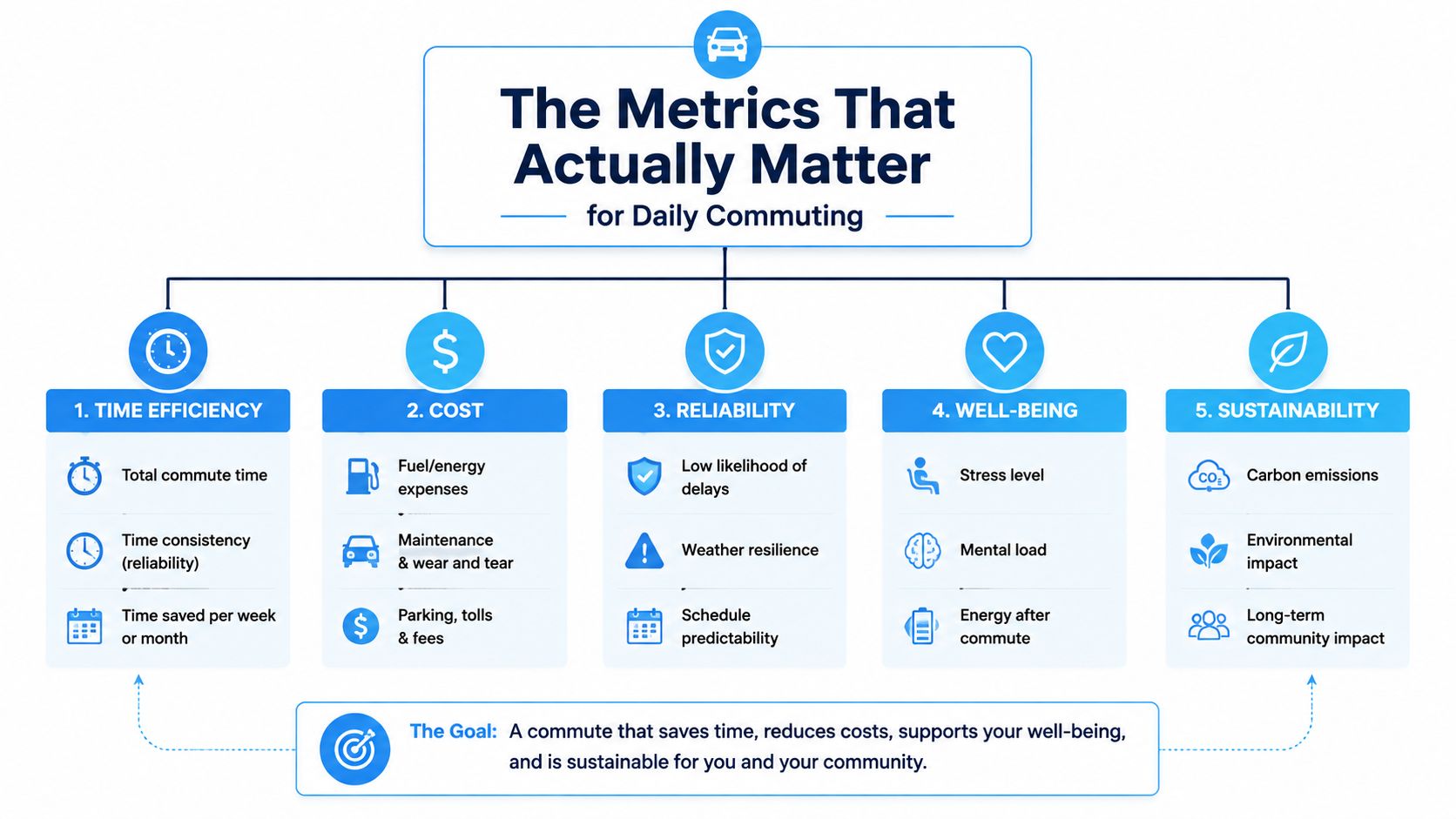
A commuter evaluation should begin with electricity use under repeated stop-start conditions, then account for the factors that can disrupt a routine. The most useful measures are real-world efficiency, charging speed, cold-weather planning, home-charging compatibility, and usable daily range. Headline range and acceleration matter less if the vehicle is expensive to recharge or leaves too little winter reserve.
Efficiency comes before battery size
Efficiency is usually expressed in kWh/100 km. A lower figure means the vehicle uses less electricity over the same distance. The Motor1 real-world comparison cited by this analysis of electric-car efficiency measured the Tesla Model 3 at 15.1 kWh/100 km, the Hyundai Ioniq 6 at 15.5 kWh/100 km, and the BMW i5 at 16.6 kWh/100 km. For a repeated commute, those measurements are more informative than battery capacity alone.
Home-charging costs follow the electricity required to replace energy used, not the battery's maximum size. If two vehicles cover the same route and one consumes more energy, that vehicle requires more electricity each day. The difference becomes more meaningful as commuting frequency rises, especially when the car is charged at home rather than at a public station.
Lower consumption also preserves flexibility. The same battery can cover more routine driving, leaving more reserve when congestion, cold weather, or a detour extends the trip.
Charging speed matters when the commute expands
Fast charging becomes more relevant when a commuter lacks home charging or regularly travels beyond the normal route. ADAC's winter highway simulation recorded 186.1 miles of range in 20 minutes for the Audi A6 Avant E-Tron Performance, compared with 120.6 miles for the Tesla Model Y AWD and 126.2 miles for the Volkswagen ID.7 Tourer Pro. (The EV Pulse guide to real-world range, efficiency, and charging)
These results describe recovery speed under a specific test, not a universal ranking for daily use. They show why charging architecture matters when a driver needs a rapid top-up. Strong charging performance can reduce the time cost of a detour, work trip, or weekend journey, while high efficiency reduces how often that top-up is needed.
Winter planning requires a buffer
Cold weather narrows the margin between arriving comfortably and stopping to charge. Independent winter guidance recommends that daily commuters in 10–32°F conditions plan on roughly a 25–30% arrival buffer, while winter tests have recorded about 34% range loss in the coldest conditions. Best-in-class vehicles can still retain 88% of warm-weather range at 32°F. (The U.S. Department of Energy's winter EV guidance)
Advertised range is therefore a weak standalone buying criterion. Estimate the round trip, apply the coldest conditions in the regular driving schedule, and set a reserve that fits the available charging access. The better commuter EV may combine winter efficiency with reliable charging recovery, rather than posting the highest laboratory range.
Comparing Top Commuter EVs by Real-World Performance
Real-world commuter performance separates into two useful measures: energy consumed during routine driving and range recovered during a charging stop. In the cited efficiency comparison, the Tesla Model 3 used the least energy, followed closely by the Hyundai Ioniq 6, while the BMW i5 consumed more. In the ADAC winter charging simulation, the Audi A6 Avant E-Tron Performance added more usable range during the test session than the Tesla Model Y AWD and Volkswagen ID.7 Tourer Pro.
These results answer different ownership questions. Efficiency affects the electricity required for each commute and the frequency of home charging. Charging speed matters when overnight charging is unavailable or a longer trip creates an unexpected need for energy. Neither measure alone identifies the best commuter EV.
| Model | Efficiency (kWh/100km) | Real-World Range | DC Fast Charge Speed | Winter Range Retention |
|---|---|---|---|---|
| Tesla Model 3 | 15.1 | Not provided in the cited data | Not provided in the cited data | Not provided for this model |
| Hyundai Ioniq 6 | 15.5 | Not provided in the cited data | Not provided in the cited data | Not provided for this model |
| BMW i5 | 16.6 | Not provided in the cited data | Not provided in the cited data | Not provided for this model |
| Audi A6 Avant E-Tron Performance | Not provided in the cited data | 186.1 miles added in 20 minutes in ADAC winter simulation | 186.1 miles added in 20 minutes in ADAC winter simulation | Not provided for this model |
| Tesla Model Y AWD | Not provided in the cited data | 120.6 miles added in 20 minutes in ADAC winter simulation | 120.6 miles added in 20 minutes in ADAC winter simulation | Not provided for this model |
| Volkswagen ID.7 Tourer Pro | Not provided in the cited data | 126.2 miles added in 20 minutes in ADAC winter simulation | 126.2 miles added in 20 minutes in ADAC winter simulation | Not provided for this model |
The efficiency leaders suit energy-conscious commuters
The Model 3 and Ioniq 6 are the strongest choices for reducing electricity use in daily driving, based on the cited test. Their close results make efficiency an important filter rather than a complete buying decision. Seating comfort, cargo requirements, home-charging access, and expected winter conditions can change which vehicle works better for a particular household.
The BMW i5's higher measured consumption represents a practical trade-off. Its size, equipment, or driving character may justify the added energy demand for some buyers. The ownership model should account for that demand because a less efficient car requires more electricity for the same commuting distance.
The charging leaders suit irregular schedules
The Audi's winter simulation result has the greatest relevance for drivers whose routine cannot depend entirely on overnight charging. It demonstrates how charging architecture can reduce downtime when a vehicle needs a substantial highway top-up. The test added 186.1 miles in 20 minutes for the Audi A6 Avant E-Tron Performance, compared with 120.6 miles for the Tesla Model Y AWD and 126.2 miles for the Volkswagen ID.7 Tourer Pro. (ADAC winter charging and highway simulation details)
The Model Y AWD and ID.7 Tourer Pro still recovered substantial range in that simulation, although both trailed the Audi. Their practical value depends on route charging availability, tolerance for charging stops, and how often longer journeys occur. A fast-charging advantage has real value only when the driver regularly uses it. For a commuter who charges at home every night, lower consumption may reduce both charging frequency and home electricity costs more consistently than occasional peak charging performance.
Matching EV Specs to Your Specific Commute Profile
The right EV depends on the routine it must handle. Record the normal round trip, the longest recurring day, overnight parking location, and coldest conditions on that route. Then separate required capability from preferred equipment.
Start with the distance pattern
Short urban commutes usually reward efficiency and charging convenience. Dense traffic can make low energy consumption more valuable than headline range. A compact model that fits the parking space and charges reliably at home may suit the routine better than a larger vehicle purchased mainly for occasional travel.
Medium suburban routes require a closer look at winter range and road mix. Highway sections increase energy use, while cold weather reduces the available margin. Compare measured consumption with charging access, rather than treating one advertised range figure as a complete answer.
How much range a motorway commute needs, with a table of round trips against WLTP range for summer and winter, is in EV highway commuting.
Long highway commutes give charging speed greater weight. In the cited simulation, the Audi A6 Avant E-Tron Performance added 186.1 miles in 20 minutes, compared with 120.6 miles for the Tesla Model Y AWD and 126.2 miles for the Volkswagen ID.7 Tourer Pro. (ADAC winter charging and highway simulation details)
Treat climate as a specification
Cold-climate buyers should calculate a conservative arrival reserve. The Department of Energy advises commuters driving in 10–32°F conditions to plan roughly a 25–30% buffer, and its winter guidance describes testing in which some EVs lost about 34% of range in the coldest conditions. (DOE winterizing guidance)
The practical requirement is enough usable range for the routine after applying a realistic weather allowance. A vehicle that retains more of its warm-weather capability can reduce pressure to buy a larger, heavier battery.
Match charging hardware to parking
A dependable overnight outlet may make basic charging sufficient for a modest commute. Longer distances, late arrivals, or a shared household circuit can justify a dedicated higher-power installation. Home charging also lets the driver recover energy predictably, which may matter more than maximum DC charging speed on a stable weekday route.
Ask these questions before choosing a model:
- Where does the car sleep? A garage or driveway with an accessible outlet creates a different ownership pattern from street parking.
- How often is the routine interrupted? Occasional long trips support stronger DC charging, while a stable local route places more weight on efficiency.
- What does winter do to the route? Apply the cold-weather buffer before comparing battery sizes.
- What do you carry? Cargo, passengers, and body style can matter more than acceleration.
- Which features reduce fatigue? Seat comfort, quietness, visibility, and predictable driver assistance influence satisfaction every workday.
Total Cost of Ownership for Commuter EVs
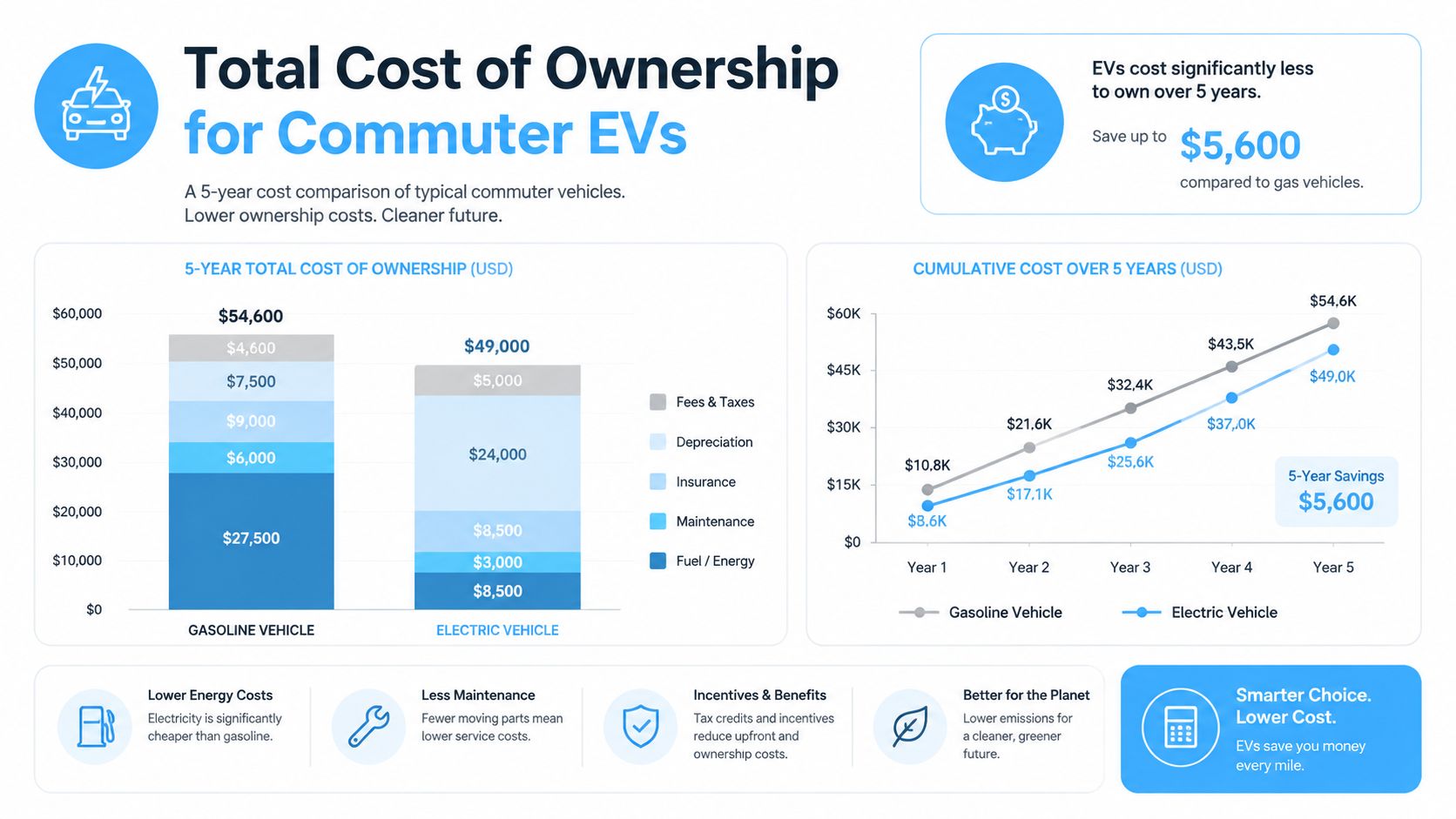
A commuter's ownership bill depends less on headline range than on how the car is charged, driven, and retained. Build the estimate around annual distance, the household electricity rate, charging losses, public-session fees, purchase price, financing, insurance, maintenance, tires, repairs, depreciation, and battery coverage. The electric-car running costs guide provides a useful starting framework.
Model charging before comparing vehicles
Home charging makes the energy line easier to forecast because each commute is tied to a known household rate. Calculate the route's energy use, add charging losses, and multiply that result by the number of commuting days. The same vehicle can produce a very different annual bill when one driver charges mainly at home and another relies on public stations.
Public charging deserves its own line in the model. Include session fees, variable energy prices, and the possibility that a convenient station is occupied or unavailable. Apartment residents should confirm access, connector compatibility, and workplace alternatives before assuming that an EV's lower operating cost will appear in practice.
Separate operating costs from ownership costs
Energy efficiency reduces repeated spending, but it cannot automatically justify a higher purchase price. Compare the extra upfront cost with the expected electricity savings over the planned ownership period. A frequently driven commuter with dependable home charging has more opportunity to recover that premium than a low-mileage driver who charges publicly.
Depreciation often outweighs small differences in electricity use. Estimate resale value from the model's expected ownership period, then include financing and insurance rather than treating the purchase price as the full vehicle cost. A less efficient vehicle with lower depreciation may be cheaper overall than a more efficient model purchased at a substantial premium.
Maintenance should be forecast by scheduled service, tires, wear items, repairs, and warranty coverage. EVs may reduce some routine powertrain service, yet tire replacement, body repairs, insurance, and manufacturer-specific service requirements still affect the total. Battery coverage also matters because it changes the financial risk of keeping the vehicle longer.
Use a sensitivity check for electricity rates, annual mileage, public charging frequency, and resale value. If a shortlist changes whenever one assumption moves modestly, the result is not a firm winner. It is a decision that depends on the driver's charging setup and ownership horizon.
A credible commuter cost model combines energy, charging access, maintenance, depreciation, financing, insurance, and purchase price. Efficiency is one input, not the entire answer.
Situational Recommendations for Different Commuter Types
No vehicle leads every commute. The right choice depends on where energy is lost, how much winter reserve the route needs, and whether charging happens at home or in public.
Efficiency-first city driver
For dense urban commuting, begin with the Tesla Model 3 or Hyundai Ioniq 6. The cited real-world test measured them at 15.1 kWh/100 km and 15.5 kWh/100 km, respectively. That lower consumption matters in stop-start traffic, where predictable daily distances make energy use and home-charging cost more important than headline acceleration.
Confirm local pricing, available charging, rear-seat and cargo needs, and the electricity rate before choosing between them. Efficiency reduces energy demand, but it does not decide the ownership case by itself.
Best differentiator: Low measured energy consumption for routine driving.
Suburban driver with occasional detours
Suburban commuters need efficiency plus reserve. The Model 3 and Ioniq 6 remain strong candidates, while an EV with faster rapid charging may fit better when errands, school runs, or longer trips regularly extend the route.
Evaluate the longest normal day rather than the advertised maximum range. The vehicle should finish that trip with a usable cold-weather buffer and recover enough charge during an unexpected stop to keep schedule changes manageable.
Long-distance highway commuter
Charging performance deserves priority over acceleration. In the cited winter highway comparison, the Audi A6 Avant E-Tron Performance added 186.1 miles in 20 minutes, compared with 120.6 miles for the Tesla Model Y AWD and 126.2 miles for the Volkswagen ID.7 Tourer Pro. (The cited winter highway charging comparison)
Those figures matter when a commuter must recharge during a short break. The relevant measure is usable range recovered at the charger, not battery capacity alone.
Best differentiator: Range recovered during the charging stop, not the size of the battery label.
Cold-climate commuter
Apply the recommended 25–30% arrival buffer for 10–32°F conditions when planning winter routes, as outlined in the earlier cold-weather guidance. A model that retains more practical range in low temperatures can reduce charging stops, but the route calculation still needs to reflect traffic, heating demand, and available charging.
Apartment resident without home charging
For an apartment resident, access determines practicality before efficiency does. A highly efficient EV can become inconvenient if public stations are unreliable, occupied, or poorly located. A faster-charging model may reduce time spent at unavoidable sessions.
Check connector availability, station operating patterns, payment requirements, and backup locations. These details often separate a workable daily routine from an ownership plan that depends on perfect charger availability.
Next Steps for Validating Your EV Shortlist
Test the shortlist on the commute itself. Track efficiency in stop-start traffic, evaluate one-pedal control, check visibility and seat support, and confirm the charge-port location. A specification sheet cannot show whether the car remains comfortable after congestion, or whether its winter range buffer suits your route.
Then verify charging at home and work. Confirm connector compatibility, identify a backup station, and compare the vehicle's charging curve with occasional highway needs. Use the EV Stats charging simulator to model charging power, session duration, and trip top-ups before judging headline range.
Run an ownership quote covering insurance, financing, maintenance, tires, and available incentives. Include home electricity costs in the comparison. Choose the model that meets the cold-weather route and charging routine first, then use comfort, space, and performance to break ties.
EV Stats combines manufacturer specifications with independent test context, side-by-side comparisons, rankings, ownership-cost estimates, and charging simulations. Visit EV Stats to compare commuting metrics before buying.