


The popular answer to “which EV has the most cargo space?” is usually a single vehicle followed by a single impressive number. That answer is incomplete. Cargo figures can combine a frunk, rear storage, and folded-seat volume, while another ranking may measure only the usable area behind a particular row. The result is a market where the apparent winner can change when the measurement method changes.
The Volkswagen ID. Buzz remains the strongest headline answer in independent maximum-volume comparisons, but that doesn't automatically make it the best choice for airport luggage, family errands, or commercial equipment. A sedan, wagon, three-row SUV, and van solve different loading problems. The useful question isn't only how much space exists, but where that space is, how easily you can reach it, and whether your seats need to remain occupied.
The electric SUV with the largest cargo figure in the evstats.org catalog is the Lucid Gravity Grand Touring, at 1,433 litres. On 21 September 2026, 667 available SUVs list a cargo litre. The median is 519 L. 85 of those 667 (13%) list 600 L or more. That litre is one stored field. It is not a seats-folded maximum, and it does not include a frunk.
The same file puts the Volkswagen ID.7 Tourer Pro at 605 L, which matches the seats-upright boot Volkswagen publishes for that wagon. The ID. Buzz LWB row is 1,340 L. Third-party rankings later on this page cite 145.5 cubic feet for a Buzz with the seats folded, about 4,120 L. Those two Buzz numbers answer different questions. Do not add them.
| SUV | Body | Catalog cargo (L) |
|---|---|---|
| Lucid Gravity Grand Touring | SUV | 1,433 |
| Škoda Peaq 90x | SUV | 935 |
| Tesla Model Y Long Range AWD | SUV | 854 |
| KGM Torres EVX | SUV | 839 |
| Cadillac LYRIQ 600 E4 | SUV | 793 |
Rechecked by body on the same available rows. Wagon median cargo is 456 L (n=61). Hatchback median is 338 L (n=191). Van median is 839 L (n=138). This is not a sales-weighted market, and makers do not share one cargo test, so 1,433 L and 519 L can be counting different cavities. Open the electric SUV list, filter the catalog, or put two names in compare. The folded-volume table below is a different measurement.
Table of Contents
- Which electric SUV has the most cargo space?
- Why the Biggest Cargo Number Is Not Always the Best Answer
- Understanding EV Cargo Measurement Standards
- Top Electric Vehicles Ranked by Maximum Cargo Volume
- How Body Style and Seat Configuration Affect Real Loadability
- Matching EV Cargo Capacity to Your Specific Use Case
- Situational Recommendations for Different Buyer Profiles
- Common Mistakes to Avoid When Evaluating EV Cargo Claims
Why the Biggest Cargo Number Is Not Always the Best Answer
The label EV with most cargo space suggests a clear winner, but the result depends on what gets counted. A maximum figure with every seat folded measures a cargo-only configuration. It says little about luggage capacity when passengers occupy the rear seats, or whether the opening accepts the objects you carry most often.
Independent comparisons show how sharply rankings can shift. The Volkswagen ID. Buzz is listed at 145.5 cubic feet with all seats folded, while the Lucid Air reaches 64.8 cubic feet, a difference of 80.7 cubic feet in the same comparison (iSeeCars electric-car cargo rankings). Those figures describe different vehicle architectures, not interchangeable solutions. The ID. Buzz uses a tall, box-like van body. The Lucid Air is a low sedan shaped around aerodynamics and road manners, so its volume is harder to use for tall or bulky items.
Practical rule: Treat a maximum-volume figure as a ceiling, not as a promise about everyday usability.
Three different shopping questions
Airport luggage requires usable storage behind occupied seats. Family errands add different constraints: a low loading opening, a manageable lift-over height, and enough room behind the second row for a stroller and groceries. Bulky equipment shifts the priority toward floor length, a flat loading surface, and seats that fold without removal.
Those requirements can reverse the apparent ranking. A method that includes the frunk and all space behind the first row favors long, upright vehicles configured for maximum volume. A behind-the-second-row measure rewards vehicles that retain practical capacity while passengers remain seated. A sedan can rank poorly on maximum volume yet provide a convenient compartment for smaller commuter loads.
Ownership context belongs in the same comparison. Reviewing electric-car running costs alongside cargo measurements can expose trade-offs that a volume table misses. A vehicle may lead on paper but fit poorly in a garage, require awkward lifting, or leave too little usable space for the people who regularly ride in it.
Why body style matters so much
Cargo utility comes mainly from body structure, not the electric powertrain alone. A van combines a tall roof, upright rear doors, and a long load floor. A sedan separates the passenger cabin from a trunk, limiting the size and shape of objects that can pass through the opening even when its stated volume appears respectable.
The more defensible approach is use-case ranking. First decide whether the priority is maximum folded capacity, passenger-friendly storage behind an occupied row, or flexible room for unusual objects. Then compare vehicles using the measurement that matches that job. The winner changes with the loading scenario, and a headline number becomes useful only after that scenario is defined.
Understanding EV Cargo Measurement Standards
A cargo-volume leaderboard can change because one source counts the frunk and another does not. Seat position, folded-seat configuration, and the space measured behind each row also alter the result. Specification sheets often present these figures as if they were interchangeable, but they answer different loading questions.
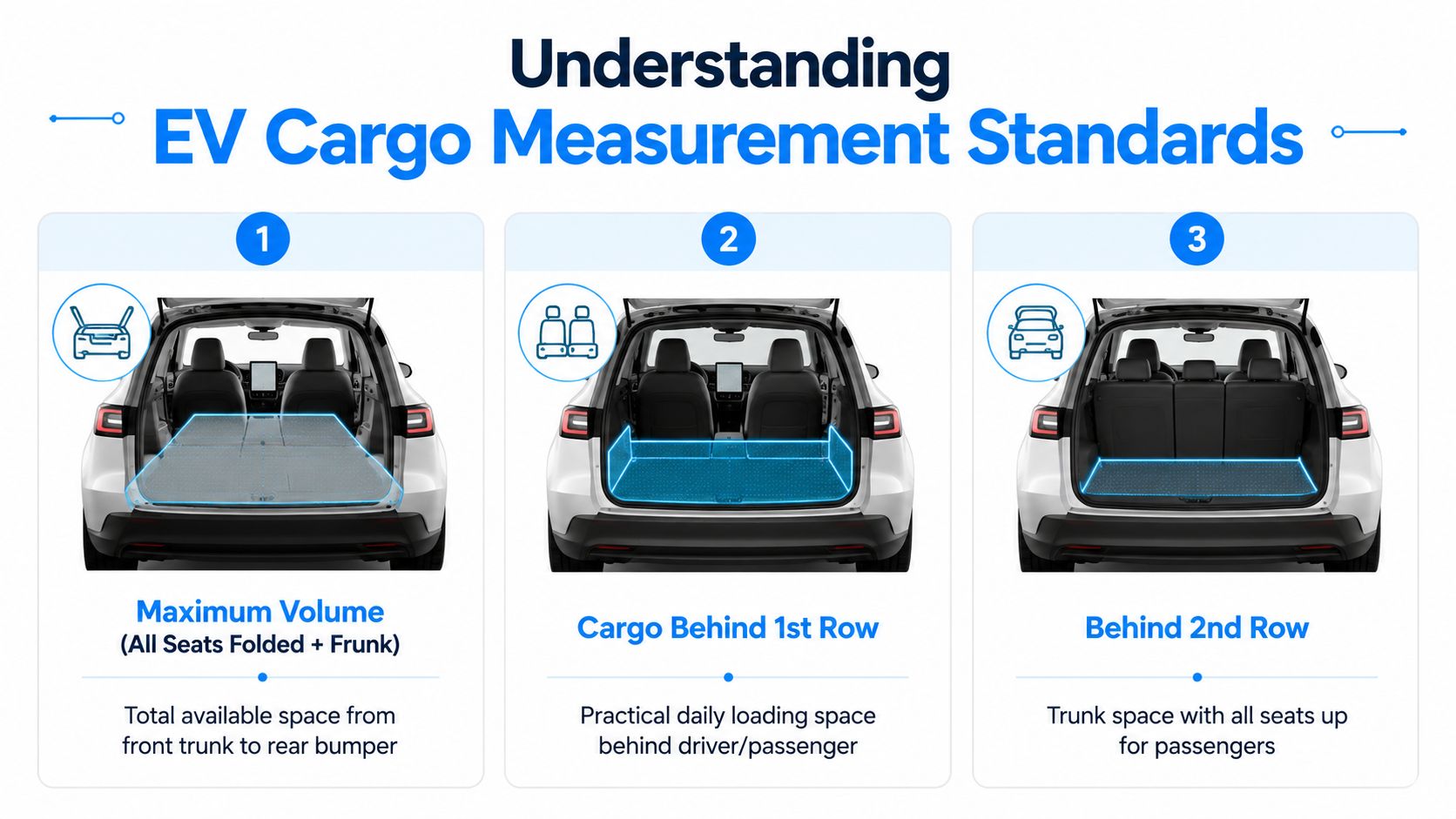
Maximum volume with seats folded
This figure creates the largest headline number. It usually measures the interior behind the first row with the rear seats folded, and some datasets include the frunk. The ID. Buzz's 145.5 cubic feet maximum figure uses that type of comparison.
It suits moving boxes, camping equipment, and large household items. It says little about a family trip in which rear passengers remain seated. A vehicle can therefore lead the maximum-volume ranking while offering less useful space for everyday passenger use.
Cargo behind the first row
This method measures the vehicle after the rear seating area has been converted into cargo space. It helps evaluate bulky loads, but it tends to reward interior length rather than passenger-friendly storage.
The result also depends on front-seat position and the treatment of folded seatbacks. Some measurements include space above or around those seatbacks, while others emphasize the floor area. Similar published totals can therefore conceal different floor shapes, hinges, wheel-well intrusions, or other obstructions.
Cargo behind the second row
For family travel, the behind-second-row figure usually has greater practical value. It describes the load area with passenger seats upright, although testing conventions vary. Some sources include a small underfloor compartment, and others exclude it.
A wagon may compare well because its roof extends farther rearward than a sedan's. A three-row SUV can post a large folded maximum yet leave limited room behind the third row when every seat is occupied. A van may retain a tall, accessible opening in its passenger configuration.
Before comparing two figures, write down three details: seats up or folded, frunk included or excluded, and the unit used.
Range comparisons require the same caution. An electric-car range comparison can vary with test conditions and definitions, just as cargo results vary with measurement boundaries. Confirm what the original figure includes before converting units, and do not treat a combined total as equivalent to rear-cargo space. Ranking EVs by the loading scenario, rather than by one maximum number, produces a more useful shortlist.
Top Electric Vehicles Ranked by Maximum Cargo Volume
The largest published cargo figure does not identify one universal winner. A van leads the maximum-volume comparison, large SUVs dominate their segment, and a wagon can be the better fit for long, low loads. The ranking changes with the loading scenario and with whether the measurement includes folded seats, frunks, or only the area behind an occupied row.
| Vehicle | Body Style | Max Cargo (cu ft) | Segment Rank |
|---|---|---|---|
| Volkswagen ID. Buzz | Electric van | 145.5 | Overall mainstream benchmark |
| Cadillac Escalade IQL | Large electric SUV | 125.2 | Large-SUV leader |
| Cadillac Escalade IQ | Large electric SUV | 119.1 | Large-SUV second |
| Lucid Gravity | Large electric SUV | 111.9 | Large-SUV third |
| Tesla Cybertruck | Electric pickup | 120.9 | Broader EV list entry |
| Rivian R1S | Three-row electric SUV | 105.1 | Broader EV list entry |
| Tesla Model X | Electric SUV | 91.5 | Broader EV list entry |
| GMC Hummer EV SUV | Large electric SUV | 81.8 | U.S. large-SUV comparison |
| Volkswagen ID.7 Tourer | Electric station wagon | 60.5 | Wagon benchmark |
Maximum-volume figures use the definitions reported by the linked rankings and are not perfectly interchangeable. Sources include iSeeCars electric cars, iSeeCars electric SUVs, and Car and Driver's electric SUV cargo comparison.
The van benchmark
The Volkswagen ID. Buzz reaches 145.5 cubic feet with all seats folded, making it the mainstream passenger-EV benchmark for maximum volume. The Lucid Air reaches 64.8 cubic feet, a difference of 80.7 cubic feet between the two entries in that comparison (iSeeCars electric-car cargo rankings).
That gap measures more than battery packaging. Upright sides, a tall cabin, and a broad rear opening let the ID. Buzz accept bulky objects that may not fit through a sedan or sharply sloped SUV opening. Its advantage is therefore dimensional, not merely numerical.
Large SUVs
The Cadillac Escalade IQL leads the electric-SUV group at 125.2 cubic feet, followed by the Cadillac Escalade IQ at 119.1 cubic feet and the Lucid Gravity at 111.9 cubic feet (iSeeCars electric SUV rankings). Their large bodies and long wheelbases produce van-like maximum capacity while retaining SUV seating and driving positions.
The Rivian R1S and Tesla Model X also rank prominently in broader EV comparisons, at 105.1 cubic feet and 91.5 cubic feet respectively (iSeeCars electric-car rankings). The GMC Hummer EV SUV reaches 81.8 cubic feet in a large-SUV comparison (Car and Driver electric SUV ranking). These figures are useful for maximum capacity, but they do not establish how much cargo remains with all passenger rows occupied.
The long-roof alternative
The Volkswagen ID.7 Tourer shows why wagons deserve a separate comparison. It offers 605 liters with the rear seats upright and 1,714 liters with them folded, equivalent to 21.3 cubic feet and 60.5 cubic feet (Volkswagen ID.7 Tourer coverage).
Its maximum is well below the ID. Buzz, yet its long roof, lower floor, and passenger-car stance may suit luggage and other elongated loads better. Maximum volume identifies the largest envelope. Usable capacity depends on the opening, floor shape, seat position, and the objects being carried.
How Body Style and Seat Configuration Affect Real Loadability
The headline cargo winner changes with the measurement method. Count every folded row and a large SUV may lead. Count only the space behind occupied seats, or include a usable frunk, and a van or wagon can become the better tool. Published volume describes a container, while real loads have fixed dimensions. A stroller has wheels and a handle, a suitcase has corners, and a bicycle needs both length and height.
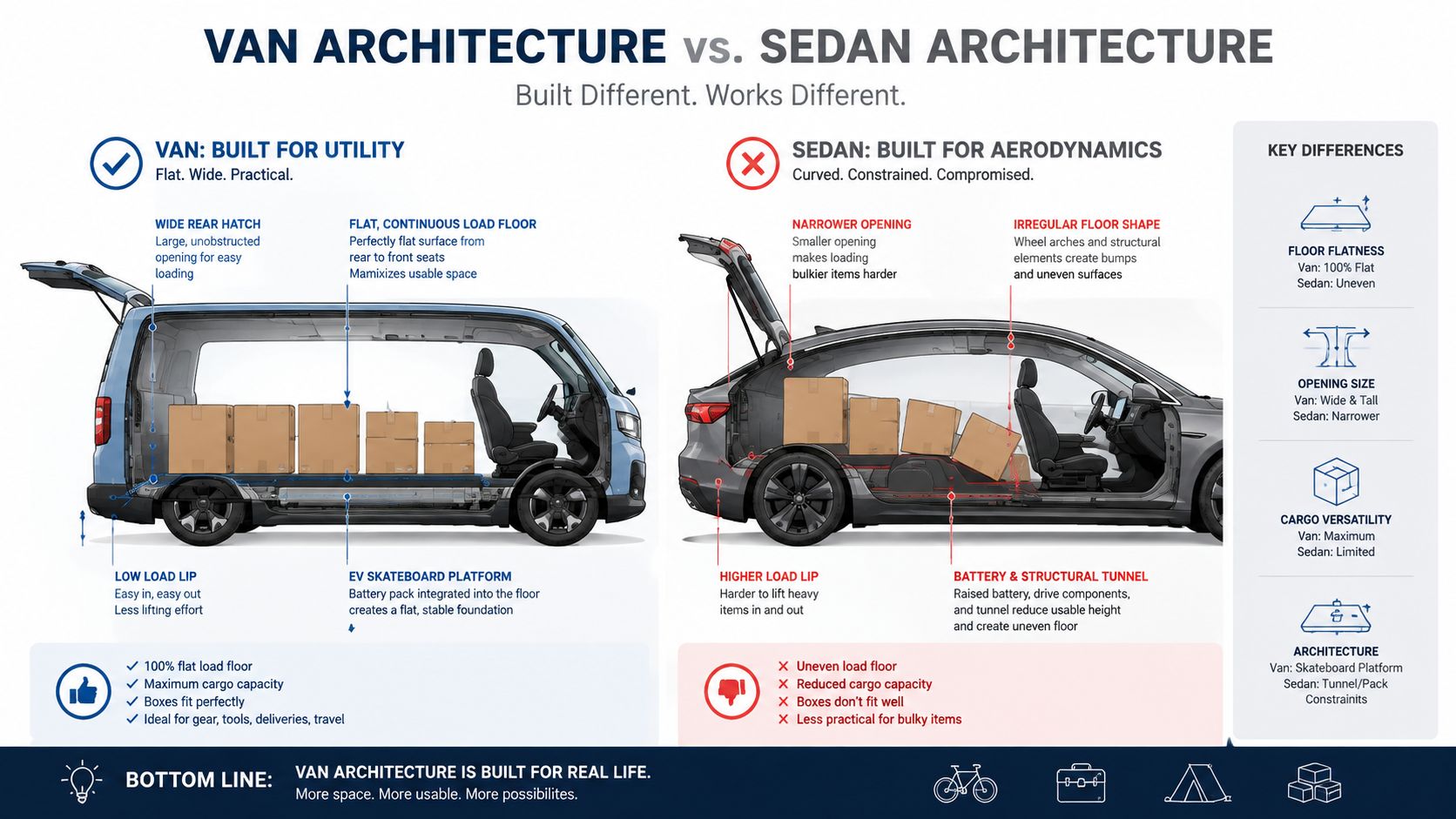
Why the box beats the wedge
A van's upright rear structure preserves height near the tailgate and maintains more consistent width through the load area. That layout suits tall boxes, stacked soft bags, and bulky equipment. An SUV can post a larger maximum figure, yet its sloping rear glass and roofline may reduce the usable space around the opening.
Wheelbase affects depth, but only where the floor remains available after folding the second or third row. Seat design matters just as much. A mechanism that folds flat in one movement can outperform a larger theoretical compartment that requires seat removal or leaves a steep step.
The practical ranking therefore depends on the object being loaded, not just the published maximum.
Passenger configuration changes the answer
Three-row vehicles create a clear trade-off. With every row occupied, the remaining rear compartment may be modest even when the fully folded figure looks impressive. Folding the third row restores luggage space, but removes the vehicle's full passenger capacity.
A two-row wagon presents a different compromise. The Volkswagen ID.7 Tourer has a defined rear load area with the rear seats upright, then gains substantially more room when those seats fold. Its long roof and low floor can suit luggage or elongated objects more effectively than a taller vehicle with a shorter, less accessible opening. The relevant comparison is therefore “behind the occupied row” versus “maximum with seats folded,” not one universal cargo number.
Frunks are useful, but not interchangeable
A frunk can isolate charging cables, tools, or compact bags from the main luggage area. It may also preserve rear-seat space. Its value remains limited by the opening, depth, and shape, so it cannot be treated as equivalent to rear cargo volume.
A contractor might place smaller equipment in the frunk while longer materials occupy the rear. A family might use it for items needed during charging stops. In both cases, access and object fit matter more than the existence of a second compartment.
A flat floor and a wide opening often beat a larger but irregular volume.
Suspension hardware can change loading height and floor behavior. Buyers comparing tall SUVs should check whether features such as rear air suspension alter access height between configurations, rather than assuming every version presents the same loading conditions.
Matching EV Cargo Capacity to Your Specific Use Case
Cargo selection should begin with the objects you carry, not the leaderboard. Measure the longest, tallest, and widest items that regularly travel in the vehicle. Then decide how many seats must remain usable. This approach exposes mismatches before a test drive, especially when a published maximum counts folded rows or a frunk that does not suit your equipment.
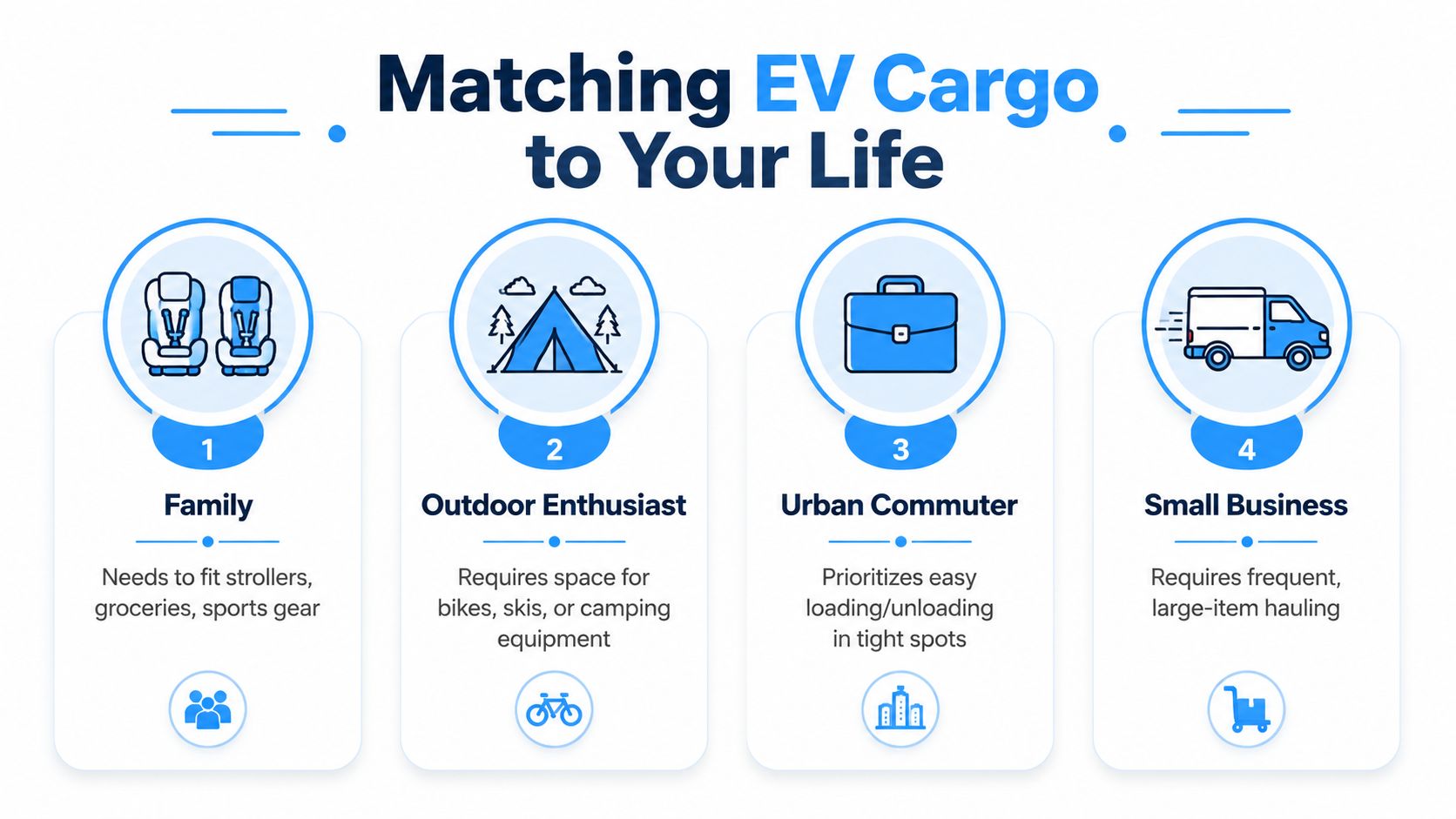
Family hauling
Families generally need usable storage with passengers aboard, rather than the largest possible cavity with every rear row folded. A wagon such as the Volkswagen ID.7 Tourer has 605 liters behind its upright rear seats, giving buyers a clear reference for routine family loading. A larger SUV or van may fit better when a third row, a tall stroller, or bulky sports equipment must travel frequently.
Test the stroller at the actual hatch opening. It should enter without removing the wheels, and grocery bags should stay isolated from the passenger area during braking. These checks reveal practical capacity more accurately than a maximum-volume figure.
Airport and travel luggage
Luggage favors width, floor depth, and a clean opening. The ID. Buzz suits travelers who carry many cases or irregular travel equipment, with a maximum folded volume of 145.5 cubic feet in independent comparisons (iSeeCars cargo ranking).
A three-row SUV remains sensible when passengers need all rows, but its maximum capacity does not describe that configuration. Load the actual suitcase set, including rigid cases and soft bags that may need stacking. Behind-row volume matters more than the headline total for a full passenger trip.
Commercial and fleet use
Fleet buyers should prioritize repeatable loading conditions. Check whether drivers can reach the floor without climbing inside, whether the tailgate clears the cargo, and whether the cabin provides secure tie-down points. A van-shaped EV often supports frequent large-item work better than a sedan because its rear opening and internal height reduce loading compromises.
The ID. Buzz establishes a useful maximum-capacity benchmark. Large Cadillac SUVs show that premium three-row designs can also provide substantial volume. The correct ranking changes with the job: equipment-only use favors access and floor usability, while mixed passenger duty makes behind-row capacity more important.
Outdoor recreation
Bikes, skis, camping cases, and wet equipment expose weaknesses that liters alone cannot show. Long items favor a long roof and floor, while upright gear benefits from a taller rear opening. The ID.7 Tourer reaches 1,714 liters with its rear seats folded, making it a credible gear-hauling option for buyers who prefer a wagon to a van.
An SUV may provide greater vertical clearance and a higher seating position, but measure the roof-rack height, hatch opening, and usable floor length together. A larger stated volume has limited value if the bike must be dismantled for every trip. Frunk space can hold smaller equipment, but its opening and shape determine whether that capacity is usable.
Situational Recommendations for Different Buyer Profiles
The family buyer
Family buyers should rank usable storage behind the occupied rear seats before maximum volume. The Volkswagen ID.7 Tourer keeps 605 liters available with the rear seats upright and expands to 1,714 liters when folded. That makes it a practical wagon for everyday passenger duty and longer trips, provided the family can work with a lower, less vertical load area.
The Volkswagen ID. Buzz fits families carrying tall strollers, bulky sports equipment, or several large travel cases. Its 145.5-cubic-foot maximum capacity is substantially higher than the sedan benchmark in the comparison (iSeeCars electric-car cargo rankings). The relevant advantage is its boxy cabin and tall opening, not the headline figure alone. Buyers should still check whether the third row is in use and whether the floor height suits heavy items.
The fleet or commercial buyer
Fleet purchasing should begin with repeatable loading conditions. Evaluate door access, lift-over height, floor protection, tie-down points, and service requirements alongside volume. A van-style EV can handle frequent bulky loads more effectively than a lower passenger car, even when a published comparison makes the numbers difficult to align.
For buyers who require an SUV body, the Cadillac Escalade IQL records 125.2 cubic feet, followed by the Escalade IQ at 119.1 cubic feet and Lucid Gravity at 111.9 cubic feet in the electric SUV ranking (iSeeCars electric SUV rankings). These vehicles suit passenger-plus-equipment work, executive transport, and buyers who reject a van layout. Their size increases the importance of loading reach, parking access, and the amount of storage available with all passenger rows occupied.
The enthusiast or lifestyle buyer
Enthusiasts often want long, flexible cargo space without adopting a van's driving position. The ID.7 Tourer is the strongest wagon-style compromise in the comparison, offering a long roof and a 60.5-cubic-foot maximum figure while retaining a passenger-car shape (Volkswagen ID.7 Tourer reference).
A Rivian R1S or Tesla Model X suits buyers who prioritize SUV clearance, seating flexibility, and a higher maximum ceiling. Their reported maximum volumes are 105.1 cubic feet and 91.5 cubic feet respectively (iSeeCars electric-car rankings). Those figures should not be ranked directly against the wagon figure without checking whether the measurements include folded seats, frunks, or different rows. For lifestyle use, opening shape and floor length often determine the winner.
Common Mistakes to Avoid When Evaluating EV Cargo Claims
A buyer sees 145.5 cubic feet, assumes the ID. Buzz will swallow every family load, and skips the test drive. Another sees a large SUV's maximum figure, then discovers that the third row leaves little room for luggage. Both decisions fail for the same reason: the headline number replaced the loading scenario.
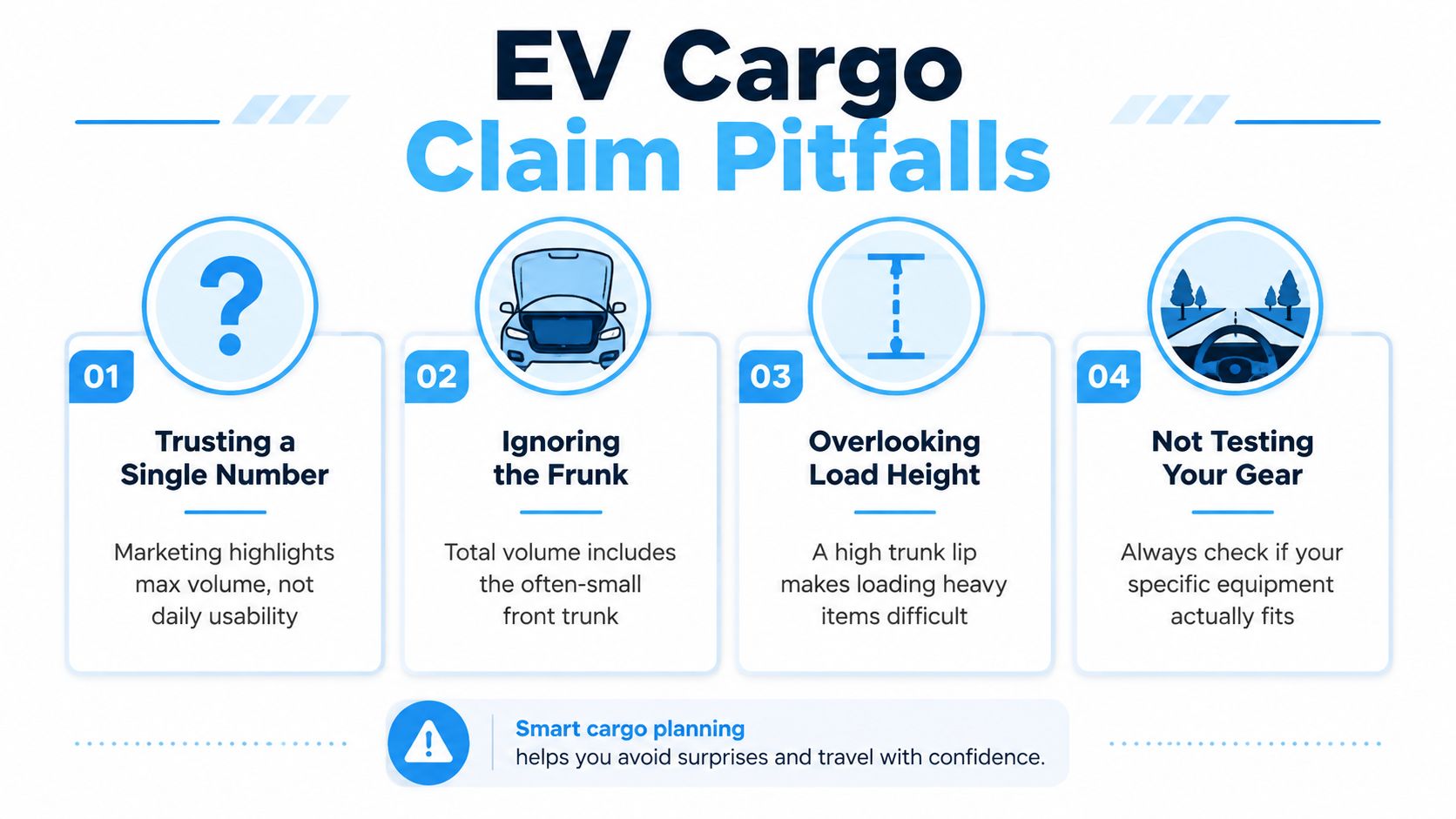
Use this checklist before signing anything:
- Verify the configuration: Confirm whether the number uses folded seats, upright seats, or a behind-the-first-row measurement.
- Separate the frunk: Ask whether front storage is included and whether it can hold the objects you carry.
- Measure access: Check hatch width, lift-over height, floor length, and roof clearance, not just total volume.
- Test your equipment: Bring a stroller, case, bike, or work item to the dealership and load it yourself.
- Inspect seat operation: Fold every relevant row and check whether the resulting floor is flat and easy to restore.
- Compare like with like: Don't rank a van's maximum internal volume against a sedan's rear-cargo figure as if they were identical tests.
The right purchase usually emerges after you record three measurements for your own routine: the cargo area with passengers seated, the maximum folded space, and the opening dimensions. That profile tells you more than a universal winner.
EV Stats brings manufacturer specifications and independent test data into a structured comparison platform, so you can evaluate cargo-related trade-offs alongside range, efficiency, charging, and ownership costs. Visit EV Stats to compare EVs side by side and build a shortlist based on the way you use your vehicle.