


The sticker price can mislead you. The International Energy Agency's analysis found that a medium-sized battery electric vehicle in Germany was 10–20% more expensive to buy in 2022, yet 10–20% cheaper in cumulative ownership cost after five years. That result changes the central question. Instead of asking only, “What does this EV cost today?”, buyers should ask, “What will this vehicle cost me to own, charge, insure, maintain, and sell?”
Table of Contents
- Introduction to EV Cost of Ownership
- Understanding Total Cost of Ownership
- Breaking Down Purchase Price and Incentives
- Calculating Energy and Charging Costs
- Accounting for Maintenance Depreciation and Insurance
- Real-World TCO Examples with Calculator Scenarios
- Summary and Next Steps
Introduction to EV Cost of Ownership
EV cost of ownership measures the financial impact of driving an electric vehicle over time, rather than comparing dealership prices alone. An EV may cost more initially, while lower energy and maintenance expenses gradually reduce the difference. The final result depends on the model, financing, insurance quote, resale value, driving habits, electricity rate, and access to affordable charging.
The IEA reports that electric cars often have a lower lifetime ownership cost than comparable internal-combustion vehicles because fuel and maintenance expenses are lower. Its analysis also shows why an upfront premium does not automatically create a higher lifetime bill. Read the report's assumptions before applying that conclusion to your own situation.
A useful review includes purchase price, incentives, financing, energy, charging equipment, maintenance, depreciation, insurance, taxes, and fees. Charging can shift the result substantially. Home charging usually follows your electricity rate, while public and fast charging may add session fees or higher per-kilowatt-hour costs. A calculator scenario using your home-versus-public charging mix can therefore reveal savings that a sticker-price comparison misses, or expose a depreciation risk that lower running costs cannot offset.
Understanding Total Cost of Ownership
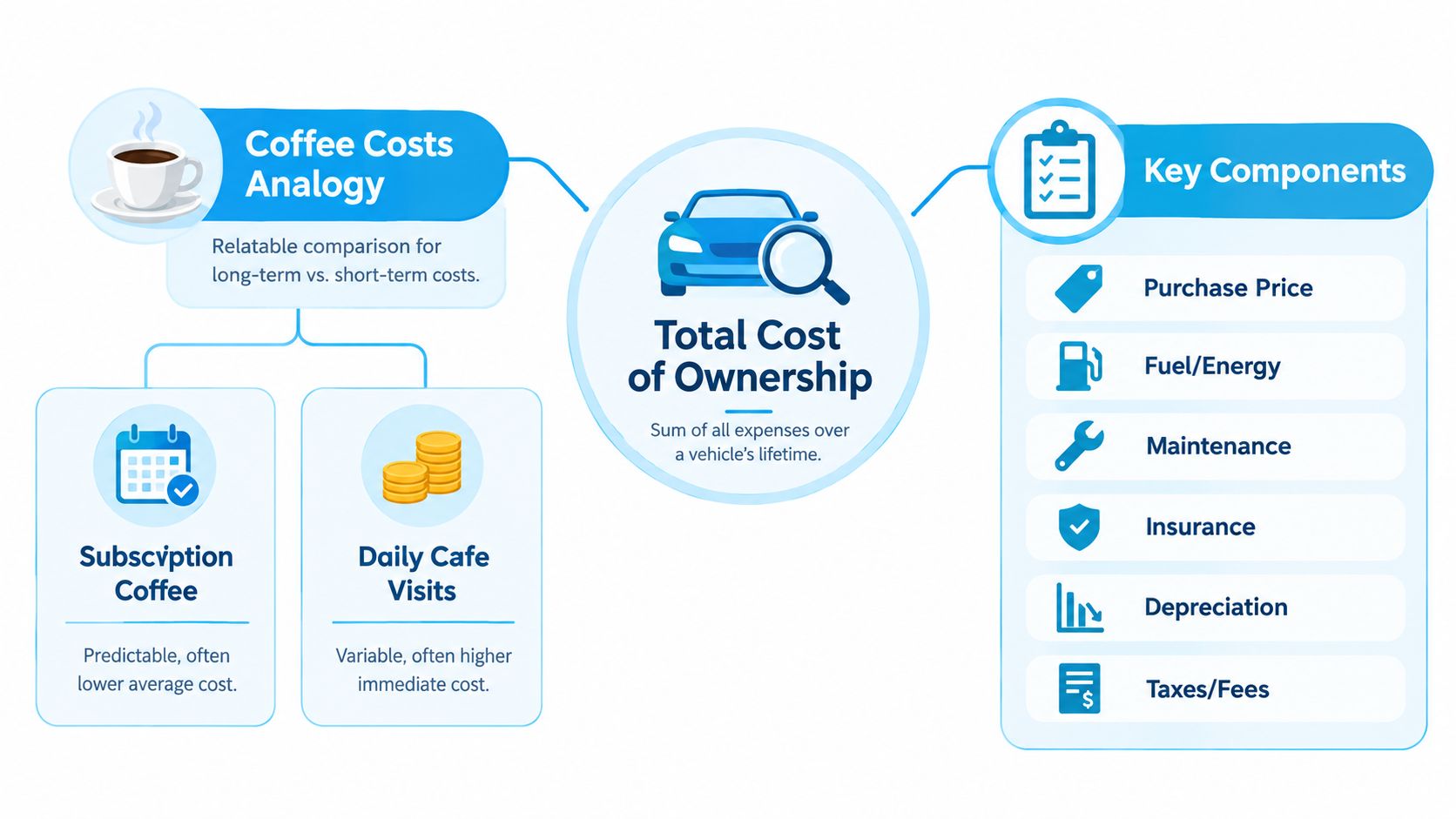
Total cost of ownership, or TCO, is the sum of every meaningful expense across the period you own a vehicle. It turns a one-time purchase into a complete financial picture. The method is similar to comparing a coffee subscription with buying a café drink every day. The subscription may look like another fixed bill, while individual purchases feel manageable, but the total depends on how often you consume coffee and what each option costs over time.
The same logic applies to an EV. A higher purchase price is only one line in the calculation. Lower energy or service costs may offset it, while depreciation, insurance, financing, or expensive public charging may erase those savings.
The main TCO inputs
Think of the calculation as a chain. Each link affects the next:
- Purchase price: The amount financed or paid at the start, including equipment and transaction costs.
- Incentives: Eligible rebates, tax credits, utility programs, or local support that reduce the effective acquisition cost.
- Energy: Electricity used for driving, calculated from your mileage, vehicle efficiency, and electricity rate.
- Charging: Home installation, workplace access, public-session fees, and the share of driving completed at each location.
- Maintenance: Scheduled service, tires, inspections, repairs, and consumables.
- Depreciation: The value the vehicle loses between purchase and sale or trade-in.
- Insurance and fees: Premiums, registration charges, taxes, financing costs, and other recurring obligations.
A simple formula is:
TCO = purchase and financing costs + energy and charging + maintenance and repairs + insurance and fees + depreciation, minus incentives and resale value adjustments.
This doesn't mean every buyer needs a complicated financial model. It means the model should reflect real behavior. If you can't install a home charger, don't use a home-charging assumption. If you drive modest distances, don't pay for a battery or trim level designed for long-distance travel unless that capability has real value to you.
Practical rule: Build the calculation around your routine first, then compare vehicles. A theoretically efficient EV may not be the economical choice if its charging setup doesn't fit your home or workplace.
Breaking Down Purchase Price and Incentives
The purchase price is the most visible part of EV ownership, but it isn't always the largest part of the final bill. Manufacturers price electric models according to battery size, equipment, production costs, market positioning, and competition. Two vehicles with similar range can have very different insurance, resale, charging, and financing profiles.
Incentives reduce the amount you need to fund, but eligibility can depend on the vehicle, buyer income, location, purchase type, and timing. Before treating an incentive as guaranteed, check the current rules with the relevant federal agency, state energy office, local authority, utility, or dealer. A rebate that arrives later also affects cash flow differently from a discount applied at purchase.
A practical way to evaluate the offer
Start with the effective acquisition cost, not the advertised MSRP:
- Record the negotiated vehicle price and mandatory fees.
- Subtract only incentives you've verified you qualify for.
- Add charger equipment and installation if you need them.
- Compare financing offers using total interest, not just the monthly payment.
- Save the assumptions so you can test the same structure against a gasoline vehicle.
A lower monthly payment can hide a longer loan or a larger final balance. Conversely, a manufacturer financing promotion may change the comparison even when two vehicles have similar prices. The goal isn't to find the lowest payment. It's to identify the lowest complete cost for the period you expect to keep the car.
The long-term case can be stronger than the purchase price suggests. Consumer Reports' EV ownership analysis found that nine popular EVs priced under $50,000 had lifetime ownership costs typically $6,000 to $10,000 lower than the best-selling and top-rated gasoline vehicles in their classes. That finding applies to the studied models, not every EV, so buyers should compare vehicle by vehicle.
Calculating Energy and Charging Costs
Charging cost begins with a simple equation:
Electricity cost = energy used in kilowatt-hours × electricity price per kilowatt-hour.
To make that useful, you need three personal inputs: how far you drive, how efficiently the vehicle uses energy, and where you charge. Your utility bill can provide the home rate. Workplace charging may be free or subsidized. Public fast charging can use a different pricing structure, including per-kilowatt-hour rates, session fees, time charges, or membership pricing.
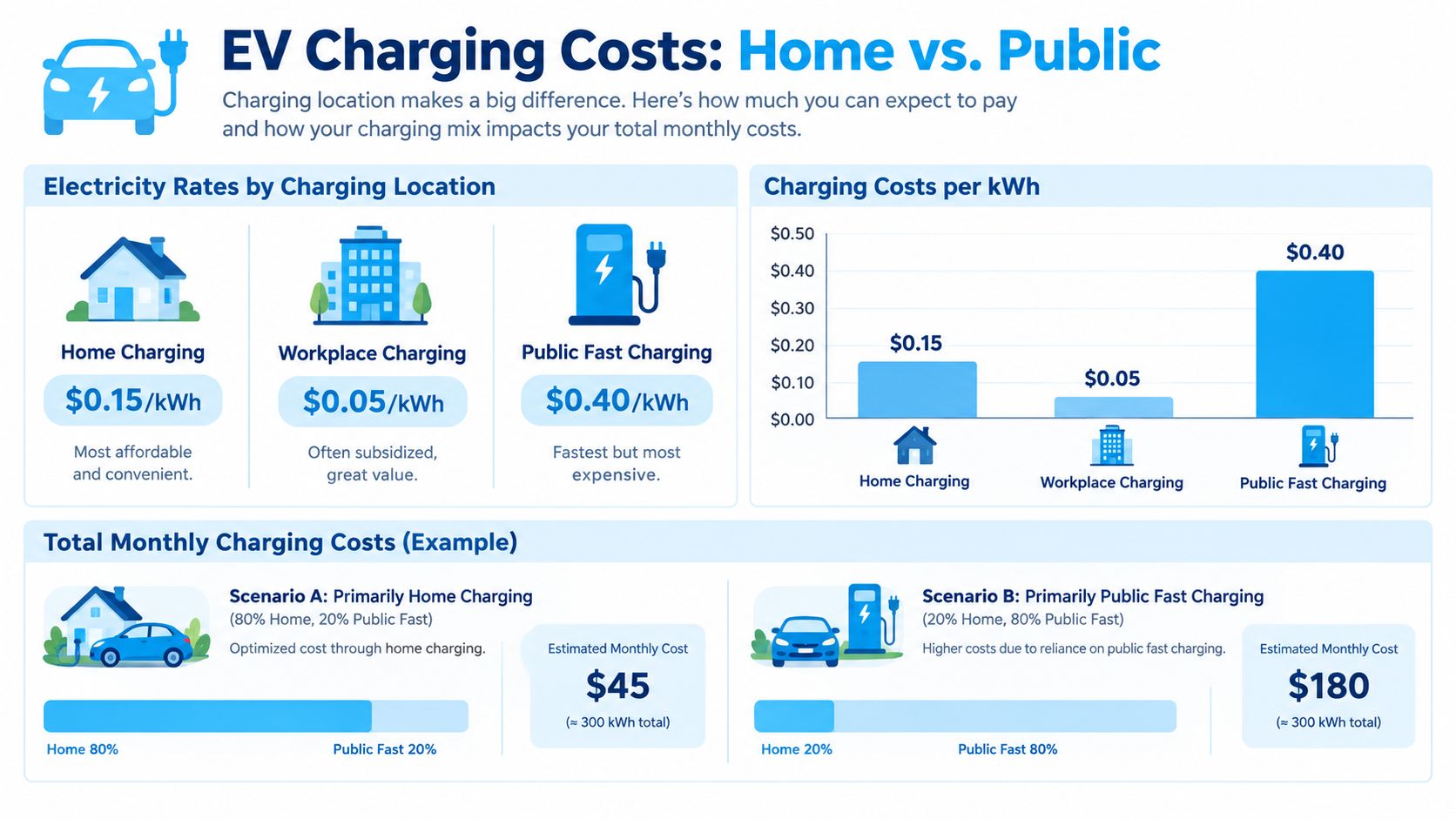
The supplied comparison visual uses illustrative rates of $0.15 per kWh at home, $0.05 per kWh at the workplace, and $0.40 per kWh for public fast charging. Those figures are scenario inputs, not universal rates. Enter your own local prices before making a purchase decision.
Build your personal charging mix
Track your driving for a representative period, then estimate the share of energy coming from each location.
| Charging source | What to record |
|---|---|
| Home | Utility rate, charging losses, installation cost, and time-of-use pricing |
| Workplace | Access rules, price, availability, and whether charging is reliable |
| Public fast charging | Per-session price, membership terms, idle fees, and frequency of use |
A driver with dependable home access can shift most routine charging to the lower-cost option and reserve fast charging for longer trips. Someone in an apartment without charging may need to use public infrastructure for ordinary commuting, which can materially change payback.
A peer-reviewed study found that lifetime TCO for a 300-mile-range midsize electric SUV varied by about $52,000, nearly 40%, across locations, while home-charging access reduced lifetime cost by roughly $10,000 on average and up to $26,000 in the analyzed scenarios. Review the location-based TCO study to understand why charging topology, electricity prices, and driving patterns matter so much.
For a practical explanation of the variables behind an EV charging bill, use this guide to how much EV charging costs. Then model separate cases, such as mostly home charging, mixed home and public charging, and public charging without home access.
Don't assume that the cheapest electricity rate is available whenever you need it. A workplace charger may be occupied, a public station may charge differently during a trip, and a home charger may require installation or electrical work. The right forecast uses the charging you can realistically complete, not the charging plan that looks best on paper.
Accounting for Maintenance Depreciation and Insurance
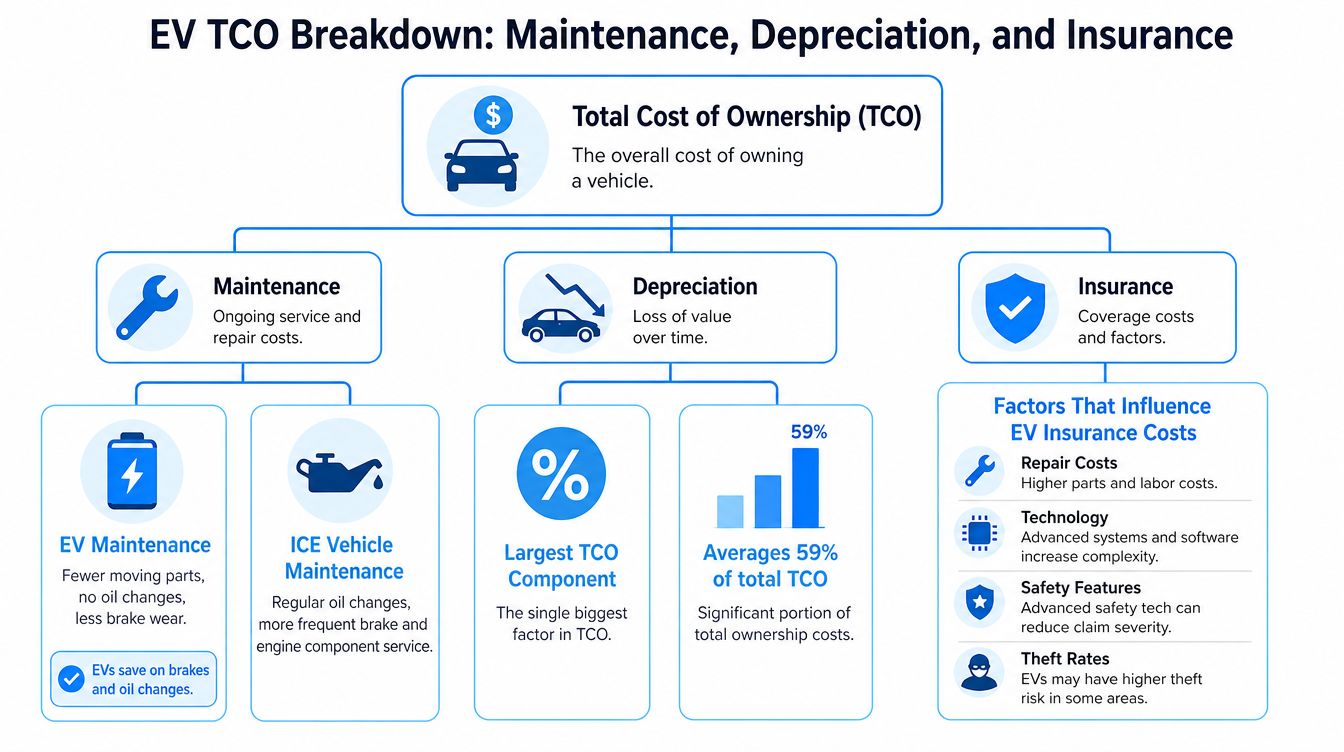
EVs generally have fewer powertrain components that require routine servicing than gasoline vehicles. They don't need engine oil changes, and regenerative braking can reduce reliance on friction brakes. That doesn't make maintenance free. Tires, suspension components, cabin filters, inspections, alignment, collision repairs, and battery or charging-system work can still affect the ownership budget.
Depreciation deserves even more attention because it can overwhelm energy savings. A TCO framework found that BEV depreciation averaged 59% of total ownership cost, compared with 34% for petrol vehicles and 44% for diesel vehicles. Read the underlying TCO study for its treatment of purchase price, energy, maintenance, tires, insurance, taxes, and battery-related costs.
Resale value changes the calculation
Depreciation is the difference between what you pay and what the vehicle is worth when you sell or trade it. It reflects buyer demand, new-model pricing, incentives, battery condition, warranty coverage, range, charging compatibility, and the broader used-car market.
A vehicle with low energy costs can still produce an expensive TCO if it loses value quickly. This is why a used EV can have a different economic profile from a new one. The used buyer may avoid the steepest initial value loss, but must investigate battery health, remaining warranty, charging capability, and likely repair exposure.
Insurance needs a local quote
Insurance isn't determined by drivetrain alone. Vehicle value, repair complexity, parts availability, safety systems, theft risk, driver history, and local underwriting all matter. Some EVs may cost more to insure because repairs require specialized parts or because the vehicle has a higher replacement value.
Get quotes for the exact trim and coverage level before signing a purchase agreement. A broad national estimate is less useful than two or three local quotes tied to the vehicle identification number or an equivalent configuration. Add the annual premium to your TCO rather than treating it as a minor afterthought.
For a practical view of recurring operating expenses, compare the guidance on electric-car running costs, then test depreciation and insurance as separate assumptions instead of hiding them inside one optimistic estimate.
Real-World TCO Examples with Calculator Scenarios
A useful calculator doesn't tell every buyer the same answer. It shows how the answer changes when the driver, vehicle, and charging setup change. Consider two fictional planning scenarios. They illustrate the method, not a reported ownership result, and they deliberately avoid inserting unverified totals.
Scenario one for an urban commuter
An urban commuter drives a predictable daily route and can charge at home. The important inputs are:
- Vehicle: Select the exact EV trim, battery configuration, and purchase price.
- Driving: Enter the commuter's expected annual mileage rather than a national average.
- Charging mix: Set the realistic home share, with public fast charging reserved for occasional longer trips.
- Electricity: Enter the household rate from the utility bill and add any time-of-use variation.
- Maintenance: Use the vehicle's service schedule, expected tire replacement, inspections, and a repair reserve.
- Depreciation: Estimate the purchase-to-resale difference over the planned ownership period.
- Insurance: Replace any default estimate with a local quote for the chosen trim.
- Financing and incentives: Add the loan terms and subtract only verified incentives.
The result should be read line by line. If energy is low but depreciation dominates, buying a cheaper trim or a lightly used vehicle may matter more than improving efficiency. If charging equipment creates a large first-year expense, include it in the acquisition cost rather than pretending it doesn't exist.
Scenario two for a high-mileage driver
Now consider a rideshare driver who travels heavily and relies on public fast charging for half of the energy used. The vehicle may accumulate operating expenses differently even if its purchase price resembles the commuter's EV.
Set the annual mileage to the driver's actual work and personal use. Assign 50% of charging to public fast charging only if that matches the driver's routine, then enter the local public rate and any membership cost. Keep home charging as a separate input, because even occasional overnight charging can change the energy line.
This scenario needs extra attention to tires, downtime, insurance coverage, and depreciation. High mileage can increase resale pressure, while frequent fast charging may affect the driver's practical charging routine and scheduling. The calculator can't replace an insurer's commercial-use requirements or a vehicle warranty review, so those items need separate confirmation.
How to read the comparison
Use the electric vehicle cost calculator to create a baseline, then duplicate it and change one assumption at a time. This isolates the variables that move the result.
| Test | Change only this input | Question it answers |
|---|---|---|
| Charging access | Home-heavy versus public-heavy mix | Can the vehicle work economically where I live? |
| Resale | Conservative versus stronger resale assumption | How exposed is my decision to depreciation? |
| Insurance | Vehicle-specific quote | Does the premium erase operating savings? |
| Mileage | Personal driving versus high-mileage use | Does utilization improve or weaken the case? |
| Purchase route | New financing versus used purchase | Is avoiding initial depreciation more valuable? |
Don't focus only on the final five-year figure. Look for the largest cost bars and stress-test them. A result that remains reasonable after changing charging access, insurance, and resale assumptions is more dependable than one that works only under perfect conditions.
Summary and Next Steps
The evidence supports a balanced conclusion. EVs can have lower lifetime ownership costs than comparable gasoline vehicles, but the advantage depends on the vehicle and how it is used. A higher purchase price may be offset over time, while charging access can change the result substantially. Model-specific comparisons also show why the drivetrain label alone is not enough.
Use your actual annual mileage, utility rate, charging routine, insurance quote, financing terms, and expected resale period as the calculator inputs. Home charging may produce a different outcome from frequent public charging, just as stronger or weaker resale can shift the total. Depreciation is not a distant detail. It is the final value assigned to the largest purchase in the calculation.
Build three cases: conservative, likely, and one with heavier public charging or weaker resale. Then compare the largest cost categories rather than relying only on the final five-year figure. If the result remains reasonable after those assumptions change, the decision is less dependent on perfect conditions.
Start with the electric vehicle cost calculator, duplicate the baseline, and change one input at a time. Confirm insurance requirements, warranty limits, charging access, and resale assumptions separately before committing. The calculator is a planning tool, not a substitute for those checks.
Use EV Stats to compare electric vehicle specifications, charging performance, and ownership-cost assumptions across models. Enter your driving and charging details in the TCO calculator, then use side-by-side comparisons to identify the EV that fits both your routine and your budget.