

You're at a highway charger with the battery lower than expected, the next station still a long way ahead, and a queue forming behind you. The obvious move is to plug in and charge to 100%. That's usually the expensive, slow choice.
The better question isn't how much does it cost to fill an EV. It's how much range do you need for the next leg, how quickly can the charger deliver it, and what will the complete session cost after fees? Public charging rewards drivers who plan the next stop instead of chasing a full battery.
Table of Contents
- Why How Much You Charge Matters More Than You Think
- How to Calculate How Much Range You Actually Need
- The Smart Charging Window and Why 80 Percent Is Often Enough
- Understanding Real Public Charging Costs Beyond the Per kWh Price
- How to Use Charging Simulators and TCO Tools to Pick Your Charge Target
- Quick Checklist for Every Public Charging Stop
Why How Much You Charge Matters More Than You Think
An EV doesn't charge at one constant speed from empty to full. DC fast chargers typically deliver their strongest power while the battery is relatively low, then reduce power as the state of charge rises. The final portion can take disproportionately long, even though it adds less useful range per minute.
That changes the economics of every stop. If the next reliable charger is comfortably within reach, staying plugged in after you've gained the needed range wastes time. At some locations, it can also trigger idle fees once charging ends or the site becomes busy. A short, deliberate top-up can be more valuable than a slower attempt to fill every available kilowatt-hour.
The three-way decision at every stop
You're balancing three practical goals:
- Reach the next dependable charger: Add enough energy for the next leg, including a sensible reserve for traffic, weather, elevation, and an unexpected detour.
- Control the bill: Pay for the energy you need, while checking session charges, membership pricing, and idle penalties.
- Protect your schedule and battery: Leave before the charging curve slows sharply, unless the route requires more energy.
Public charging prices vary considerably by location. In the United States, AAA reported a national commercial and public charging average of 42.4¢ per kWh in August 2026, with state averages ranging from 31.1¢ per kWh in Kansas to 52.9¢ per kWh in West Virginia (AAA's public charging price data). At a typical efficiency assumption of about 3.5 miles per kWh, that national average equals roughly 12.11¢ per mile, or $12.11 per 100 miles, before any additional station charges.
Key takeaway: Charge for the next leg, not for an imaginary perfect battery percentage.
A full charge still has a place. It makes sense before leaving an area with sparse infrastructure, before reaching a destination without reliable charging, or when the next drive demands the vehicle's entire usable range. But on a normal highway route with functioning stations ahead, the winning habit is simple: arrive with a plan, charge into the efficient part of the curve, and leave when the next leg is covered.
How to Calculate How Much Range You Actually Need
Start with the route, not the charger. Your target should come from the distance to the next practical stop and the conditions you expect on the road.
Step one, identify the next dependable stop
Choose a charger you'd use, not merely the closest pin on a map. Check connector compatibility, operating status, access hours, and whether another station is available if the first one is occupied or offline. A route planner may show several options, but your calculation should use the station that gives you a realistic fallback.
Then estimate the distance from your current location to that stop. Add a safety buffer based on the trip. A short urban hop in mild weather needs less reserve than a remote highway stretch involving cold temperatures, strong wind, steep climbs, heavy cargo, or a trailer.
Step two, convert miles into energy
Use your vehicle's real-world efficiency rather than relying blindly on a laboratory range figure.
The basic calculation is:
Energy required = planned miles ÷ miles per kWh
For example, if the next stop is 120 miles away and your car is averaging 3 miles per kWh on that route, the energy requirement is:
120 ÷ 3 = 40 kWh
That figure covers the planned distance only. Add your chosen reserve afterward. Don't hide the reserve inside an optimistic efficiency estimate, because separating the two makes the decision easier to audit when conditions change.
Step three, translate energy into battery percentage
Divide the energy you need by the battery's usable capacity, then convert the result into a percentage.
If your vehicle has a usable capacity of 75 kWh and the route requires 40 kWh, the planned energy represents a little over half of the usable pack. You'd then add your reserve and compare the result with your current state of charge. The station display or vehicle app can help you monitor the percentage, but the energy target is often more useful because charging networks bill primarily by kilowatt-hour.
Use your car's usable battery capacity where available. Gross battery capacity includes energy the vehicle may hold back for protection, so using the larger figure can make your target look safer than it really is.
Step four, adjust for the road you're actually driving
Efficiency changes with speed, temperature, terrain, wind, passengers, and luggage. Highway driving usually consumes more energy than slower mixed driving, while hills can temporarily make the dashboard range estimate look alarming even when the route remains manageable.
Use the vehicle's recent consumption history as your starting point. If the car has been using more energy than usual, plan from that higher consumption rather than resetting your expectations to the advertised range. You're trying to avoid two mistakes at once: arriving at the next charger with an uncomfortable reserve, and paying for a long session that adds range you won't use.
A practical target is the amount needed to reach the next charger plus a reserve you can explain. If you can't state why you're charging beyond that target, you're probably buying time at the slowest part of the curve.
The Smart Charging Window and Why 80 Percent Is Often Enough
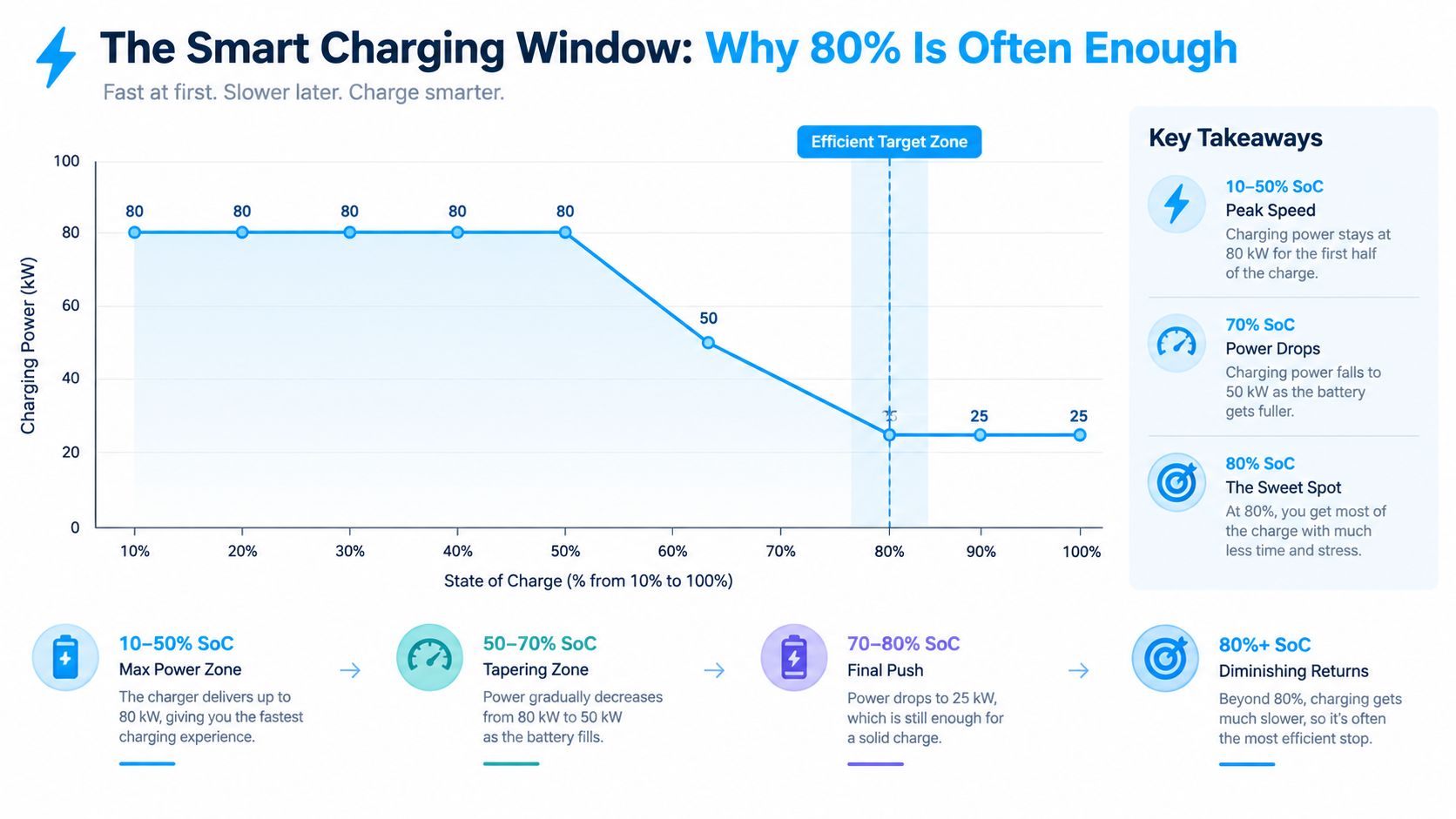
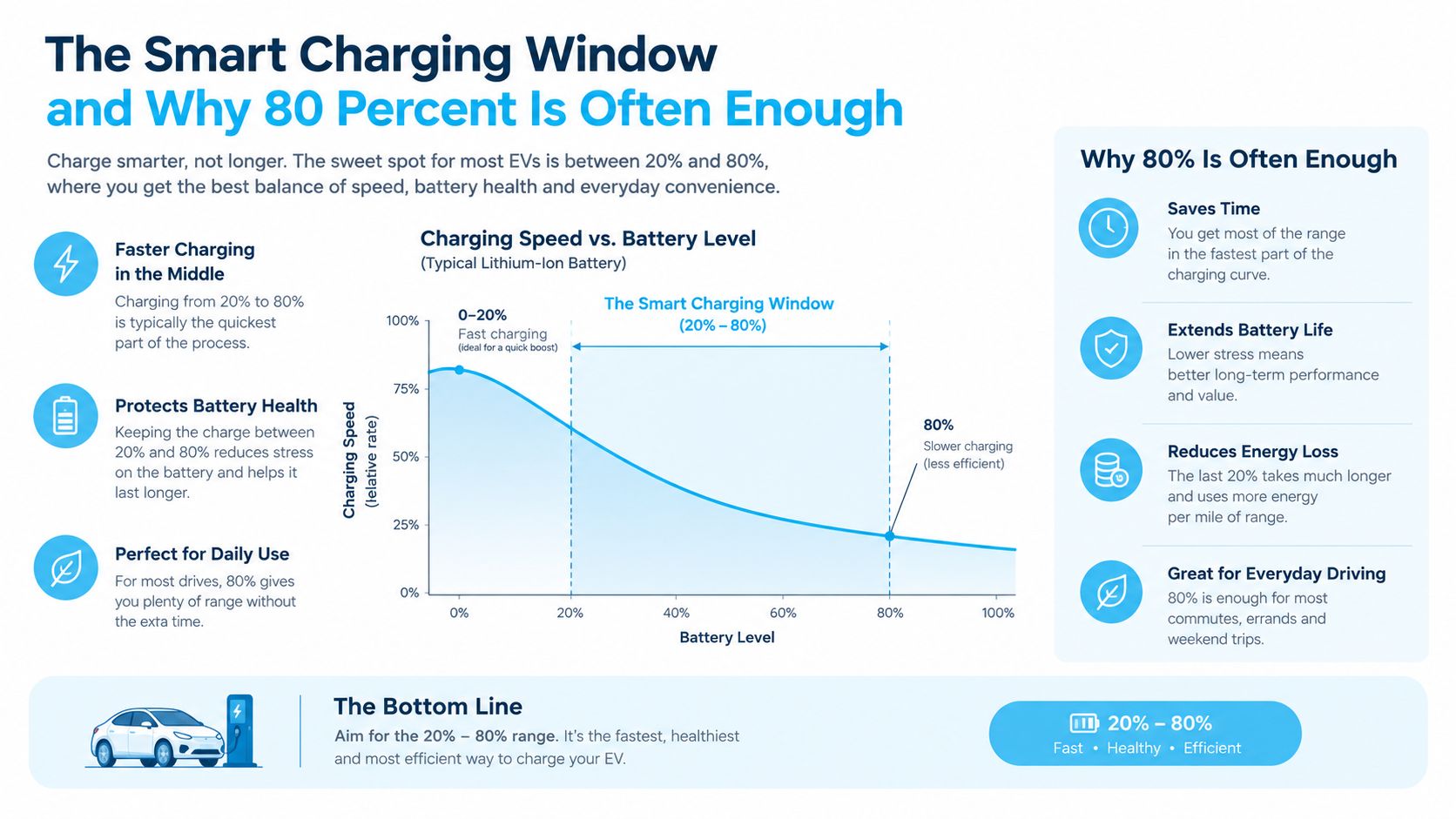
The familiar 20% to 80% charging window works because DC fast charging usually slows substantially near the upper end of the battery. Consumer Reports describes the practical pattern clearly: many EVs can reach about 80% in roughly 20 to 60 minutes on DC fast charging, while the 80% to 100% segment can take as long as the first 60% to 70% combined (Consumer Reports guidance on common charging problems).
That taper isn't a minor inconvenience. If you stay for the final portion, your car may accept power slowly while occupying a valuable connector. You pay for the energy, but you also spend time waiting for energy that may not help you reach the next meaningful destination.
Why the middle of the battery is the working zone
Arriving at a fast charger with a lower state of charge gives the vehicle more opportunity to accept high power. Leaving around 80% usually gives you a strong combination of added range and reasonable stop time. The exact result depends on the vehicle, charger, battery temperature, and station output, but the principle remains useful across road trips.
Battery longevity also favors avoiding unnecessary extremes in everyday use. The EV battery degradation overview provides useful context for understanding why routine charging habits matter, although trip planning should always follow the vehicle manufacturer's instructions.
Use this rule for ordinary highway stops:
Arrive low, leave around 80%, and stop earlier if the next charger is close.
The rule has exceptions. Charge higher when the next charging opportunity is uncertain, the route enters a remote area, the destination lacks dependable power, or you'll need the vehicle immediately after arrival. A full charge can also be sensible at home before a long day if you have time and don't need to occupy a public fast charger.
Daily drivers and fleet operators should think differently from road trippers. A private vehicle that returns home regularly may need only enough energy for the next day's driving. A fleet vehicle needs a repeatable departure target that protects route completion and minimizes downtime. In both cases, the right target is operational, not emotional. A high percentage isn't automatically better if it takes too long to obtain.
Understanding Real Public Charging Costs Beyond the Per kWh Price
A cheap per-kWh rate can still produce an expensive stop. The final bill depends on how much energy you add, how fast your vehicle accepts it, whether the station charges by time, and whether you leave before idle fees begin. Calculate the cost of the next driving leg, not the cost of filling the battery to 100%.
Public charging prices vary sharply by location. AAA's August 2026 figures put the United States national public average at 42.4¢ per kWh, with state averages ranging from 31.1¢ per kWh in Kansas to 52.9¢ per kWh in West Virginia (AAA's state-by-state charging prices). The same energy addition can therefore produce a different bill before station-specific fees or membership discounts.
The United Kingdom shows a separate price split. Zapmap's August 2026 Price Index, based on usage data covering around 75% of UK public chargers and 2,000,000 charging sessions per month, reported weighted pay-as-you-go averages of 54p per kWh for Standard and Standard Plus chargers rated from 3 kW to 49 kW. Rapid and Ultra-rapid chargers rated at 50 kW and above averaged 77p per kWh. Rapid charging was about 42.6% more expensive per kWh than slower public charging, before discounts or other fees (UK charging-cost analysis on GearUp Insights).
Public charging price comparison
| Market and Charger Type | Average Price per kWh | Cost per 100 Miles Context |
|---|---|---|
| United States, public and commercial charging | 42.4¢/kWh | Roughly $12.11 per 100 miles using about 3.5 miles per kWh |
| Kansas, public charging average | 31.1¢/kWh | Lower energy cost than the U.S. average, with actual cost still dependent on vehicle efficiency |
| West Virginia, public charging average | 52.9¢/kWh | Higher energy cost than the U.S. average, before station-specific fees |
| United Kingdom, Standard and Standard Plus, 3 kW to 49 kW | 54p/kWh | Slower charging can suit longer parking stays |
| United Kingdom, Rapid and Ultra-rapid, 50 kW and above | 77p/kWh | Faster charging carries a higher average energy rate |
Read the fee structure before you connect
Idle fees commonly add about $0.10 to $1.00 per minute after charging ends or when a location is congested, according to the guide on public charging fees and pricing structures. A low-rate session can become expensive if you walk into a shop and forget the vehicle is still connected.
Check these four items on the station screen or network app:
- Energy pricing: Is billing based on kWh, minutes, or both?
- Session charges: Does the network add a fixed guest or connection fee?
- Reservation pricing: Does booking the connector create another charge?
- Idle rules: When does the penalty start, and does congestion affect it?
Membership may lower the energy rate, but occasional drivers should compare the complete session cost before subscribing. Include the energy needed for the next leg, the expected charging time, any detour, and the risk of an idle fee. A cheaper charger is a poor choice if it adds a long wait or leaves you paying for avoidable parking time.
For a broader ownership-cost view, use this EV charging cost analysis to compare public charging with the wider cost of operating an EV.
How to Use Charging Simulators and TCO Tools to Pick Your Charge Target
You are ten minutes from departure, the charger is still adding power, and the battery has moved into its slow upper range. A simulator helps you decide whether those extra miles justify the wait before you plug in. Enter the exact vehicle, battery information, arrival charge, and target charge, then compare the charging curve, time, and energy added. Set the target where the next leg is covered without paying for unnecessary minutes.
Model the session before choosing the stop
Use this sequence:
- Select the exact vehicle: Similar battery sizes can accept power at very different rates. Model the vehicle you are driving, not a comparable trim.
- Set the starting charge: Enter the percentage you expect on arrival. A low-charge session can behave very differently from one that begins near the taper zone.
- Test a practical target: Compare a mid-band target with a higher one. The difference reveals how much time the final portion requires.
- Record energy added: Convert the added energy into usable range with the vehicle's efficiency. That turns a battery percentage into a route decision.
- Compare alternative stops: A cheaper charger may add a detour or deliver power slowly. A slightly more expensive station beside the highway can shorten the trip and reduce the chance of another stop.
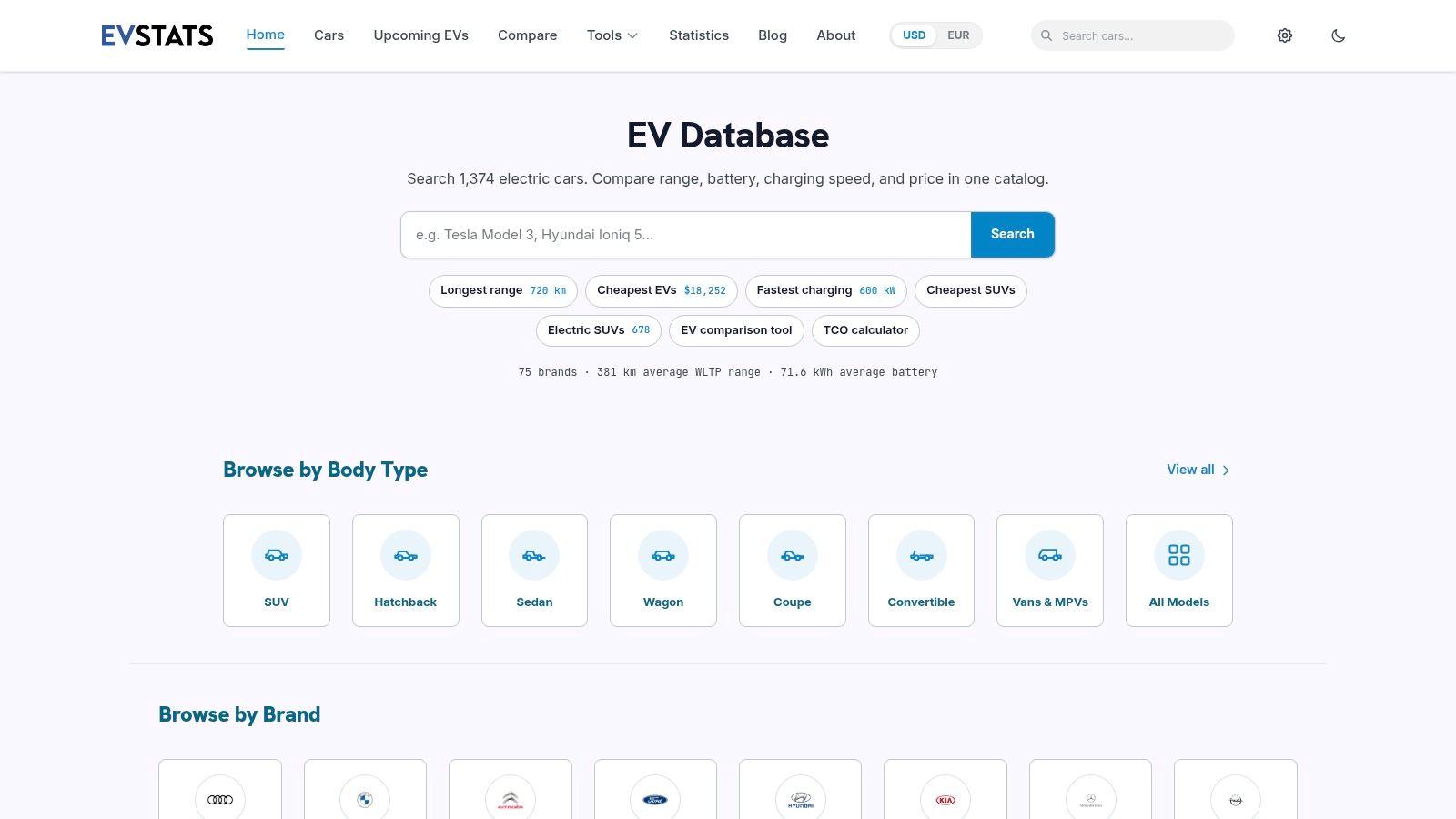
Use the Charging Simulator for this comparison. Its output is a planning estimate, not a guarantee. Battery temperature, shared chargers, station performance, and the vehicle's battery-management strategy can all change the result.
Compare a top-up with a full session
A 75 kWh battery pack shows why trip-based planning beats a full-battery mindset. Charging from 20% to 80% adds 60% of the stated capacity, or 45 kWh before accounting for usable-capacity differences or charging losses. Charging from empty to full involves the entire stated pack, while public fast charging also spends more of the stop in the slower upper range.
At a U.S. public charging average of 42.4¢ per kWh, 45 kWh of billed energy would equal $19.08 before fees, compared with $31.80 before fees for 75 kWh, as noted earlier. These figures illustrate energy cost only. The station's tariff, usable battery capacity, charging losses, and added charges determine the actual bill.
Use the TCO tool to compare public charging with the options available on your route. If the battery starts full from home, a fast-charge session may only need to cover the next highway segment. Test the cost and time of adding enough for the next 60 to 200 miles, then stop at the target that meets the leg's requirements. Paying for a full battery at every station wastes time when the charging curve has already slowed.
Quick Checklist for Every Public Charging Stop
A good charging stop begins before the cable comes out. Decide the next destination, estimate the energy required, and set a departure target that matches the route. Don't let the charger screen make the decision for you while you're already paying.
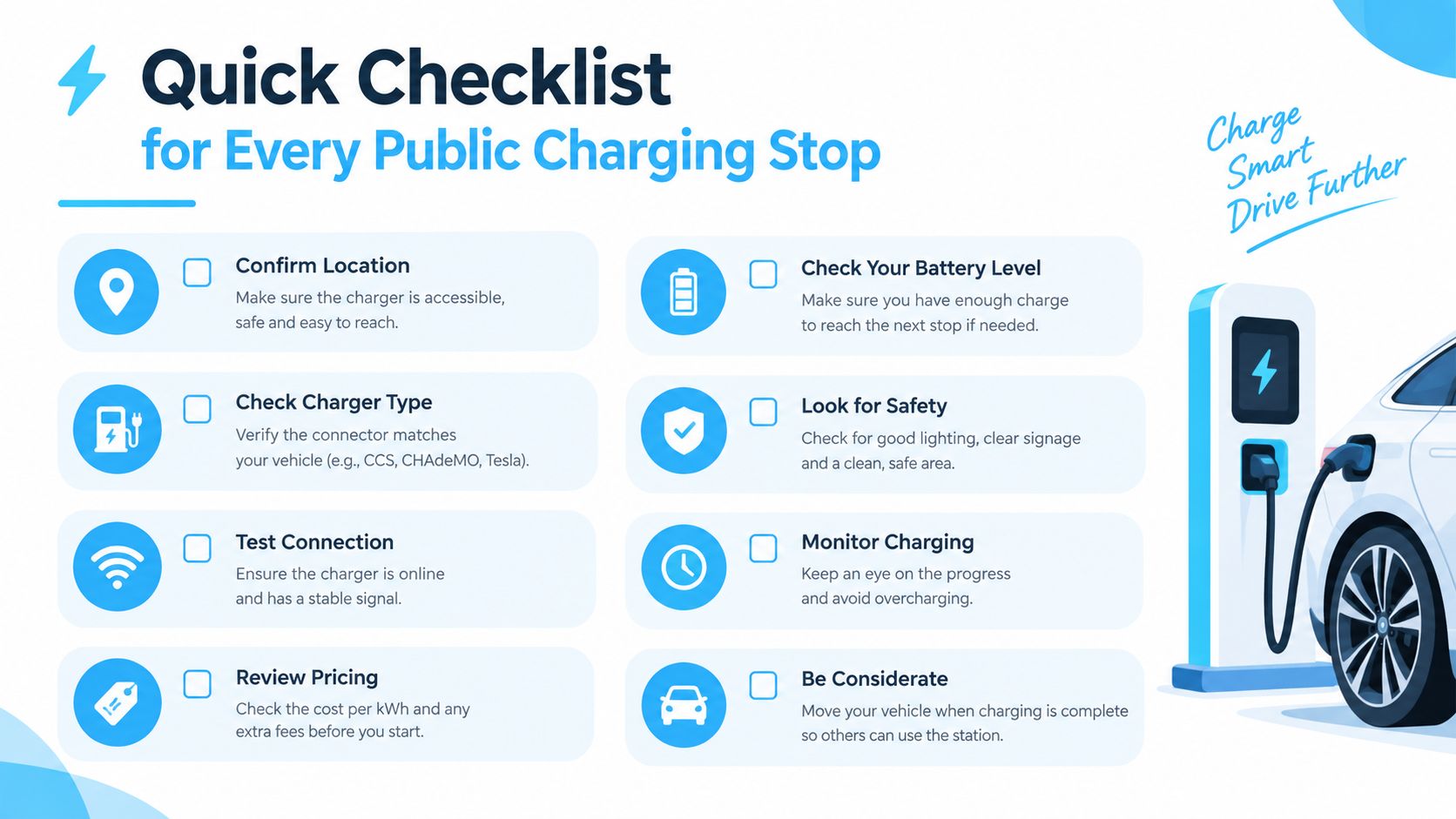
Use this compact routine:
- Calculate the next leg: Start with distance, real-world efficiency, and a sensible reserve.
- Set a stopping point: Aim for the range you need, often within the efficient mid-band rather than 100%.
- Check the complete tariff: Look for per-kWh pricing, time billing, session charges, reservation costs, and idle fees.
- Confirm compatibility: Verify the connector type and the station's advertised power before arrival.
- Authenticate early: Open the network app, confirm the account, and have an alternative payment method ready.
- Watch the session: Set a reminder for the planned departure time so the car doesn't remain connected after charging ends.
- Leave the connector available: Move the vehicle promptly when the session is complete, particularly at busy highway sites.
Failed sessions are common enough to deserve their own prevention routine. A Consumer Reports charging-community survey found that 21% of public charging sessions had at least one problem. Hardware represented 36% of problem sessions, while payment issues represented 23% (Consumer Reports charging-session problem data). Separate reliability analysis found about 7% of sessions unsuccessful in one dataset, with roughly 81% of failures attributed to user-oriented errors and 19% to technical faults. “No Authentication” accounted for about 75.7% of usability failures in that analysis, so checking app access and payment before arrival isn't busywork.
Practice with a simulator before a demanding road trip. Once you know your vehicle's charging curve and typical efficiency, how much to charge at a charging station becomes a quick range calculation instead of a stressful guess. Smart partial charging keeps stops shorter, bills more predictable, and every connector available for the next driver.
Use EV Stats to compare EV charging performance, model realistic top-ups with its Charging Simulator, and evaluate trip costs with its TCO Calculator. Pick your vehicle, test different charge targets, and plan your next public charging stop around the range you need.