

The average new EV transaction price in the U.S. fell to about $45,000 in early 2026, down from over $65,000 in 2022, according to a 2026 EV cost guide. That shift changes the meaning of the best value electric car. Buyers can now find long-range models without paying luxury-car money, but the lowest sticker price still doesn't guarantee the lowest ownership cost.
A better comparison combines purchase price, usable range, real-world efficiency, charging speed, and resale value. The right EV depends on whether you charge at home, rely on public stations, drive mostly in town, or spend hours on highways. The cheapest model may save money at the dealership while costing more in charging time, energy, or depreciation. For a live catalog sort by list price, see the cheapest electric cars ranking. Crossover shoppers can use the cheapest electric SUVs list.
Table of Contents
- Why EV Value Means More Than Sticker Price in 2026
- The Four Metrics That Define EV Value
- Ranked Best Value EVs by Budget Tier
- How Depreciation Flips the Value Rankings
- Charging Access Changes the Value Equation
- Situational Recommendations for Different Buyers
- Your EV Value Evaluation Checklist
Why EV Value Means More Than Sticker Price in 2026
The Hyundai Kona Electric SE starts at $32,875 for 200 miles of range, while the Ford Mustang Mach-E Premium reaches 300 miles for $39,995. The Chevrolet Equinox FWD offers 319 miles for $41,100, and the Tesla Model 3 Long Range RWD provides 363 miles for $42,490, according to the same 2026 cost analysis. These comparisons establish the entry point for value, not the final ranking.
A composite value score should combine price per range, real-world efficiency, depreciation retention, and charging-infrastructure fit. The cheapest EV can score well on purchase cost yet lose ground if it consumes more electricity, takes longer to recharge, or has weaker demand on the used market. A higher-priced model may deliver more usable mobility and fewer charging interruptions, particularly for drivers who make regular highway trips or lack reliable home charging.
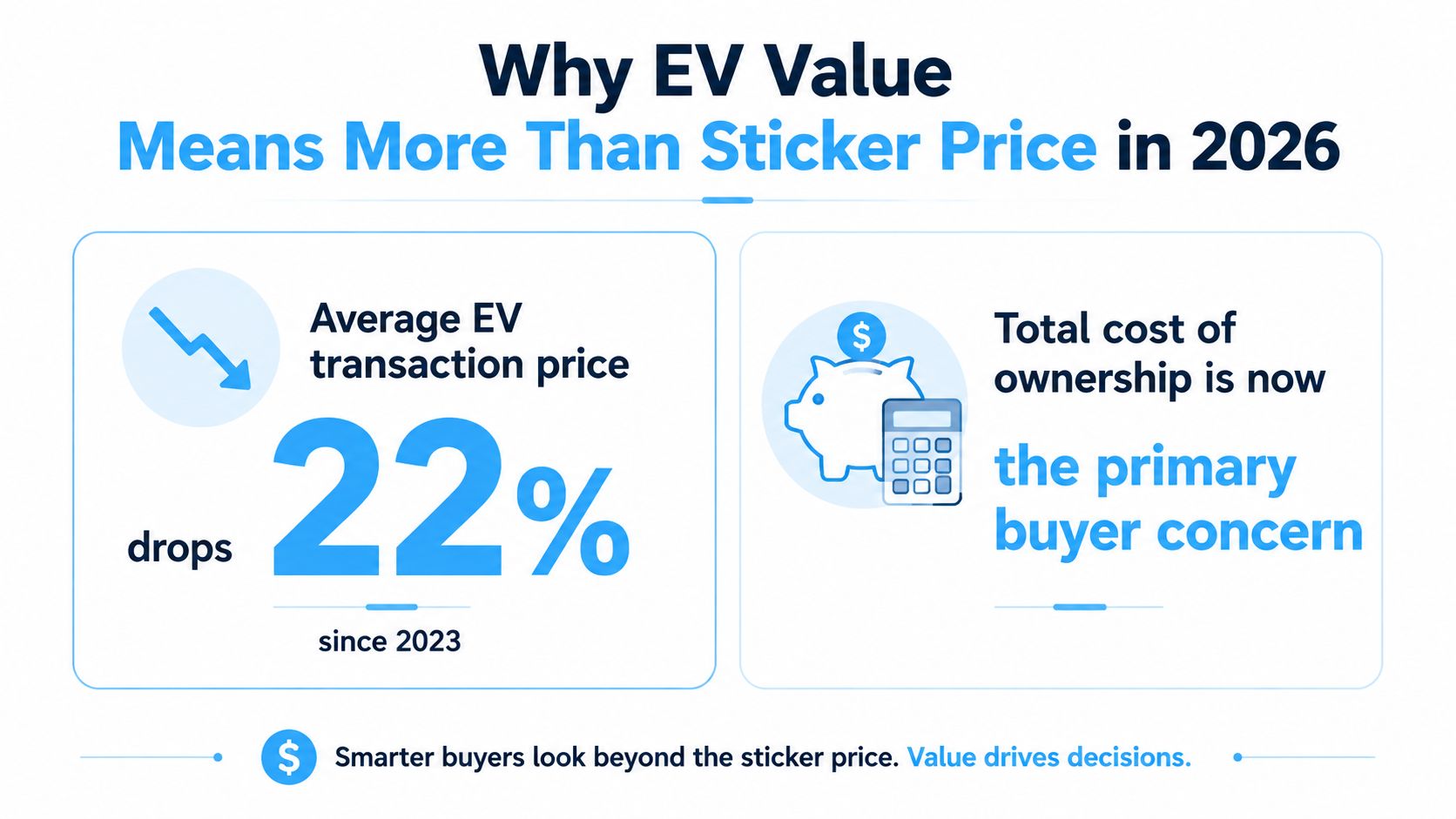
Purchase price is only the first calculation
The ownership equation is:
True cost = purchase price + energy + maintenance + insurance + financing impact − resale value
The exact inputs will vary by driver, but the framework prevents monthly payment or showroom price from standing in for total cost. An EV with rapid depreciation can erase its initial price advantage. Conversely, an efficient model charged mainly at home may recover a higher purchase price through lower operating costs.
A Europe-focused BEUC summary of electric-car total cost reports that battery electric vehicles are already the cheapest powertrain on a lifetime total-cost basis for medium cars bought today, excluding subsidies and tax incentives. Its analysis places medium-car price parity first, in 2026, followed by small cars in 2029 and large cars in 2032.
Value depends on the ownership clock
Long-term owners should give greater weight to energy use, maintenance, warranty coverage, and battery durability. Buyers who expect to sell or trade sooner should assign more weight to depreciation retention and used-market demand. Charging access also belongs in the score: a low-cost EV that depends on inconvenient public charging may deliver less practical value than its specification sheet suggests.
Medium cars often rank strongly because operating savings can offset higher entry prices within a few years. That category is not automatically a bargain. Vehicle size, efficiency, charging behavior, resale demand, and the owner's holding period must be assessed together.
Practical rule: Compare the money you will spend and lose during ownership, not only the amount paid on purchase day.
The Four Metrics That Define EV Value
A credible EV value score separates four measurements that marketing pages often combine. Each captures a different cost or constraint, so the weighting should reflect how and how long you will drive the vehicle. A composite score that combines price per range, real-world efficiency, depreciation retention, and charging fit explains why the lowest sticker price rarely identifies the strongest overall value.
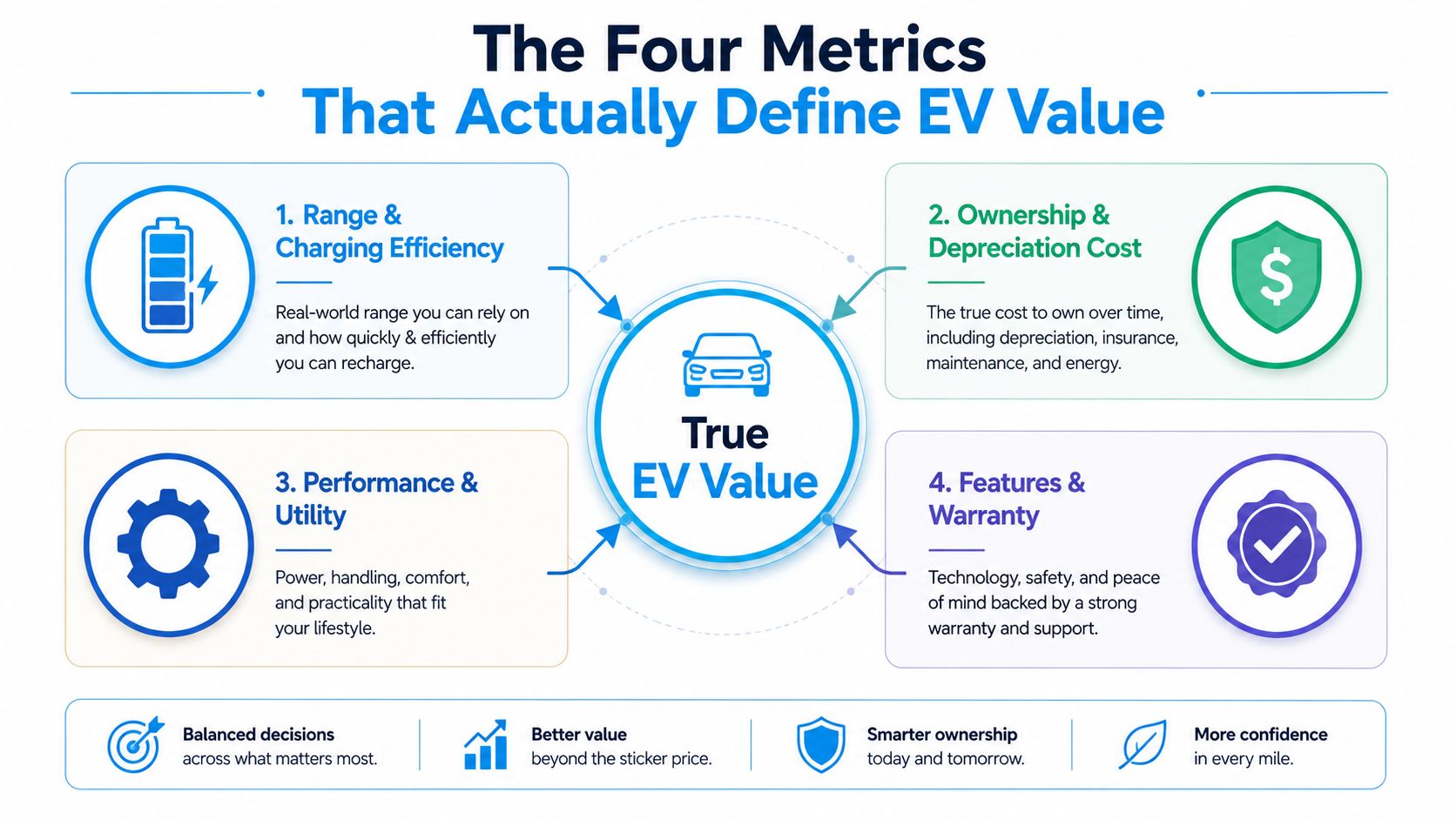
Price per range
Divide purchase price by EPA range to estimate the amount paid for each mile of rated mobility. The measure excludes ownership costs, yet it provides a consistent starting point for comparing upfront value. The Hyundai Kona Electric SE offers 200 miles at $32,875, while the Hyundai Ioniq 6 SE RWD offers 361 miles at a $38,615 starting MSRP, according to EV Pulse testing and specifications.
Price per range favors models that combine a moderate price with substantial battery-backed travel. It can overrate a vehicle that charges slowly, uses more electricity in everyday driving, or loses value quickly in the used market.
Real-world efficiency
Efficiency measures distance traveled per unit of electricity. The Hyundai Ioniq 6 SE RWD reached about 3.9 miles per kWh in mixed driving, so its rated range represents more useful mobility than the same headline figure from a less efficient vehicle. A cost-per-mile calculation method for electric cars can connect efficiency with your electricity rate, charging mix, and annual mileage.
Efficiency has greater financial weight for high-mileage drivers and owners who frequently pay public-charging rates. It can also reduce the battery capacity needed for a target range, improving the relationship among vehicle size, energy use, and purchase price.
Depreciation retention
Resale value determines how much of the purchase price remains recoverable. A model that retains more value can have a lower effective ownership cost, even when its initial price is higher.
Retention must be compared by model, trim, body style, market, and ownership horizon. Brand-level assumptions conceal meaningful differences. The cheapest new EV may therefore lose its upfront advantage by the time it is sold or traded.
Charging infrastructure fit
Charging fit measures compatibility with your real access to electricity. A homeowner with dependable overnight charging can place more weight on efficiency and comfort. An apartment resident who relies on public stations may value DC charging speed, station availability, and a practical range buffer more than the lowest purchase price.
Use these weighting priorities:
- Home charging: Emphasize efficiency, battery size, and long-term operating cost.
- Public charging: Emphasize DC charging performance, network availability, and predictable range.
- Frequent highway travel: Give range and charging speed similar weight.
- Short ownership period: Increase the importance of depreciation retention.
- Long ownership period: Put more weight on efficiency, warranty, and service costs.
No single metric determines value. The strongest candidate is the EV with a balanced composite score across the measurements that shape your ownership costs.
Ranked Best Value EVs by Budget Tier
The table ranks listed models by a composite value view: purchase price relative to EPA range, available efficiency and charging evidence, and fit for the buyer's use case. It does not assign resale or infrastructure scores where the supplied data provides no comparable figures. A blank entry means the data is unavailable, not that the vehicle lacks the feature.
| Model | Price | EPA Range | Efficiency (mi/kWh) | DC Fast Charge | Best For |
|---|---|---|---|---|---|
| Hyundai Kona Electric SE | $32,875 | 200 miles | Not provided | Not provided | Lowest-cost new EV above 200 miles |
| Hyundai Ioniq 6 SE RWD | $38,615 | 361 miles | 3.9 mi/kWh | 233 kW peak | Efficient long-distance driving |
| Ford Mustang Mach-E Premium | $39,995 | 300 miles | Not provided | Not provided | Affordable 300-mile capability |
| Chevrolet Equinox FWD | $41,100 | 319 miles | Not provided | Not provided | Range-focused crossover value |
| Tesla Model 3 Long Range RWD | $42,490 | 363 miles | Not provided | Not provided | Long range in a sedan |
| Nissan Leaf 2026 | Not provided | 303 miles | Not provided | Not provided | Affordable long-range entry point |
Under $35,000
The Hyundai Kona Electric SE is the clearest candidate in this tier. Its 200-mile EPA range and $32,875 list price give buyers a relatively low-cost route into a new EV with mainstream usable range, based on the 2025 U.S. comparison.
Its value comes from access to that range at a lower entry price. The supplied data does not establish real-world efficiency, DC charging performance, depreciation retention, or charging-network fit. Buyers who drive long distances should verify those factors before treating the Kona as the best overall value.
$35,000 to $45,000
The Hyundai Ioniq 6 SE RWD is the strongest measured value in the supplied data. It combines 361 miles of EPA range, about 3.9 mi/kWh, a $38,615 starting MSRP, a 233 kW DC fast-charge peak, and an estimated 18-minute 10% to 80% session on 800V hardware, according to EV Pulse's 2026 range and efficiency guide.
Those specifications improve both range-per-dollar and time efficiency on highway trips. The sedan body limits its appeal for buyers who need a tall cargo area or SUV seating position. Its ranking also remains conditional because the available comparison does not establish resale performance or local charger access.
$45,000 to $55,000
The Ford Mustang Mach-E Premium, Chevrolet Equinox FWD, and Tesla Model 3 Long Range RWD serve different value priorities. The Mach-E delivers 300 miles for $39,995, the Equinox provides 319 miles for $41,100, and the Model 3 reaches 363 miles for $42,490.
The Equinox fits buyers who value crossover space and range. The Model 3 offers the strongest rated reach among these three in a sedan format, while the Mach-E suits drivers who want a crossover with exactly 300 miles of rated range. Price-per-range alone favors the Model 3, but body style, cargo needs, charging access, and expected resale can change the final composite ranking. The cheapest option is therefore not automatically the best value.
How Depreciation Flips the Value Rankings
A low purchase price can become a false economy when resale value falls quickly. Verified 2-year EV value retention ranges from about 64.2% for the Tesla Model Y to 78.3% for the Volkswagen ID. Buzz, according to 2026 EV resale analysis.
That spread can reorder a value ranking built only on MSRP, range, and efficiency. The Rivian R1S retained 73.1% in the same coverage, showing how model-specific demand can outweigh a vehicle's higher entry price. These figures do not establish a universal ownership cost, since purchase price, mileage, condition, incentives, and local demand still affect the result. They do establish that sticker price and retained value are separate variables.
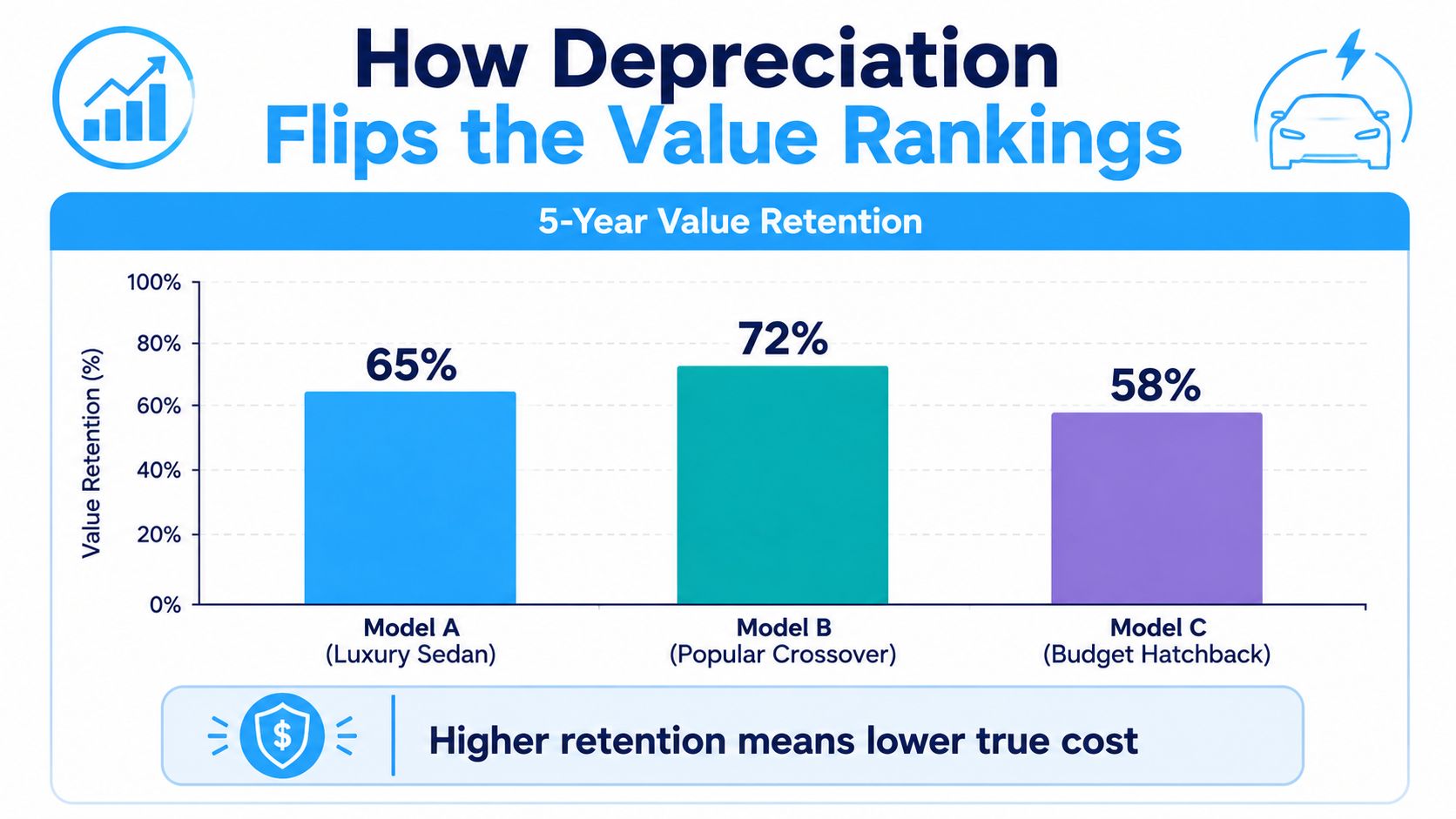
The resale equation
Use this calculation before calling an EV a bargain:
Net vehicle cost = purchase price − expected resale value
Then include energy, maintenance, insurance, and financing costs. A $40,000 EV that preserves a larger share of its original price than a $35,000 rival can produce the lower net vehicle cost. The relevant comparison is therefore the dollars lost, not the percentage saved at purchase.
Body style and used-market demand influence that calculation. Popular crossovers may attract a broader pool of second-hand buyers, while unusual formats can retain value for more specialized reasons. Brand perception matters, but model-level retention evidence should carry more weight than a badge assumption.
Used EV pricing has also moved closer to normal market conditions. A 2026 market summary reports that used EV prices had fallen 20% to 30% from their peak, bringing many models closer to gasoline-car price parity.
Why ownership length changes the answer
Ownership horizon changes which metric deserves the highest weight. Buyers keeping an EV well beyond its early depreciation period can place more emphasis on energy use, battery warranty, and charging convenience. Buyers planning to trade within a few years should give retention a much larger role in the composite value score.
The Volkswagen ID. Buzz's stronger reported retention does not make it the best choice for every driver. Space, efficiency, charging fit, purchase price, and resale must still align. Depreciation is the correction that keeps an attractive new-car deal from becoming an expensive resale event.
Charging Access Changes the Value Equation
Charging access can change an EV's ranking even when its price-per-range looks attractive. Independent 2026 coverage estimates roughly 70,000 public DC fast-charging ports in the U.S., while noting that home charging remains the normal choice for convenience and lower cost. The EnergySage EV charging guide reports that public fast charging typically costs about twice as much as home charging. Drivers comparing ownership costs can also review this EV charging cost guide.
The composite value score therefore needs a charging-access adjustment. An efficient EV charged overnight at home can keep operating costs low. A cheaper or less efficient EV that depends on public stations may create higher electricity bills, longer stops, and detours that the sticker price does not capture.
Three charging profiles
Homeowner with Level 2 charging. This buyer should weight efficiency, moderate-to-long range, and battery size. The Hyundai Ioniq 6 SE RWD fits that profile because its verified 3.9 mi/kWh real-world efficiency reduces energy use for daily driving, while its long rated range limits road-trip stops. Its value comes from the interaction between efficiency and predictable access, not range alone.
Apartment resident using public charging. This buyer should evaluate DC charging behavior and station availability before prioritizing the lowest MSRP. Peak power does not describe the full experience. The vehicle must sustain useful charging performance, and reliable stations must be available near home, work, or regular destinations.
Long-distance commuter. This profile requires both range and charging speed. The average real-world range across 2026 EV models is reported at 325 miles, while the 2026 Nissan Leaf reaches 303 miles of EPA-estimated range, according to EnergySage's market coverage. These figures show progress in the affordable segment, but highway efficiency and charging curves still determine how often and how long the driver stops.
For public-charging users, range per dollar is incomplete. A vehicle that needs fewer sessions but charges slowly may be less useful than one with slightly less range and faster, better-supported charging. The practical cost includes electricity, time, detours, and the possibility of arriving at a busy station.
Situational Recommendations for Different Buyers
The best value electric car changes with the buyer. A strong recommendation should identify the constraint first, then choose the model that minimizes the cost of satisfying it.
Budget-conscious first-time buyer
Start with the Hyundai Kona Electric SE if a new vehicle, a mainstream crossover shape, and 200 miles of EPA range at $32,875 meet your needs. It's the strongest verified entry-price choice in this comparison, but buyers who travel long distances should confirm DC charging behavior before committing.
Family needing range and practicality
Consider the Chevrolet Equinox FWD for a crossover-oriented buyer who values 319 miles of range at $41,100. Its appeal comes from the combination of family-friendly format and long rated range, although the supplied data doesn't establish its efficiency or charging speed. If fast road-trip stops matter more than crossover packaging, the Ioniq 6 deserves a test drive instead.
Commuter with home charging
The Hyundai Ioniq 6 SE RWD is the most convincing fit. Its 3.9 mi/kWh real-world efficiency, long range, and fast-charging hardware serve both weekday economy and occasional highway travel. The sedan body may not work for buyers who regularly carry bulky cargo.
Apartment dweller without home charging
Choose based on charging access before choosing based on range. A vehicle with strong DC charging and a compatible local network can outperform a cheaper model that spends longer at public stations. Inspect station availability during your normal schedule, then shortlist EVs whose charging performance fits those locations.
Frequent long-distance traveler
The Ioniq 6 is the clearest verified recommendation because it combines efficiency, range, and a 233 kW DC fast-charge peak. The Tesla Model 3 Long Range RWD is another strong candidate for buyers who prefer a sedan and its 363-mile rating at $42,490, while the Mach-E and Equinox make more sense for those who need crossover form.
Use a broader electric-car buying guide to organize financing, charging, warranty, and test-drive questions before reducing the shortlist to two or three vehicles.
Your EV Value Evaluation Checklist
Use this checklist before signing a purchase agreement. It separates advertised specifications from the ownership factors that determine your composite value score: price per range, real-world efficiency, depreciation retention, and charging fit.
Calculate usable range value
Divide the current transaction price by EPA range, then compare the result with your normal trips. Extra range has limited value if you rarely use it. Short range can cost more over time if it forces frequent public charging or repeated route planning.
Test efficiency in your conditions
Drive on mixed roads with climate controls set as usual, then record the consumption display. Compare that result with independent testing where available. Efficiency affects charging expense and the battery capacity needed for each trip, so it can change the ranking between similarly priced EVs.
Investigate depreciation
Search for model-specific resale evidence instead of relying on brand reputation. A vehicle that retains value can outperform a cheaper model over a short ownership period, even when the initial price difference appears attractive.
Verify charging performance
Ask how long the car takes to charge in realistic conditions, not only its maximum advertised power. Check whether your regular stations support the vehicle and whether its route planner can identify compatible chargers. Charging access is part of value, not a separate convenience feature.
Model the full ownership cost
Include energy, maintenance, insurance, financing, and expected resale value. Apply the electricity rate that matches your actual setup, because home and public charging can produce very different results. The EV cost-per-mile framework can help organize the calculation, while your driving pattern determines the outcome.
Watch for warning signs and positive signals
Treat poor efficiency, weak charging performance, and steep depreciation as value penalties. Favor models that combine useful range, efficient energy use, credible charging hardware, and sustained used-market demand. A low purchase price cannot compensate for every weakness.
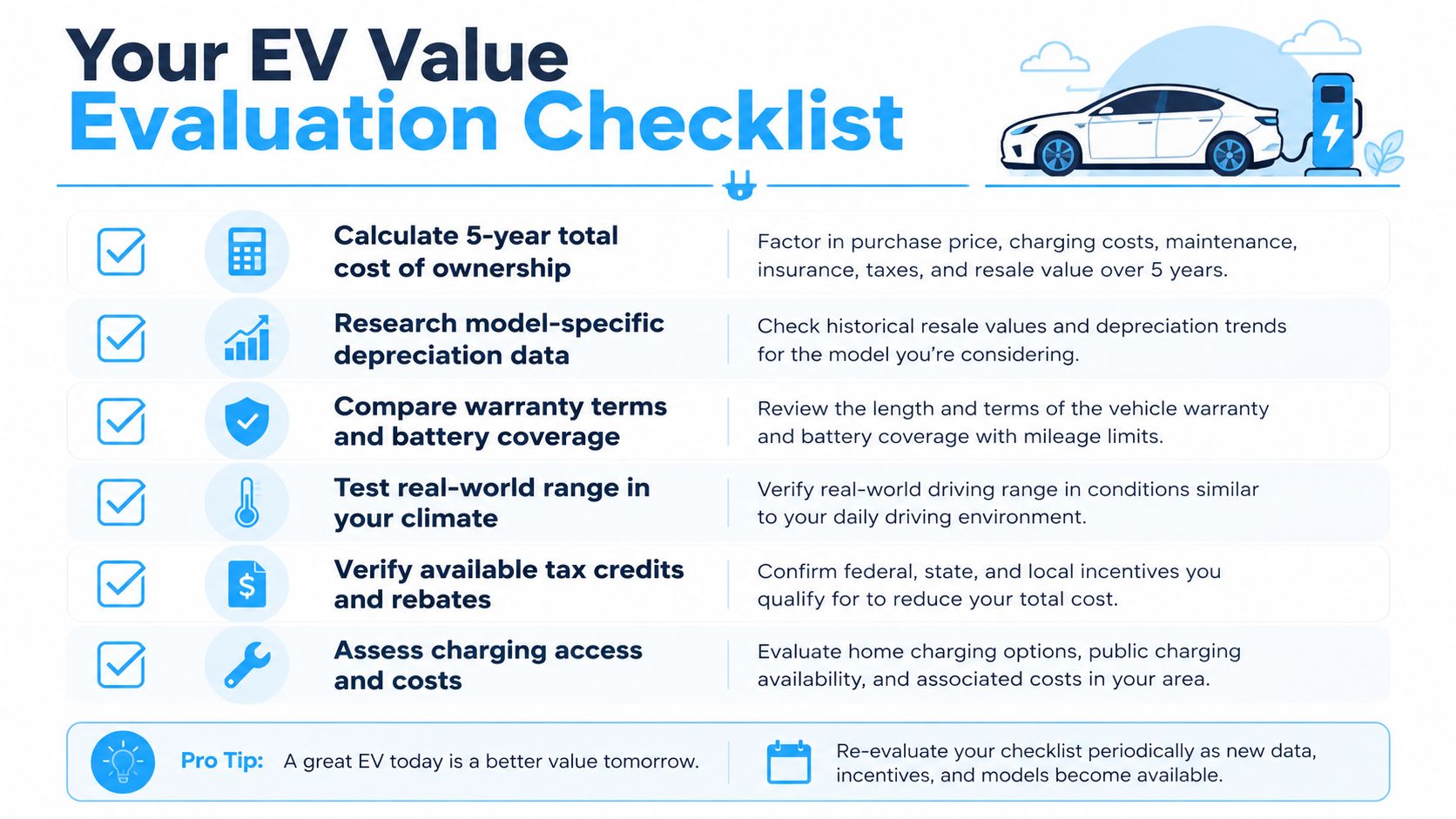
The strongest decision comes from comparing a small group of vehicles against your charging access, ownership timeline, and driving distance. Ask which EV delivers the most usable transportation after energy, charging, depreciation, and other ownership costs, rather than choosing the cheapest sticker price.
EV Stats helps you compare electric vehicles through structured specifications, real-world context, range and efficiency rankings, charging simulations, side-by-side comparisons, and total-cost estimates. Visit EV Stats to build a shortlist based on your driving pattern, charging access, and ownership budget.