

The best EV for long distance driving isn't automatically the one with the biggest EPA or WLTP number. That advice sounds sensible until you plan a highway trip, because the car that minimizes total travel time is the one that combines usable highway range, fast sustained charging, and efficient road-trip consumption. A vehicle can look dominant on paper and still lose to a better-charging rival once stops, tapering, and highway drag enter the equation.
| Metric | What buyers usually assume | What matters on a road trip |
|---|---|---|
| Range rating | Longer is always better | Enough range to avoid excessive stops |
| Charging power | Higher peak kW wins | Higher average power across the usable window wins |
| Highway efficiency | Same as lab figures | Real range at steady-speed cruising matters more |
| Vehicle type | One winner fits all | Sedans, SUVs, and pickups serve different trip profiles |
That's why a smart comparison starts with trip time, not bragging rights. The metric that matters is how far an EV can travel between short, fast stops and how quickly it can recover energy without slowing to a crawl near the top of the battery. For a buyer comparing the best EV for long distance driving, the question isn't just “How far does it go?” It's “How long will the whole journey take, after charging?” That shift is the difference between marketing and actual road-trip usability.
Table of Contents
- Why Maximum Range Is Not the Whole Story
- Key Metrics That Define Long-Distance EV Performance
- Top Long-Distance EV Contenders by Vehicle Type
- Real-World Range Versus Laboratory Numbers
- Matching EVs to Specific Long-Distance Use Cases
- How to Evaluate and Shortlist EVs for Your Road Trips
- Situational Recommendations for Every Long-Distance Driver
Why Maximum Range Is Not the Whole Story
The oldest shortcut in EV buying is also the least reliable one for road trips, picking the car with the biggest range figure and assuming it will be the best long-distance choice. That logic made more sense when mainstream EVs were still short-range commuters. The original Nissan Leaf launched in 2010 with about 73 miles of range, while the Lucid Air Grand Touring reached 512 miles on the EPA cycle by 2025 to 2026, becoming the first production EV to exceed 500 miles in U.S. official testing.
That jump is real, but it does not settle the buying question. Highway travel now depends on how range, efficiency, and charging performance work together. A car with excellent advertised range can still lose time if it slows sharply at the charger, and a car with a lower range rating can finish a trip sooner if it holds highway efficiency and takes energy quickly.
The road trip metric is total time, not single-charge distance
Independent road-trip testing makes that trade-off plain. Edmunds reported the Lucid Air Dream Edition Range at 505 miles in real-world testing, while MotorTrend recorded 330 miles of road-trip range for the Lucid Air Pure RWD versus 394 miles EPA, showing that highway performance is shaped by more than laboratory numbers alone. That is the part many shopping guides overlook.
Practical rule: If two EVs have similar range, the one that restores energy faster on the route often finishes the trip sooner.
The buyer should focus on how quickly the car can add usable miles on a long drive. That shifts the evaluation away from battery size alone and toward the combination of sustained charging power and highway efficiency. For a 500- or 1,000-kilometer drive, the better EV is often the one that spends less time at chargers while still keeping consumption under control on the open road.
Range sets stop frequency, but charging speed and highway efficiency determine whether those stops are short or disruptive. For a closer look at how efficiency shapes usable distance, this EV efficiency guide is a useful companion reference.
Key Metrics That Define Long-Distance EV Performance
The wrong metric can make a car look stronger than it is. Peak charging power is the obvious example. A headline figure can look impressive on a spec sheet, but road-trip usefulness depends on what the car sustains across the usable charging window, especially because charging slows sharply above 80%. The more relevant benchmark is average power across the 10% to 80% range, plus how many miles the car adds during a short stop.
What to look at instead of a single headline figure
A practical guide to long-distance EVs recommends comparing miles added per 10 minutes at motorway consumption, and it highlights the Mercedes-Benz CLA Shooting Brake and XPENG G6 at about 124 miles added per 10 minutes, with average 10 to 80% charging power of 179 kW and 241 kW respectively, according to EV Guide UK. That framing is stronger than relying on peak kilowatts alone, because it ties charger behavior directly to route time.
| Metric | What It Measures | Why It Matters for Long Trips |
|---|---|---|
| EPA or WLTP range | Official tested distance on a standard cycle | Useful for comparison, but it is not the whole highway story |
| Real-world highway range | Distance at steady road speeds | Better predicts how far you will go between charging stops |
| 10% to 80% charging time | Time to recover a practical amount of energy | Shows how long each stop really takes |
| Average charging power | Power sustained across the charging window | More informative than peak kW for road-trip planning |
| Miles added per 10 minutes | Distance recovered during a short stop | Best proxy for actual route efficiency |
| Aerodynamic efficiency | How well the car cuts through air | Strongly affects high-speed range and energy use |
Why highway speed changes the answer
Highway testing makes the gap between lab numbers and road-trip reality hard to ignore. In independent 70-mph testing, the Lucid Air Pure RWD returned 330 miles, the Lucid Air Grand Touring Performance also recorded 330 miles, the Hyundai Ioniq 6 SE Long Range RWD returned 291 miles, and the Tesla Model 3 Dual Motor returned 258 miles, according to MotorTrend. Same road, same speed, very different outcomes.
That matters because road-trip buyers do not drive in a vacuum. They drive in wind, in traffic, with luggage, sometimes with passengers, and often at steady highway speeds. A car that holds efficiency at speed and stays strong through the charging window will usually beat a more glamorous spec sheet on total journey time.
The final filter is vehicle behavior under repeated stops. A car with a strong charging curve and efficient aero can stay consistent across a full day of driving. A car that charges quickly only at the beginning, or loses efficiency at speed, can look better on paper than it feels on the route.
The best long-distance EV is the one that keeps adding useful miles fast enough to make each stop brief.
Top Long-Distance EV Contenders by Vehicle Type
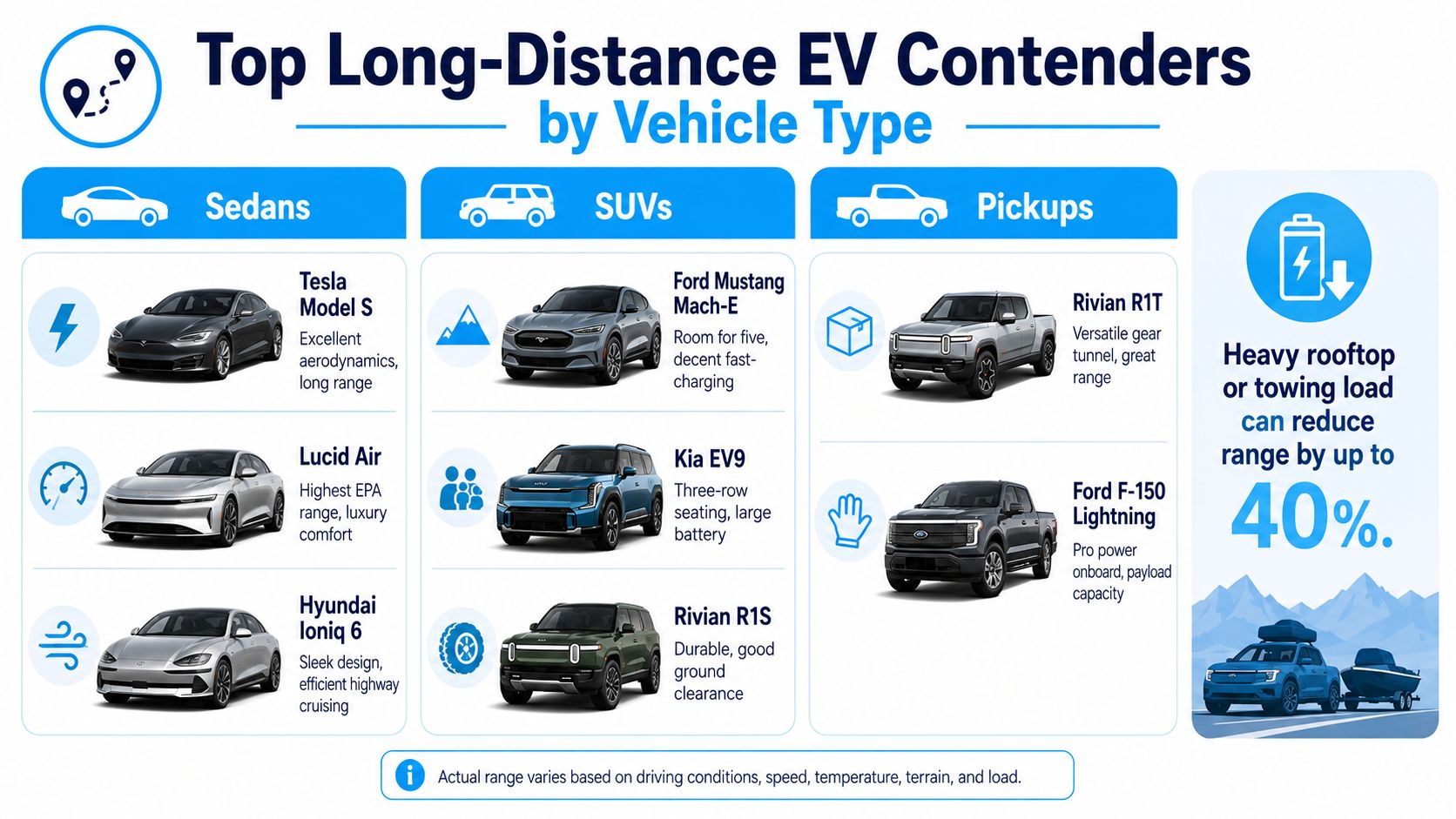
The right long-distance EV depends on body style as much as brand. Sedans usually win on aerodynamics and highway efficiency. SUVs trade some of that efficiency for space and flexibility. Pickups serve a different mission entirely, where cargo, towing, and utility can matter more than the cleanest range figure.
Sedans still set the efficiency benchmark
The Lucid Air remains a benchmark for range-first buyers because its production-market numbers sit at the top end of the category. The Lucid Air Grand Touring reached 512 miles on the EPA cycle, according to Recharged, and its real-world road-trip testing has also stood out. The Tesla Model S and Tesla Model 3 remain relevant because they combine strong efficiency with route-planning ease, while the Hyundai Ioniq 6 is a standout for aerodynamic design and charging speed.
Sedans matter because the road trip penalty for inefficiency compounds over distance. A slippery body shape lowers the energy needed to maintain speed, which gives the car more usable miles from the same battery and can reduce the number of stops. For buyers who spend most of their time on motorways, that often matters more than extra seat height.
SUVs are the family compromise
SUVs dominate because buyers need room, not because they're always the most efficient. The Kia EV9, Ford Mustang Mach-E, and Rivian R1S serve different kinds of households, from three-row family travel to mixed-use commuting and weekend adventure. The trade-off is clear. An SUV usually gives up some highway efficiency to gain space, comfort, and cargo flexibility.
That's not a bad trade if the vehicle is carrying children, luggage, or gear on every long trip. It is a bad trade if the buyer only wants the fewest possible charging stops. For that driver, a sedan often remains the cleaner answer.
Pickups solve a different problem
The Chevrolet Silverado EV, Cadillac Escalade IQ, GMC Sierra EV, Rivian R1T, and Ford F-150 Lightning show how the pickup and truck-based long-range segment has evolved. These vehicles can be serious long-distance tools, but the reason to buy them is usually not pure efficiency. It's payload, towing, and utility.
| Body Type | Best Strength | Best Fit |
|---|---|---|
| Sedan | Highway efficiency and low stop frequency | Solo drivers, commuters, and long motorway trips |
| SUV | Passenger and cargo flexibility | Families and mixed-use travel |
| Pickup | Towing and work utility | Adventure buyers and heavy-duty use |
The cleanest takeaway is that body style changes the definition of “best.” A sedan can minimize charging stops. An SUV can make a family trip less stressful. A pickup can handle tasks that a sedan can't.
Real-World Range Versus Laboratory Numbers
Laboratory range figures still matter, but only as a baseline. Highway testing is where the ranking starts to shift, because steady-speed driving exposes the difference between a car that looks efficient on paper and one that stays efficient when drag rises and conditions change.
Why highway testing changes the ranking
MotorTrend's 70-mph testing is a useful reality check. The Lucid Air Pure RWD returned 330 miles on the road, the Lucid Air Grand Touring Performance also returned 330 miles, the Hyundai Ioniq 6 SE Long Range RWD reached 291 miles, and the Tesla Model 3 Dual Motor recorded 258 miles, according to MotorTrend. That spread shows why buyers should avoid treating the lab order as a reliable forecast for motorway use.
Cleaner aerodynamics usually reduce drag losses, and drag rises quickly as speed increases. That is why sedans often stay closer to their official figures than boxier vehicles. It also explains why trip planning depends on what the car can do at 70 mph, not just what it achieved in certification testing.
What a driver should infer from the numbers
Independent road tests show that some top-tier EVs still deliver exceptional distance in practice. The Lucid Air Dream Edition Range reached 505 miles in Edmunds testing, a result highlighted by Recharged. The broader point is not just that Lucid performs well. The better highway EVs combine efficiency, usable range, and charging behavior in a way that reduces trip time, not just range anxiety.
For buyers who spend a lot of time on motorways, official range should be treated as the ceiling and real-world highway results as the planning number. That is the safer way to judge whether a car fits a real route, especially when speed, weather, and luggage all change the outcome.
Buyer shortcut: Use laboratory range to compare models, then use real-world highway testing to decide whether the car fits your route style.
For readers who want to compare how range changes across models and test cycles, this EV range comparison resource helps frame the gap between paper figures and road use.
The interpretation should stay strict. If a car's real-world highway result stays close to its official number, it is easier to trust for long trips. If the gap is wide, the buyer should expect more charging stops and longer travel days.
Matching EVs to Specific Long-Distance Use Cases
A single ranking list hides the key decision. Long-distance driving changes with passenger count, cargo weight, towing, climate, and how the driver wants to spend time at chargers. The same vehicle that works well for a solo interstate run can be a weak fit for a family or for someone pulling a trailer.
Family travel rewards space and predictable charging
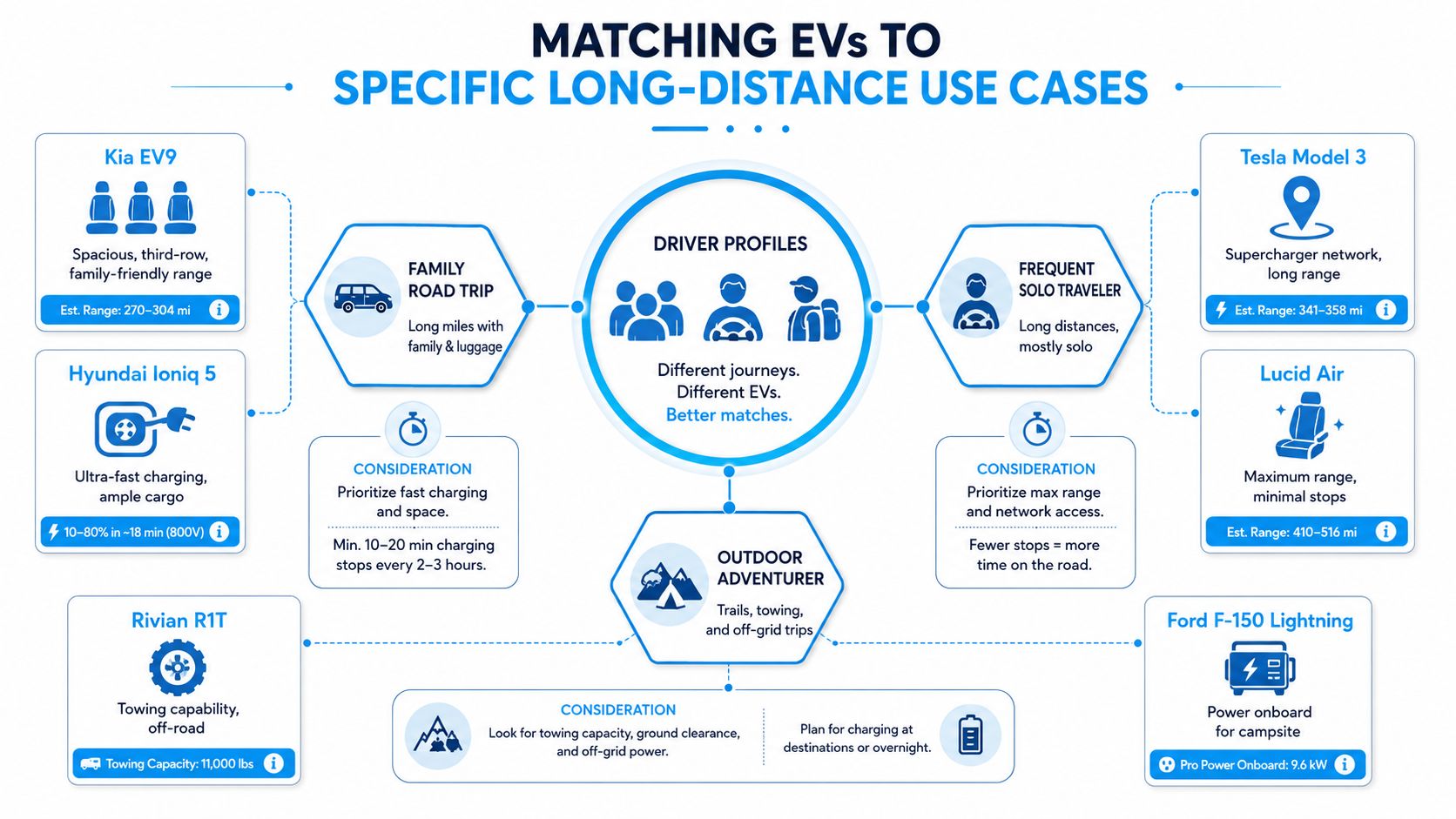
For family road trips, the Kia EV9 and Hyundai Ioniq 5 solve different problems. The EV9 offers three-row flexibility and interior space that makes long hours on the road easier to manage for everyone inside. The Ioniq 5 is more focused on fast charging and cargo flexibility, which matters more when a trip is built around short stops than when seat count is the priority.
Families should weigh charging behavior as heavily as battery size. A car that takes energy quickly during a meal break can matter more than a slightly larger rated range when the vehicle is carrying children, luggage, and the usual clutter that comes with a family departure.
Solo travelers can prioritize efficiency and route simplicity
Frequent solo travelers usually want the fewest stops and the least routing friction. The Tesla Model 3 remains a strong reference point because charging network access and route planning reduce uncertainty, while the Lucid Air makes the strongest case for minimal-stop travel when the buyer wants the longest practical range.
That choice depends on how much stop planning the driver will tolerate. A highway commuter who can charge at home and travels on predictable corridors may value the Tesla route ecosystem. A driver who wants to stretch each leg of the trip may prefer Lucid's range-first setup.
Towing, hauling, and outdoor use change the equation
The Rivian R1T and Ford F-150 Lightning fit a different category. They matter because road trips are not always light-luggage runs between two points. Some drivers tow, carry equipment, or need onboard power for camping and work.
Practical rule: If towing is part of the job, choose the vehicle for utility first and range second.
That trade-off becomes obvious in pickup form. A truck can be the right answer even when it is not the most efficient one. The deciding factor is whether the vehicle does the job the driver needs done.
Cold weather and speed expose weak efficiency
Cold-weather trips and steady high-speed highway use reveal weak efficiency quickly. Geotab notes that EV range is influenced by air temperature, driving habits, vehicle load, terrain, and charging patterns, and its analysis showed that EVs can perform differently in real-life conditions than their rated range suggests, according to Geotab. That matches what drivers see on winter trips and on loaded highway runs.
The implication is straightforward. If your use case includes winter driving, towing, or sustained high-speed cruising, shortlist cars with strong efficiency and a charging curve that holds up as the battery approaches the top of the window. For a closer look at why the stop itself matters more than the peak number, see this charging-speed guide.
The best match is always situational. Long-distance buyers who judge vehicles by the job they need done, not by a universal winner, make better choices.
How to Evaluate and Shortlist EVs for Your Road Trips
Start with the routes you drive, not the ones in brochure copy. A vehicle that looks perfect for a single cross-country outing can be awkward if your real pattern is repeated motorway runs, school pickups, or winter travel. The shortlist should begin with the route, then move to charging behavior, then to the vehicle itself.
Build the shortlist from the trip, not the badge
Use comparison tools that let you line up range, charging power, body type, and route fit in one view. The reason is simple. You're not comparing abstract products. You're comparing how each car behaves on the same roads, under the same stop pattern, with the same driver needs.
A good workflow looks like this:
- Define the longest routine route. That gives you the minimum range target.
- Check the charging window, not just the peak kW. A high peak means little if the curve falls away quickly.
- Verify highway efficiency with independent testing. Lab ratings are a baseline, not a promise.
- Match body style to use case. Sedan, SUV, and pickup solve different problems.
- Confirm charger compatibility on your route. Fast charging is only helpful if the right hardware is available.
If you want a deeper explanation of fast-charging behavior, this charging-speed guide is a helpful reference for understanding why the usable stop matters more than the peak headline.
Separate manufacturer claims from trip reality
A model page should never be the final word. Look for independent road tests, charging simulations, and comparisons that normalize range and charging performance. That's where patterns show up, especially across sedans and SUVs that may have similar official figures but very different highway behavior.
Good shortlist discipline: trust standardized data first, marketing copy last.
That approach reduces guesswork and makes the process repeatable. It also keeps you from overvaluing a single impressive number when what you really need is a car that arrives on time, stops briefly, and fits the way you travel.
The strongest shortlist is usually small. Two or three cars, matched against your routes, will reveal which one fits. Anything broader tends to hide the trade-offs that matter.
Situational Recommendations for Every Long-Distance Driver
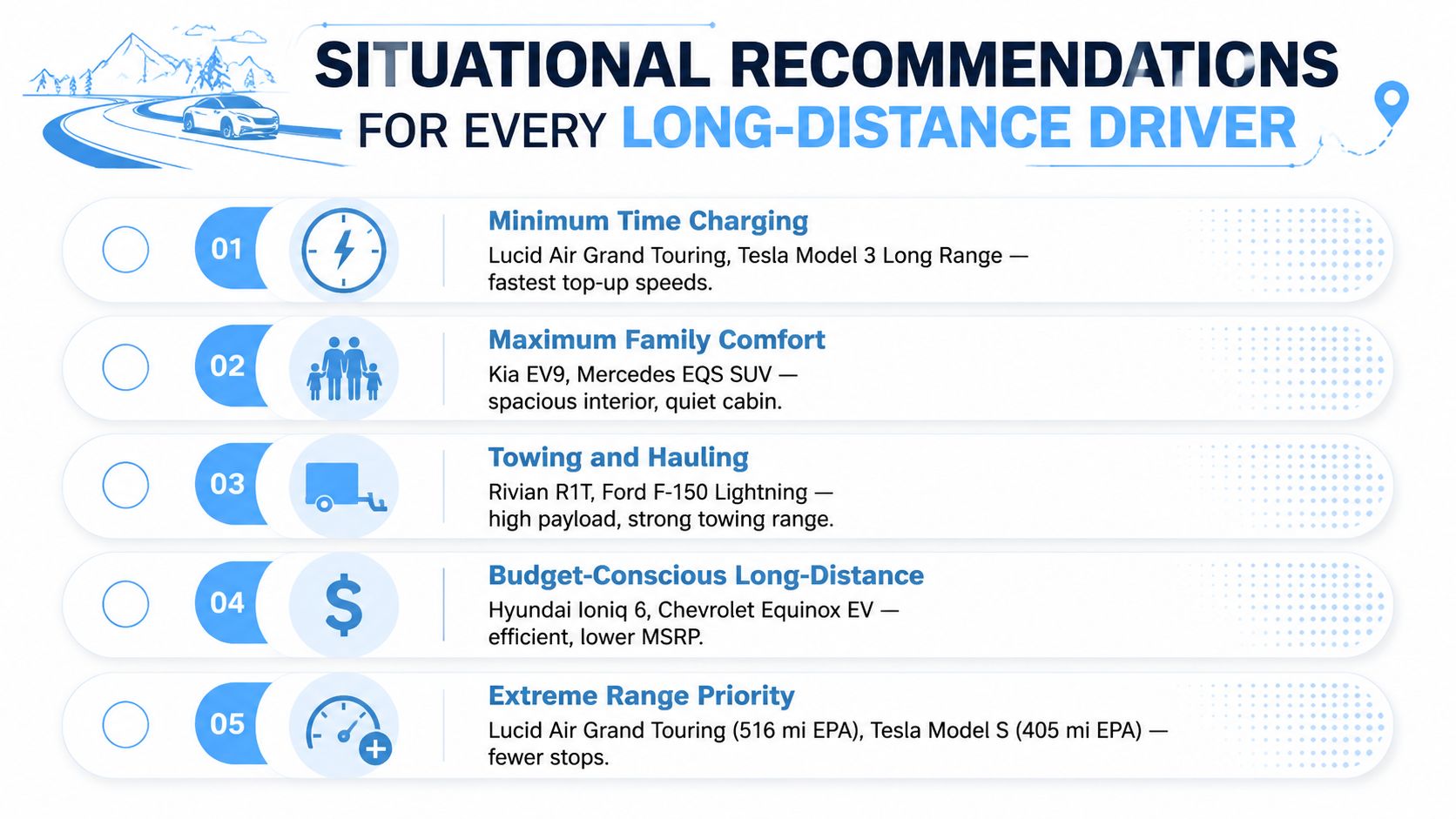
If your priority is minimum total trip time, the Lucid Air Grand Touring is hard to ignore because it pairs top-end range with the kind of road-trip performance that keeps stops infrequent. For drivers who care more about charging network convenience and a proven highway workflow, the Tesla Model 3 Long Range still belongs near the top of the list.
For family comfort, the Kia EV9 is the practical answer when you need three rows, while the Volvo EX90 makes sense for buyers who want a larger premium SUV with serious family duty. For towing and hauling, the Rivian R1T and Ford F-150 Lightning are the obvious utility-first picks because they solve a different problem than a sleek sedan.
If you want the best value per mile of range, the Tesla Model 3 Long Range and Mercedes CLA Electric stand out because they combine strong official range with a price point that keeps them within reach of more buyers. If your only goal is extreme range priority, the Lucid Air Grand Touring and Tesla Model S remain the cleanest answers because they minimize the number of charging stops on long corridors.
The right choice is the one that matches your travel pattern, not the one that wins a spec-sheet contest. Before you buy, check the route you drive most often, the charger access you have, and the kind of vehicle you'll be happiest living with on day 1 and day 200.
If you're narrowing down the best EV for long distance driving, start with the EVs with the longest range, then use EV Stats comparisons and charging context to separate lab numbers from highway reality. Visit EV Stats to compare models side by side and shortlist the EV that fits your routes, not just the one with the loudest headline figure.