

The 2025 Porsche Taycan Turbo GT currently sets the benchmark for the fastest EV charge, averaging 213 kW from 10% to 90% state of charge, peaking at 317 kW, and completing the session in 24 minutes. That average matters more than the peak because drivers spend the whole stop on the charging curve, not at the brief top of it. The catalog ranking by peak DC lives on the fastest charging EVs page.
| Model | Independent test metric | What stands out |
|---|---|---|
| 2025 Porsche Taycan Turbo GT | 213 kW average, 317 kW peak, 24 minutes from 10% to 90% | Best current benchmark for sustained session speed |
| 2024 Chevy Silverado EV | 198 kW average | Previously led this test series before being displaced |
| Lucid Air Grand Touring | 208 miles in 20 minutes | Strong long-stop recovery on an ultra-fast platform |
| Tesla Model S Plaid | 193 miles in 20 minutes | Fast real-world energy recovery, not just a headline peak |
Table of Contents
- What the Fastest EV Charge Looks Like in 2026
- Charging Metrics Every Buyer Should Understand
- The Fastest Charging EVs You Can Buy Right Now
- How a Real Charging Curve Behaves Over a Session
- Why the Charger on the Wall Sets the Speed Limit
- Matching Charging Speed to Real Driving Use Cases
- Decision Rules for Choosing a Fast-Charging EV
- Frequently Asked Questions About the Fastest EV Charge
What the Fastest EV Charge Looks Like in 2026
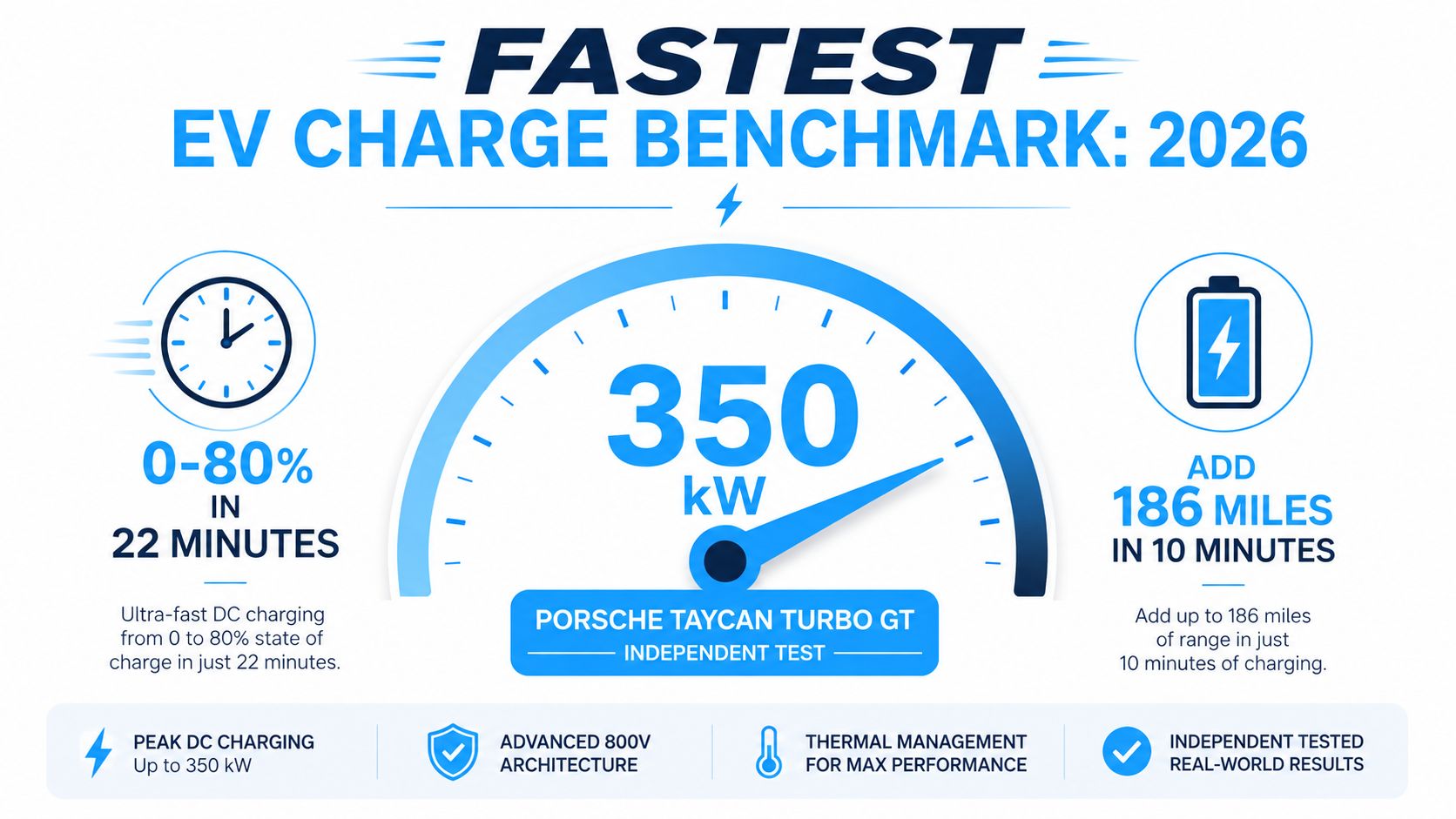
The current benchmark is the 2025 Porsche Taycan Turbo GT, which averaged 213 kW from 10% to 90%, peaked at 317 kW, and finished the recharge in 24 minutes in independent testing. That matters because a short-lived peak can look dramatic on a spec sheet while the average charging power is what cuts stop time on a road trip. Car and Driver's test report makes the same point by showing how the Taycan Turbo GT displaced the 2024 Chevy Silverado EV, which averaged 198 kW in the same test series.
Why the average beats the headline
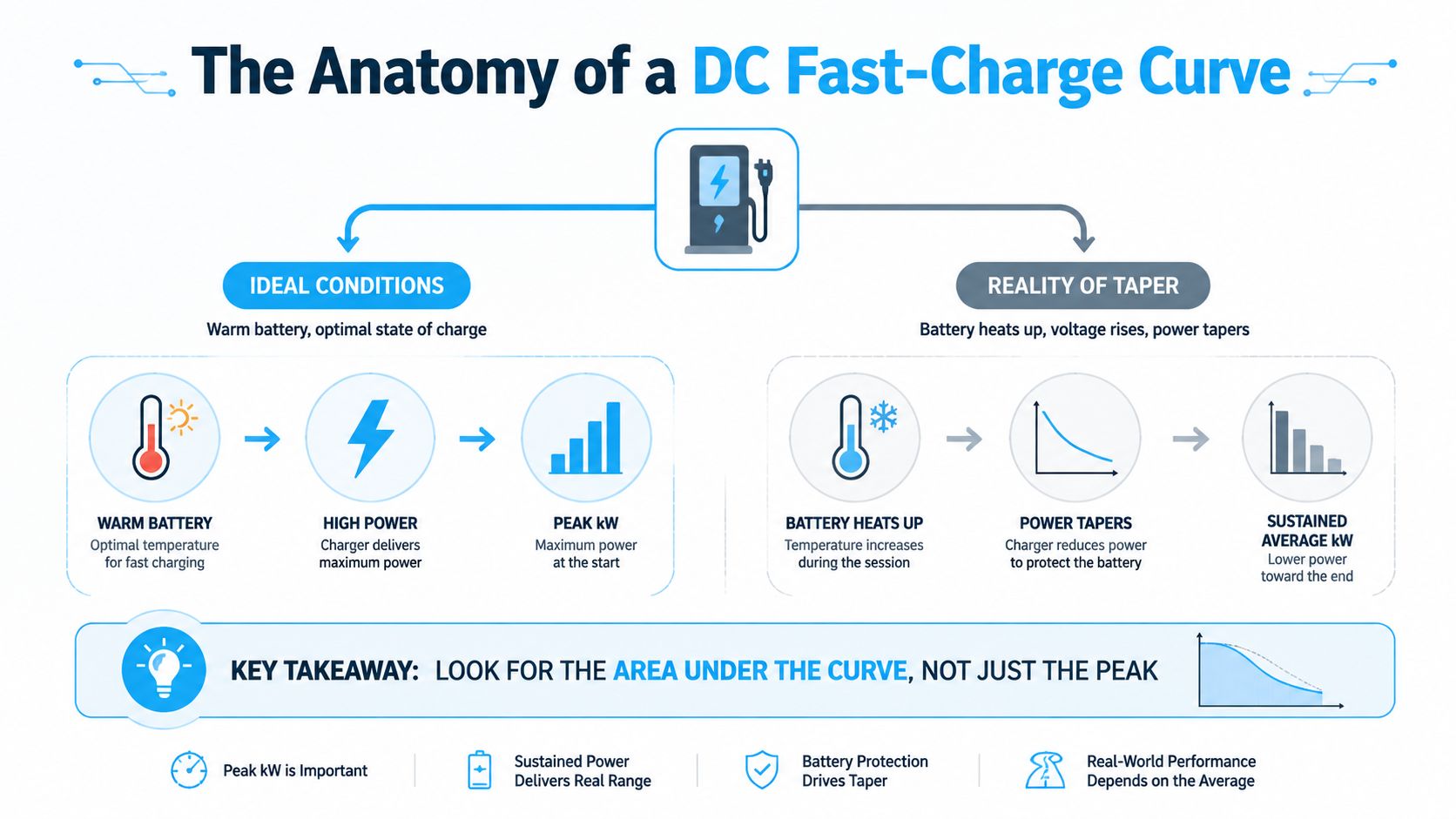
A charging session is a curve, not a single spike. The car starts high, then the battery management system eases power down as the pack fills and protects the cells. For buyers, that means the number that matters most is the power the car can hold for long enough to add useful range, not the brief maximum it flashes at the start.
Practical rule: if you only remember one thing, remember this, average session power tells you more about travel time than a peak kW figure ever will.
The market's top end has moved fast enough that 200+ kW average charging is now part of the conversation for elite vehicles, not an outlier. That shift changes trip planning, because the best cars now recover enough energy for meaningful highway miles in roughly the time most drivers would spend on a meal break. The independent test benchmark and recent ultra-fast session results for the Lucid Air Grand Touring and Tesla Model S Plaid show that the front of the pack is now judged by sustained power, not just a marketing number.
A strong peak reading still has value, but only if you know where it sits in the session. If it appears for a brief moment, it can flatter a car that does not spend much time charging there. The better question is whether the curve stays high enough long enough to matter, and whether the charger can supply that power without drama.
For a fuller explanation of how charging power rises, tapers, and changes with state of charge, see how EV charging works. That context helps separate a genuine fast-charging setup from a headline number that looks better than it behaves on the road.
Charging Metrics Every Buyer Should Understand
Peak power, average power, and the window that matters
Peak charging power is the highest kW value a car reaches during a session. It is the easiest number to market, and the easiest one to misread. A vehicle can touch a big peak for a short moment and still spend most of the stop far below that level.
Average charging power is the better buying metric because it reflects the whole session. That is why comparisons built on 10–80% time, average charge rate, and curve behavior are more useful than a single peak figure. The testing approach discussed in Car and Driver's testing framework discussion shows why analysts keep returning to those measures, and why session-level results are easier to trust than headline numbers alone.
The practical comparison buyers should use
| Metric | What it measures | Why it matters |
|---|---|---|
| Peak charging power | The highest momentary kW a car reaches | Useful for spotting capability, but it can be brief |
| Average charging power | The sustained power across the session | Better proxy for real stop duration |
| 10–80% time | How long it takes to add most usable road-trip energy | Common comparison window for DC fast charging |
| Time to add 100 miles | How quickly a car restores range | Easier to connect to a real trip plan |
| Charging curve | How power changes as state of charge rises | Explains why two cars with the same peak can charge differently |
These metrics only make sense in context. A car that briefly shows 300 kW can still lose to one that holds near 220 kW for much longer, because the second car spends more of the stop at useful speed. The charger matters too. A strong onboard curve does not help if the site cannot deliver the power, if the battery is cold, or if the pack is already near the part of the curve where taper begins. For a plain-language overview of charging levels, see EV charging levels explained.
A good ranking answers a simple question: how much usable energy does the car add during the time a driver is stopped? That is why sustained average power, charger compatibility, battery temperature, and state of charge matter more than the largest number in the headline.
The Fastest Charging EVs You Can Buy Right Now
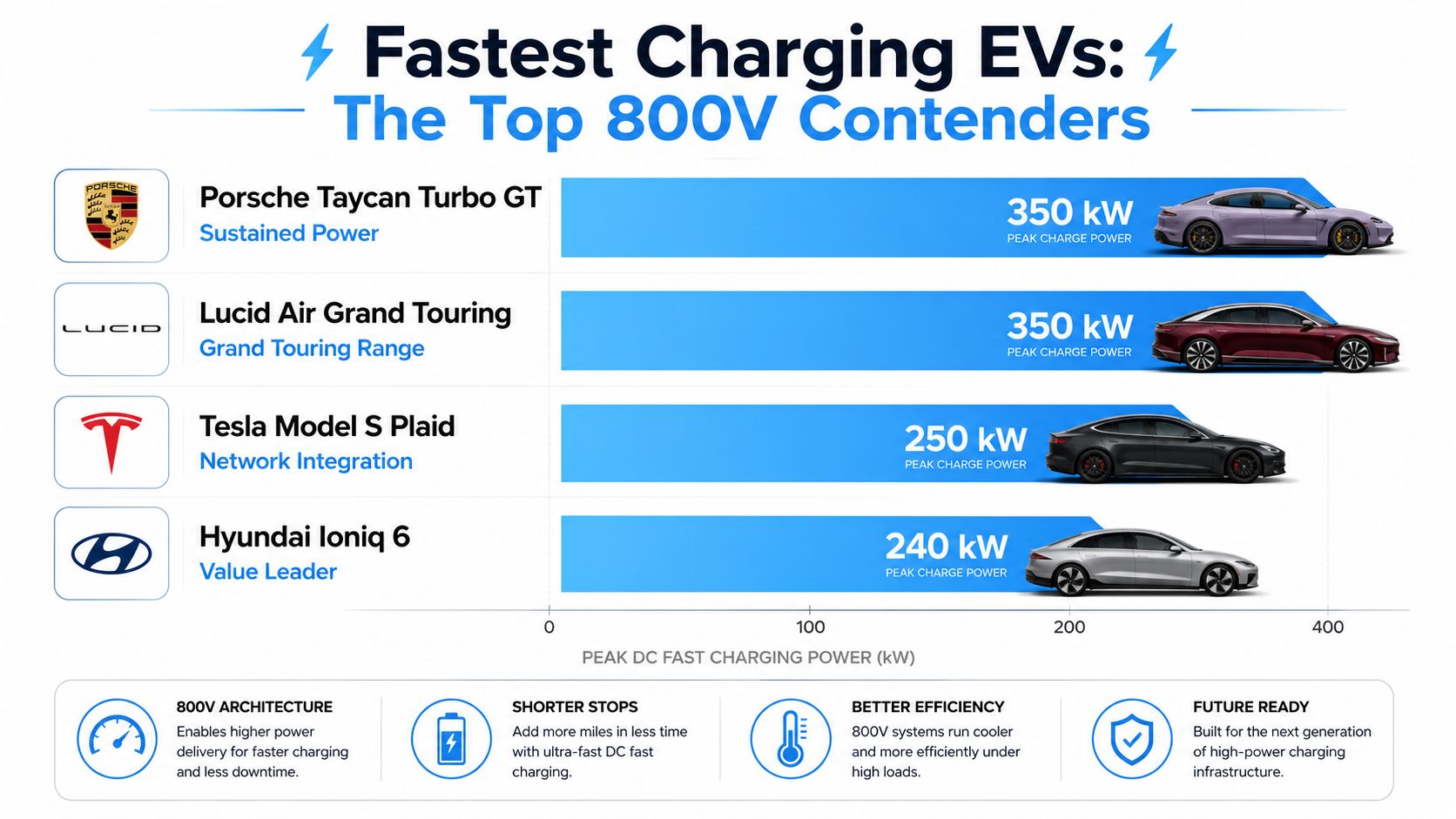
The headline number can hide more than it reveals. In independent benchmark testing, the Porsche Taycan Turbo GT has led on average charging power, while the Lucid Air Grand Touring and Tesla Model S Plaid have also posted top-tier session results that matter more to a real driver than a short-lived peak. Car and Driver's benchmark coverage shows why the best charging EV is not always the one with the biggest kW figure on a spec sheet.
Where the leaders separate
The Porsche Taycan Turbo GT is the clearest answer if the question is which EV charges fastest over an actual stop. Its 213 kW average from 10% to 90% and 317 kW peak point to a curve that stays strong for longer, which matters more than a brief spike at the start of the session. That is also why it can outrun a heavy-duty vehicle like the 2024 Chevy Silverado EV, even though pickup buyers often expect sheer size and battery capacity to dominate the result.
The Lucid Air Grand Touring belongs in the same discussion because its verified test result showed 208 miles added in 20 minutes, which is the kind of number that maps well to a real roadside stop. The Tesla Model S Plaid is close behind with 193 miles added in 20 minutes, so its session performance remains highly competitive even though its charging hardware and network advantages are different from Lucid's. For buyers comparing cars on a trip plan, that gap is easier to understand than a peak-kW comparison.
Why architecture changes the ranking
800V cars usually hold high power more comfortably than many 400V designs, so they keep appearing near the top of independent charts. That matters because a charging session is not just a race to the first peak, it is a test of how long the car can stay in a useful power band before taper begins.
The Hyundai Ioniq 6 is a useful counterpoint because it shows how the result changes with the test method, the charger, and the state of charge window. One car may look strongest on a peak chart, while another looks better once the comparison focuses on energy added during the time most drivers are stopped. If you want a broader framework for those tradeoffs, how to charge faster explains the hardware and battery factors that shape the result.
The shortlist is not about the highest number winning. It is about which vehicle keeps enough power on the curve to shorten the stop on the route you drive, and whether the charger site can support that car at the right battery temperature and state of charge.
How a Real Charging Curve Behaves Over a Session
Why the strongest power shows up early
A DC fast-charge session usually starts at its strongest when the battery is low and warm enough to accept energy quickly. As the state of charge rises, the vehicle starts tapering power to protect the pack and manage heat. That taper is not a flaw, it's how modern EV battery systems keep charging stable.
Battery temperature matters just as much. A cold pack resists high power until it's conditioned, while an overheated pack will throttle to reduce stress on the cells. That's why the same vehicle can deliver very different numbers on different days, even at the same charger.
Reading the curve like an analyst
The most important visual cue is not the peak, it's the shape. A steep early spike that collapses fast can make a car look impressive in a screenshot while delivering a mediocre real stop. A flatter curve often produces a better trip experience because the car stays in a useful power band longer.
The cleanest way to think about it is simple. Look for the area under the curve, not just the top of it. If you want the mechanics behind that behavior, the charging explanation at this EV charging guide gives the right background without the marketing gloss.
Why the Charger on the Wall Sets the Speed Limit
The station caps the session
An EV cannot charge faster than the station can supply. A 50 kW charger will never deliver 100 kW to a capable vehicle, no matter how advanced the car is. That limit is where many “fastest EV charge” comparisons go wrong, because the charger is part of the performance equation too.
Public hardware now spans multiple tiers, from 50 kW units to 150 kW, 350 kW, 400 kW, and emerging 480 kW equipment in some markets. Those figures only matter when the vehicle, connector, and site can all support them, and when the grid connection can hold output without sagging. The infrastructure side has expanded quickly, as reflected in the IEA's charging report, which says global fast chargers reached 2 million in 2024 and ultra-fast chargers of 150 kW or above grew by over 50% that year.
Availability is now part of speed
The same report says more than 1.3 million public charging points were added globally in 2024, an increase of more than 30% year over year, and that China accounted for 80% of global growth in fast-charging deployment, with its fast-charger count rising from 1.2 million in 2023 to 1.6 million in 2024. Scale matters because the strongest charging curve means little if the right hardware is not available when a driver needs it.
In the U.S., charging access is scaling too. Industry reporting shows 18,041 new DC fast-charging ports were deployed in 2025, total U.S. DCFC ports surpassed 70,000 by the end of 2025, and public fast-charging usage reached an estimated 141 million sessions in 2025, up about 30% year over year. Those figures point to a simple conclusion, the fastest EV only feels fast if the station can support it. For the broader context on hardware tiers and connector limits, EV charging levels is the useful companion read.
Matching Charging Speed to Real Driving Use Cases
Long trips, apartments, fleets, and weekend drivers
A long-distance commuter or road-trip-heavy household gets the clearest benefit from a car that holds strong DC power for a meaningful stretch of the session. For that buyer, the ability to add a useful amount of range quickly matters more than a low sticker on a spec sheet. An 800V EV with strong sustained performance can turn a highway stop into a short pause instead of a long wait.
An urban apartment dweller is different. If most charging happens overnight at work, in a garage, or at slower public stations, the edge from ultra-fast DC charging shrinks. In that case, convenience, connector access, and home or workplace charging often matter more than the absolute top-end number.
Bottom line: the fastest EV charge only pays off when your driving pattern actually sends you to DC fast chargers often.
Why fleets and routine drivers think differently
Fleet buyers usually care about repeatability. A delivery route or service schedule values predictable energy cost and dependable access more than headline peak power, especially when vehicles return to base and can recharge on AC hardware between shifts. For that reason, the guidance on how to charge faster is most useful when it's applied to route discipline, charger choice, and state-of-charge planning rather than just a spec race.
The cleanest way to judge usefulness is to ask where the car spends its life. If it lives on a commute with occasional road trips, fast DC charging is a nice buffer. If it lives on long-haul duty or repeated intercity travel, the difference between a short and a strong curve becomes part of the ownership calculation.
Decision Rules for Choosing a Fast-Charging EV
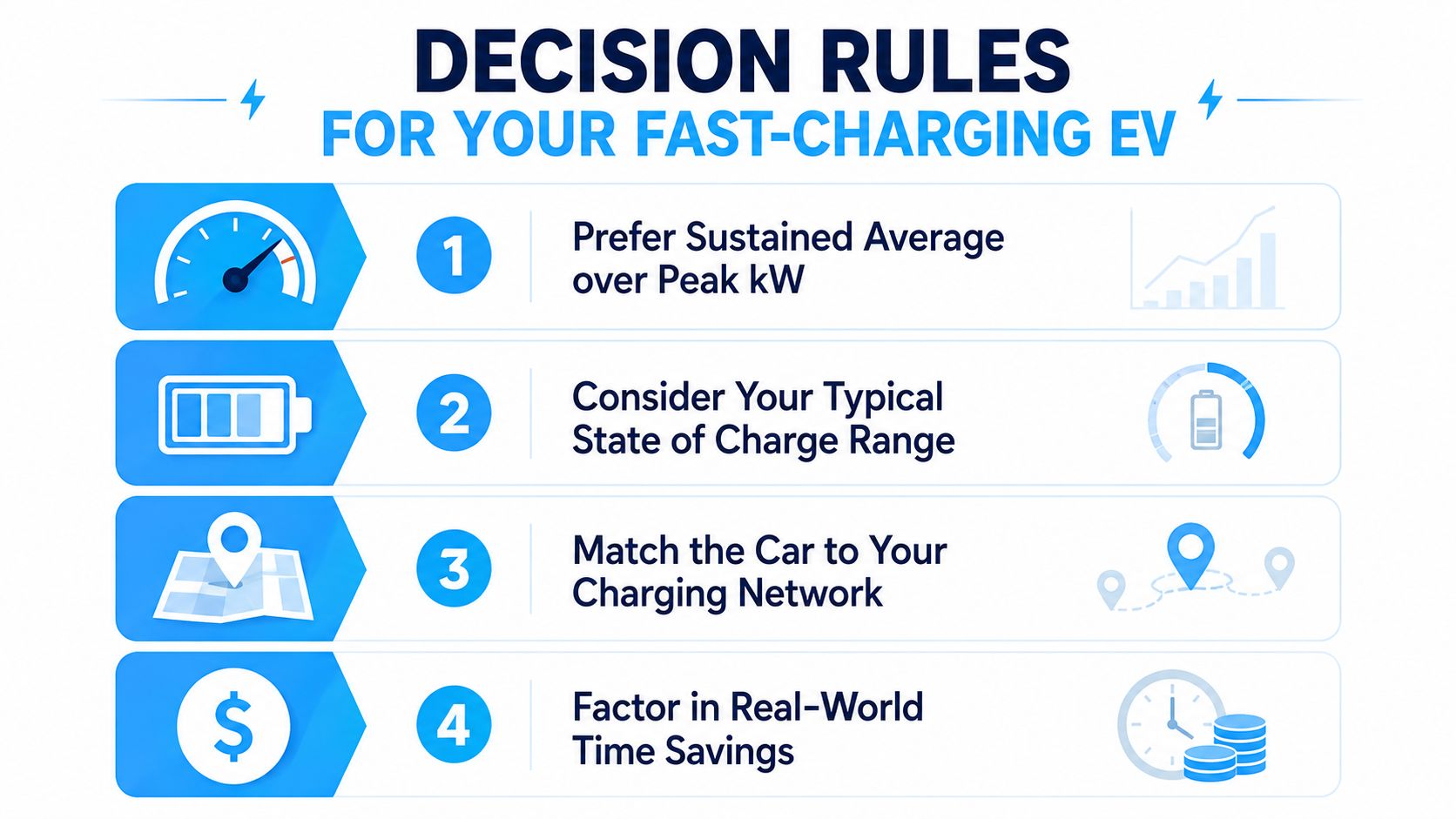
The right choice is usually not the car with the biggest peak number. It's the car that keeps enough power for long enough, on the chargers you'll use, on the routes you drive.
- Prefer sustained average over peak kW. The session average tells you more about real stop time than a brief spike.
- Check your charging network first. A fast car on weak hardware is still limited by the station.
- Match speed to your state-of-charge habits. If you routinely plug in at high battery levels, you won't see the same benefit as a driver who arrives low.
- Pay for speed only when you'll use it often. For many drivers, efficiency plus reliable access beats the most aggressive charging curve.
Those rules hold together because charging speed is a system, not a badge. Car, charger, battery temperature, and state of charge all shape the result, and the best purchase is the one that fits that whole system, not just one number in isolation.
Frequently Asked Questions About the Fastest EV Charge
Why does cold weather slow charging even on fast EVs? Because the battery must be warm enough to accept high power, and cold packs resist fast intake until they're conditioned. That's why winter stops often look worse than summer stops, even on capable 800V vehicles.
Does home charging make peak DC speed less important? Yes, for many drivers. If most energy comes from overnight AC charging, DC speed matters mainly for occasional long trips.
What happens when a 400 kW-capable EV uses a 350 kW station? The charger becomes the ceiling. The car can only draw up to the station's rated output, so the session tops out below the vehicle's theoretical maximum.
Do Tesla Superchargers always match 800V-native networks on peak power? Not necessarily. The actual session depends on the station's hardware, the vehicle's acceptance, and the charging curve, not the brand name on the pedestal.
If you want the charging numbers behind more EVs, not just the marketing headlines, EV Stats gives you side-by-side specs, independent-test context, and comparison tools built for buyers who care about real session speed. Use it to check how a specific model performs against the chargers on your route before you decide what belongs in your driveway.