

The common advice is simple: choose the electric SUV with the biggest official range. That advice is increasingly unreliable. Price-first shoppers should start from the cheapest electric SUVs ranking, not the longest-range gallery. A vehicle with the longest EPA or WLTP figure may still take longer to complete a highway journey than a slightly shorter-range SUV with better efficiency and faster charging.
The best electric SUV range is therefore not one number. It's a combination of certified range, motorway efficiency, cold-weather resilience, charging time, passenger capacity, and access to dependable charging infrastructure. In 2026, the market's most useful comparison is no longer “how far can it go on paper?” but “how much time does it save across the journeys I make?”
| Model | EPA Range | WLTP Range | Long-trip interpretation |
|---|---|---|---|
| Lucid Gravity Grand Touring | Up to 450 miles | Not listed in the supplied data | Exceptional U.S. headline range |
| Cadillac Escalade IQ and IQL | Up to 460 miles | Not listed in the supplied data | Among the longest EPA-rated electric SUVs |
| Rivian R1S | Around 410 miles | Not listed in the supplied data | Strong range in a large SUV format |
| BMW iX xDrive60 | 364 miles | About 600 km | Strong U.S. EPA position |
| Tesla Model X | 348 miles | Not listed in the supplied data | Long-range luxury alternative |
| Hyundai Ioniq 9 | 335 miles | Not listed in the supplied data | Three-row SUV with a competitive EPA figure |
| Tesla Model Y Long Range | Around 330 miles | About 565 km | Efficiency and charging access matter |
| Kia EV9 RWD Long Range | Not listed in the supplied data | About 560 km | Three-row family SUV with strong official range |
| Volvo ES90 | Not listed in the supplied data | 650 km | European range leader in the cited ranking |
| Audi Q6 e-tron Performance | Not listed in the supplied data | About 625 km | Strong European premium option |
The table mixes EPA and WLTP figures because buyers and reviewers often do the same. That's precisely where mistakes begin. The standards measure range differently, and official ratings still say less about a cold motorway journey than many shoppers assume.
Table of Contents
- Why Headline Range Numbers Can Be Misleading
- Understanding WLTP vs EPA Range Standards
- Top Long-Range Electric SUVs of 2026
- The Role of Charging Speed in Long-Trip Efficiency
- Real-World Variables That Reduce Usable Range
- How to Choose the Right Electric SUV for Your Needs
- Tools for Deeper EV Research and Comparison
Why Headline Range Numbers Can Be Misleading
The electric SUV with the highest official range may not be the quickest choice for a long road trip. Certified tests provide a consistent comparison, yet they cannot reproduce every condition affecting an EV on the motorway. Sustained speed, cold weather, cabin heating, passengers, luggage, elevation changes, and charger availability can all reduce usable distance.
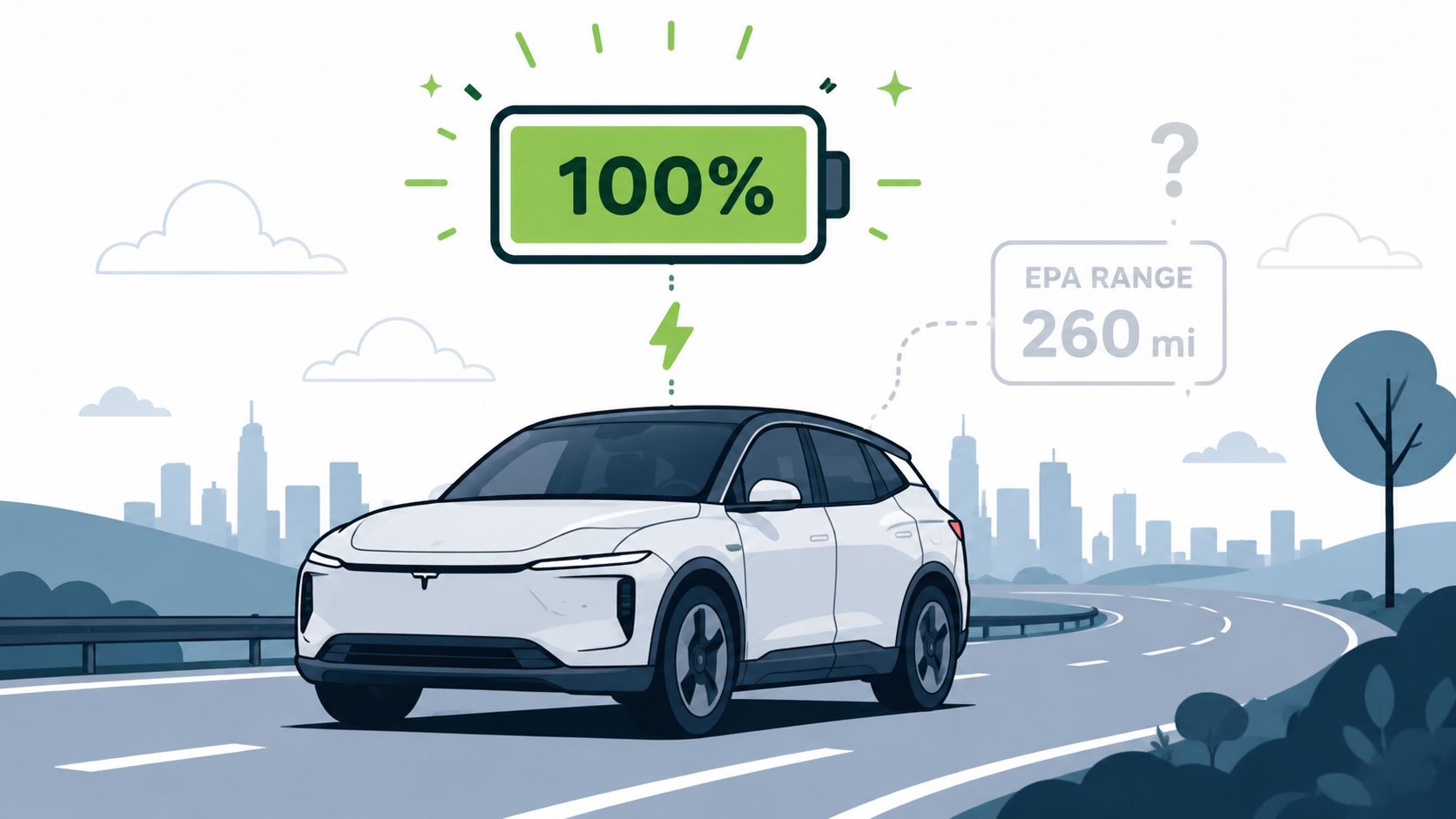
Battery capacity alone is an incomplete measure. A larger pack can add mass, while an aerodynamic body and efficient drivetrain may travel farther with less stored energy. A serious range comparison therefore needs to examine energy consumption and charging behaviour, alongside the official figure.
Independent testing shows how quickly headline range can diverge from motorway performance. The Tesla Model Y Long Range has been reported at roughly 295 miles in a 70 mph highway test, compared with an EPA range of around 330 miles, according to the P3 Charging Index 2024. The gap does not make the Model Y unsuitable for travel. It provides a more useful planning reference for drivers who spend much of their time at highway speeds.
Why charging changes the calculation
A longer starting range can reduce the number of stops, but stop duration determines how much time the trip takes. The same independent comparison reports roughly 27 minutes for a 10–80% DC fast-charge session for the Tesla Model Y Long Range. Hyundai Ioniq 5 and Kia EV6 models have shorter EPA ranges of about 303 to 310 miles, yet can complete that charging window in roughly 18 minutes and add more miles during a 15-minute session.
Practical rule: Compare the time needed to recover the next useful leg of a journey, not only the distance available after a full charge.
Winter testing makes the official figure less dependable still. One 2026 test set reported average losses of around 20 to 30%, with some vehicles performing worse, according to DrivingEco's real-world electric SUV coverage. Drivers who regularly combine winter weather with fast roads should use the certified number for like-for-like comparison, then examine highway efficiency and charging performance before deciding which SUV saves the most time.
Understanding WLTP vs EPA Range Standards
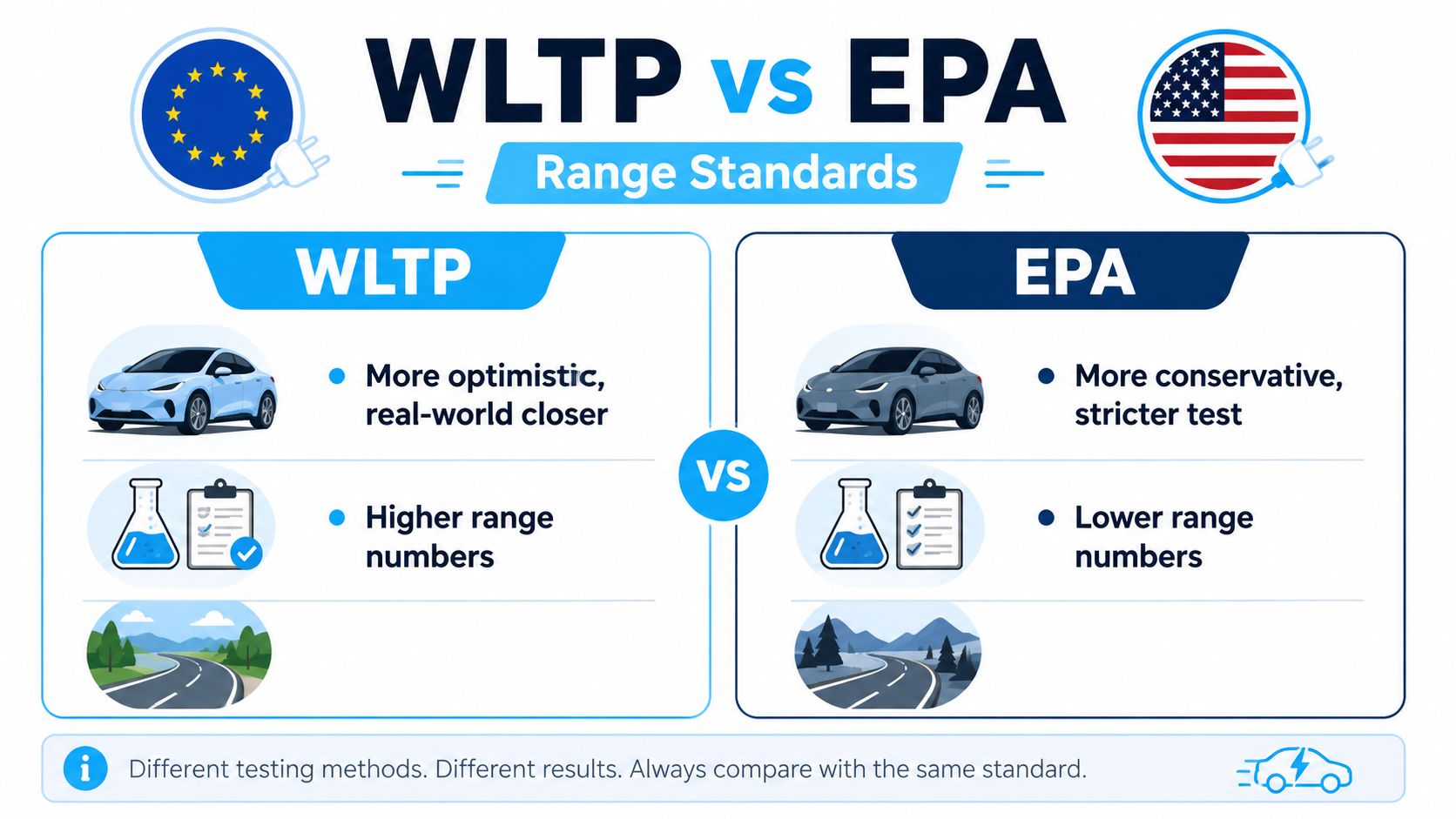
WLTP and EPA figures aren't interchangeable. European rankings generally use WLTP, while U.S. comparisons typically use EPA, and the different test cycles can place the same broad class of vehicle on very different-looking leaderboards.
WLTP figures are generally higher and are often described as more optimistic. EPA figures are typically more conservative for U.S. buyers. That doesn't mean one standard is useless. It means a driver should compare vehicles within the same certification system before drawing conclusions across markets.
How the leaderboards shift
A 2026 European ranking placed the Volvo ES90 at 650 km WLTP, the Audi Q6 e-tron Performance at about 625 km, the BMW iX xDrive45 at about 600 km, and the Tesla Model Y Long Range at about 565 km, according to Highmotor's 2026 electric SUV ranking. The same ranking listed the Kia EV9 RWD Long Range at about 560 km WLTP, showing that a three-row family SUV can sit close to premium models on the official European scale.
The U.S. picture looks different. The same cited market comparison reported the BMW iX xDrive60 at 364 miles EPA, the Tesla Model X at 348 miles, and the Hyundai Ioniq 9 at 335 miles. These figures shouldn't be converted casually into a direct global ranking because certification conditions, vehicle configurations, and market specifications can differ.
The practical adjustment is straightforward:
- Use EPA against EPA. For U.S. shopping, EPA is the more relevant baseline for comparing local vehicles.
- Use WLTP against WLTP. European buyers should keep the comparison within the same standard.
- Expect real driving to vary. Speed, temperature, terrain, load, and climate control can all move the result away from certification.
- Check the configuration. Drivetrain, wheel choice, seating layout, and battery version can change a model's rating.
A deeper electric car range comparison can help organize figures from different markets, but the final decision still requires attention to the standard used for the vehicle you'll buy.
The following video provides useful visual context for how EV range testing is discussed across markets.
Top Long-Range Electric SUVs of 2026
The 2026 market has separated into two groups. At the top, a few premium SUVs have crossed the 400-mile EPA barrier, a threshold that was previously unusual in the category. Below them, mainstream and premium alternatives offer substantial range, but their road-trip value depends more heavily on efficiency, charging speed, and network access.
The Lucid Gravity Grand Touring is the clearest segment outlier. Independent rankings report up to 450 miles of EPA-estimated range, while other coverage places the model around 435 to 450 miles depending on configuration, as reported by Car and Driver's electric SUV rankings. The Cadillac Escalade IQ and IQL have been listed at up to 460 miles EPA, placing both among the longest-range electric SUVs sold in major markets, according to Car and Driver's range ranking.
2026 Electric SUV Range Leaders
The supplied verified data doesn't provide consistent battery capacities or model-by-model WLTP figures for every vehicle below. Rather than fill those gaps with estimates, the table shows only the figures supported by the available sources.
| Model | EPA Range (mi) | WLTP Range (km) | Battery (kWh) |
|---|---|---|---|
| Lucid Gravity Grand Touring | Up to 450 | Not provided | Not provided |
| Cadillac Escalade IQ | Up to 460 | Not provided | Not provided |
| Cadillac Escalade IQL | Up to 460 | Not provided | Not provided |
| Rivian R1S | Around 410 | Not provided | Not provided |
| Tesla Model Y Long Range | Around 330 | About 565 | Not provided |
| BMW iX xDrive60 | 364 | Not provided | Not provided |
| Tesla Model X | 348 | Not provided | Not provided |
| Hyundai Ioniq 9 | 335 | Not provided | Not provided |
| Volvo ES90 | Not provided | 650 | Not provided |
| Audi Q6 e-tron Performance | Not provided | About 625 | Not provided |
| BMW iX xDrive45 | Not provided | About 600 | Not provided |
| Kia EV9 RWD Long Range | Not provided | About 560 | Not provided |
The Rivian R1S, at around 410 miles EPA, demonstrates that strong range is available in a large, practical SUV, though it doesn't match the extreme ratings of the Lucid and Cadillac models. The Tesla Model Y Long Range sits around 330 miles EPA, which looks modest beside the premium leaders, but its efficiency and charging ecosystem can matter more than its place in a static leaderboard.
The market benchmark has moved into the 400-plus-mile class, but that benchmark still belongs mainly to the upper end of the segment.
European buyers face a different shortlist. The Volvo ES90's 650 km WLTP leads the cited European ranking, while the Audi Q6 e-tron Performance and BMW iX xDrive45 follow closely. The Kia EV9 is the important practical counterexample. Its about 560 km WLTP rating shows that a three-row family SUV can compete with luxury vehicles on official range, even though its larger body and passenger-focused design raise different efficiency questions.
Battery capacity alone can't explain the hierarchy. Aerodynamics, motor efficiency, tire selection, curb weight, drivetrain configuration, and software all influence how far an SUV travels. Buyers should treat the table as a first filter, then use highway-test results and charging data to decide whether the additional range is worth the vehicle's size, price, and ownership trade-offs.
The Role of Charging Speed in Long-Trip Efficiency
Long-trip efficiency is not just about how far an SUV can go before stopping. It is also about how quickly it can add usable miles and rejoin the route. That second part is easy to ignore because range tables are simpler than full trip-time comparisons.
The gap shows up clearly in fast-charging data. The Tesla Model Y Long Range needs roughly 27 minutes for 10–80% DC fast charging, while the Hyundai Ioniq 5 and Kia EV6 can complete similar 10–80% sessions in about 18 minutes and add more miles in 15 minutes, as shown in P3 Charging Index data discussed earlier. A longer highway range still matters, but a slower charging curve can erase part of that advantage on a road trip.
Why an 800V SUV can be the faster choice
An 800V system can support higher charging power and shorten the time needed to add energy, if the charger and battery are compatible. That matters most on repeated long drives, where the car may need several short stops instead of a single overnight recharge.
The arithmetic is straightforward. A longer-range SUV may leave home with more reserve, but a shorter-range model that restores distance quickly during a brief break can reach the destination sooner. The result depends on route length, starting state of charge, charger spacing, battery temperature, and the power the station delivers.
A separate 2026 ranking points in the same direction. The Zeekr 7X Long Range is described as pairing 615 km WLTP with 480 kW peak charging, while the BMW iX3 Neue Klasse is cited at up to 800 km WLTP, according to DrivingEco's range and charging ranking. Those figures do not prove which SUV wins a specific trip, but they show why range and charging speed now need to be evaluated together.
A better road-trip metric
Peak range alone is an incomplete filter. For long trips, buyers should compare four things:
- Highway distance: how far the SUV goes at the speed you use.
- Charging window: how long it takes to move from a low travel state to a practical departure state.
- Energy recovery: how many miles the SUV adds during a short stop.
- Station compatibility: whether the route's chargers can deliver the power the vehicle expects.
A guide to EV charging speed helps decode peak-power claims, but peak power is only part of the story. Charging curves, battery temperature, charger conditions, and state of charge determine how much of that advertised capability a road trip really uses.
Real-World Variables That Reduce Usable Range
The official range figure is a controlled-test result, not a motorway promise. Sustained highway speed increases aerodynamic resistance, and large SUVs pay a greater energy penalty because they move more mass and air. As noted earlier, the Model Y Long Range's highway result illustrates the difference between certification and actual travel conditions without repeating the full comparison.
Weather and cabin demand
Cold weather reduces usable range through two mechanisms. The battery operates less efficiently, while heating the cabin consumes additional energy. A 2026 winter-test set reported average losses around 20 to 30%, with some models declining by more, according to DrivingEco's real-world range analysis.
Winter highway planning therefore needs more margin than a mild-weather commute. Buyers in cold climates should check whether the SUV supports battery preconditioning, maintains reasonable efficiency at low temperatures, and offers dependable charging alternatives along the route. A vehicle that arrives with a warmer battery may also spend less time charging, linking seasonal range performance directly to trip duration.
Mass, cargo, and body design
Passengers and luggage increase rolling and energy demands. Roof equipment and towing can add aerodynamic drag, often creating a larger penalty at highway speed than their weight alone suggests. Three-row SUVs face a difficult efficiency trade-off because their space and utility require more material and a larger body.
The Kia EV9's position in European rankings, at about 560 km WLTP, shows how competitive three-row SUVs have become on official figures. That number still cannot be treated as guaranteed motorway distance, particularly with a full passenger load or roof-mounted equipment.
Efficiency can identify a different winner from the WLTP leaderboard. Coverage cited by DrivingEco notes that the Mercedes EQS SUV can lead on WLTP, while the Tesla Model Y Long Range can achieve a stronger km/kWh ratio in real use. A more efficient or aerodynamic SUV may therefore preserve more usable distance, even when its battery or official range appears less impressive.
Use electric vehicle efficiency guidance to assess consumption instead of treating range as an isolated specification. Begin with tested highway behaviour, then adjust for cold weather, speed, terrain, passengers, cargo, and towing. The practical comparison is the distance recovered per charging stop, not the largest figure printed in a brochure.
How to Choose the Right Electric SUV for Your Needs
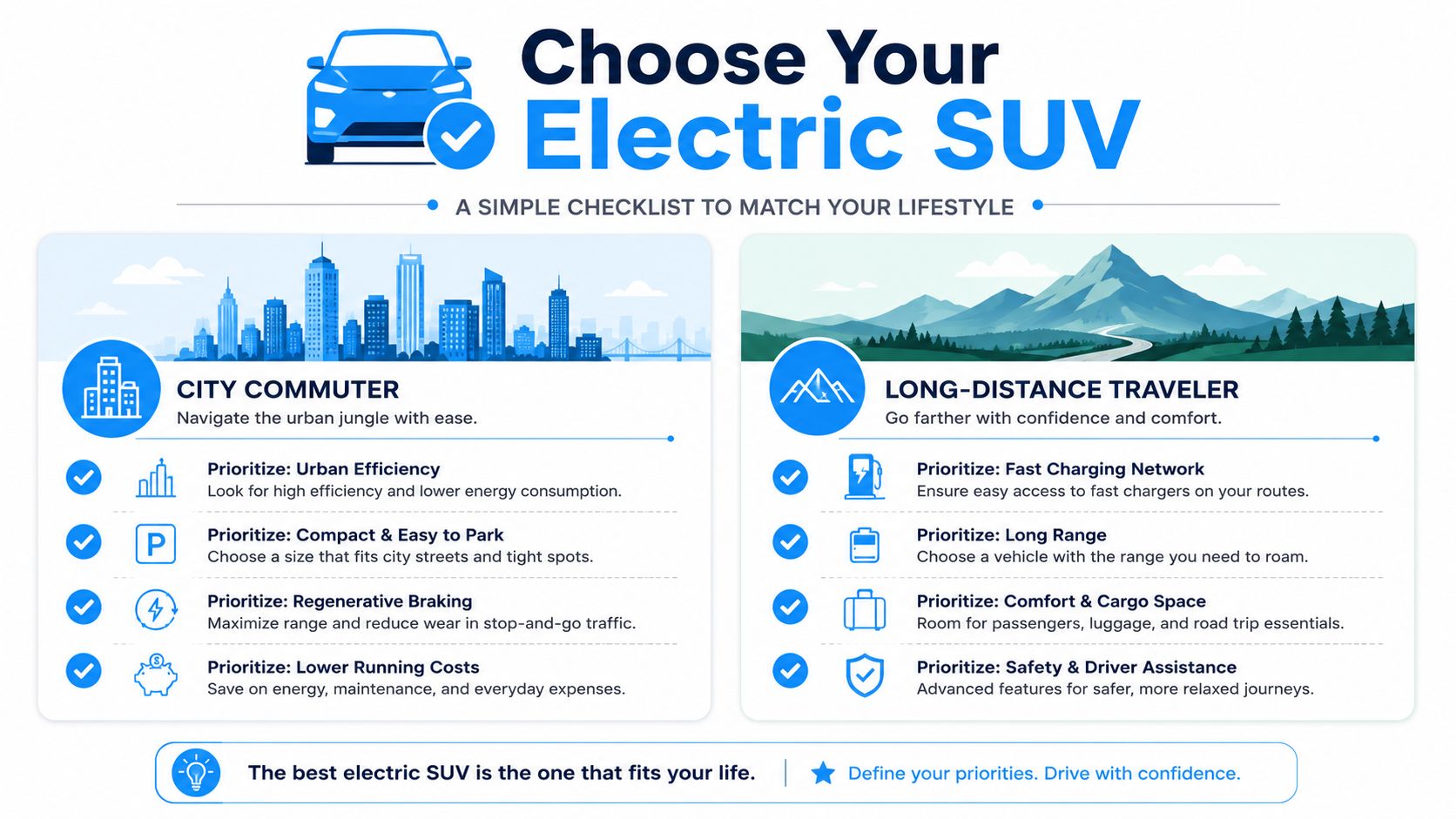
The right SUV depends on the shape of your driving, not the top position on a range leaderboard. A city commuter, a family crossing the country, and a driver towing equipment may all define “best range” differently.
Start with the charging routine
If you can charge at home, your daily requirement may be lower than the largest official figures suggest. A vehicle with efficient urban consumption and predictable overnight charging can be more convenient than a premium SUV purchased mainly for occasional trips.
If you depend on public charging, the priority changes. You'll want a vehicle with strong route-planning support, a dependable charging network on your regular roads, and a charging curve that makes short stops productive. The Tesla Model Y Long Range illustrates how network access and efficiency can offset a less dramatic headline number.
Match the vehicle to the passenger load
Families should test the SUV with the people and equipment they regularly carry. A three-row vehicle such as the Kia EV9 can make sense when passenger capacity matters, while a smaller and more efficient model may be better for buyers who rarely use the additional seats.
For frequent long-distance travel, create a shortlist using three filters:
- Highway resilience: Look for independent motorway results rather than relying on WLTP or EPA alone.
- Charging recovery: Compare 10–80% timing and miles added during a short session.
- Seasonal margin: Choose enough usable reserve for cold conditions, detours, and a full cabin.
The best choice is the SUV that leaves you with the fewest compromises on your most common difficult journey, not the one with the most impressive brochure figure.
Towing requires extra caution. Added load and aerodynamic resistance can reduce usable range substantially, so a buyer who regularly tows should prioritize charging availability along the route and practical recovery time over an enormous unladen rating. The same logic applies to roof boxes, full luggage compartments, and winter driving.
Finally, compare the vehicle's charging capability with the infrastructure you can reach. An SUV's technical peak is valuable only when a compatible charger can deliver it, and route reliability matters more than an isolated laboratory maximum.
Tools for Deeper EV Research and Comparison
A serious comparison starts by normalizing the data. Manufacturers publish range, battery, charging, and efficiency information in different formats, while independent tests may use different temperatures, speeds, routes, and vehicle configurations. A useful research process keeps those distinctions visible instead of collapsing everything into one ranking.
Start with official figures within the same market. Then add independent highway and winter evidence, charging-session results, and the practical requirements of your route. Side-by-side comparison tools are especially useful when one SUV has more range but another has faster charging, because the trade-off becomes visible rather than buried in separate specification pages.
A good research platform should let you examine:
- Range context: Official certification alongside real-world guidance.
- Charging behaviour: AC and DC capability, session timing, and route implications.
- Ownership costs: Energy, maintenance, and depreciation assumptions.
- Vehicle fit: Seating, body style, drivetrain, and use-case filters.
- Cross-market data: Clear separation between EPA and WLTP figures.
Use the result as a shortlist, not a verdict. Verify the exact trim, wheel configuration, battery version, and local charging support before ordering, then test the models that remain against your normal passengers, luggage, climate, and driving speed.
EV Stats offers an independent EV database with standardized specifications, side-by-side comparisons, rankings, ownership-cost estimates, and charging simulations. Use EV Stats to compare electric SUVs by range, efficiency, and charging performance, then build a shortlist around the journeys you make.