
EVSTATS Logo
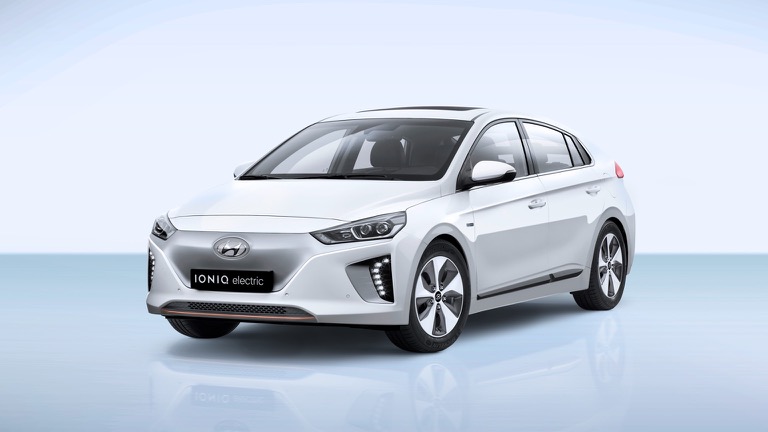
Hyundai IONIQ Electric
Hyundai logo
Hyundai

Hyundai IONIQ Electric

Available Sedan FWD
33.300 € $35,964£28,305
WLTP Range
190 km118 mi
Net Battery
28 kWh
0-100 km/h
9.9s
Peak Power
88 kW
A day with this car
DC 10–80%
19 min
69 kW peak · 65 kW avg
Home wallbox
5h
6.6 kW AC · 0–100% overnight
Winter highway
137 km85 mi
Cold, 120 km/h class
Charge ports
CCS
Type 2 · left rear

One-stop highway day · 225 km140 mi in 2h 18min

139 km86 mi
1h 16min
15 min
charge
86 km53 mi
47min
WLTP Range
190 km118 mi
Official Combined
Usable Battery
28 kWh
30.5 kWh Gross
Peak Power
88 kW
118 hp
0-100 km/h
9.9 s
Max: 165 km/h103 mph
DC Fast Peak
69 kW
High-Power DC

Performance & Powertrain

FWD Dedicated EV Platform
Total System Power 88 kW (118 hp)
Total System Torque 295 Nm
0-100 km/h Sprint 9.9 s
Top Speed 165 km/h103 mph
Drivetrain Configuration FWD
Platform Code No Data

Battery Engineering & Chemistry

400 V NMC622
Usable Battery Capacity 28 kWh
Nominal Battery Capacity 30.5 kWh
Battery Type Lithium-ion
Cell Form Factor No Data
Nominal Voltage No Data
Total Cell Count No Data
Pack Configuration No Data
Manufacturer Battery Warranty No Data / No Data

Dimensions, Cargo & Towing

Frunk: No Data
Boot Cargo Volume 350 L12.4 cu ft
Max Cargo (Seats Down) 1410 L49.8 cu ft
Front Trunk (Frunk) No Data
Unladen Curb Weight 1,495 kg3,296 lbs
Overall Length 4470 mm176.0 in
Width (with mirrors) No Data
Overall Height 1450 mm57.1 in
Wheelbase 2700 mm106.3 in
0
Towing Capacity (Unbraked) 0 kg0 lbs
Gross Vehicle Weight (GVWR) 1880 kg4,145 lbs
Max Payload Capacity 460 kg1,014 lbs

Cabin, Chassis & Thermal Management

Seating Capacity 5 people seats
Isofix Anchor Points Yes, 2 seats
Turning Circle 10.6 m34.8 ft
Market Segment C - Medium
Roof Rails No
Heat Pump Standard Equipment

Euro NCAP Safety Assessment

★★★★★ 5 Stars (2016)
Adult Occupant Protection 91%
Child Occupant Protection 80%
Vulnerable Road Users (Pedestrians) 70%
Active Safety Assist Systems 82%

Estimated Range by Weather & Road

Efficiency: 115 Wh/km185 Wh/mi

Estimates, not measurements: the WLTP figure scaled by the same temperature and road factors for every car (for example 65% for cold motorway driving, 115% for mild city driving). Your range depends on speed, wheels, load and heating. For a planned stop, use the charging simulator.

Estimated Range Envelope
Cold Highway: 124 km77 mi | Mild Urban: 218 km135 mi
Worst-Case Winter Highway WLTP Lab: 190 km118 mi Best-Case Mild Urban
❄️ Cold Winter (-10°C)
Cabin Heat On
City Driving
Urban stop-and-go
141 km88 mi
Highway Cruising
Motorway speeds
124 km77 mi
Combined Cycle
Everyday winter commute
133 km83 mi
☀️ Mild Summer (23°C)
Optimal Temperature
City Driving
Peak regen recovery
218 km135 mi
Highway Cruising
Motorway speeds
156 km97 mi
Combined Cycle
Ideal mixed-use range
182 km113 mi
High-Power Road Trips

DC Ultra-Fast Charging (10% to 80%)

⚡ CCS2 High-Power
Peak Intake
69 kW DC
Maximum Power
10-80% Session
19 min
Typical Road Stop
Average Power
65 kW DC
Sustained Rate
Range Added
420 km/h261 mph
Added per Hour
Plug & Charge (ISO 15118) No
Battery Preconditioning Auto via Nav
Autocharge Protocol Yes
Home & Overnight

AC Destination & Wallbox Charging (0% to 100%)

Type 2 Inverter
Max AC Power
6.6 kW AC
3-Phase Wallbox
0-100% Duration
5 hours
Full Overnight Charge
Charge Speed
38 km/h24 mph
Range per Hour
Port Location
Left Side - Rear
Body Placement
Mobile Power Station

Bidirectional Charging Capabilities (V2X)

V2L (Vehicle-to-Load)
Camping & devices
-
V2H (Vehicle-to-Home)
Emergency backup
Not supported
V2G (Vehicle-to-Grid)
Grid arbitrage
Not supported

Highway Endurance Score

EVDB Index
1.0/ 5.0
Urban Focused / Frequent Charging Stops

Calculated from sustained 10-80% DC fast charging speed, cold-weather aerodynamic drag, and official WLTP range (190 km118 mi).

Vehicle Overview

  • Manufacturer Hyundai
  • WLTP Range 190 km118 mi
  • Net Battery 28 kWh
  • DC Fast Charging 69 kW
  • Towing Capacity No Towing
  • Market Availability Available
  • Release Date 10/1/2016
  • Telemetry Verified 5/26/2026
Frequently Asked Questions

Hyundai IONIQ Electric Range & Charging FAQ

What is the real-world highway and winter range of the Hyundai IONIQ Electric?

The official combined WLTP range for the Hyundai IONIQ Electric is 190 km (118 miles).

In cold winter conditions (-5°C / 23°F) at highway cruising speeds (120-130 km/h), expect a realistic highway range of approximately 137 km (85 miles) due to cold battery chemistry, cabin heating, and higher aerodynamic drag.

How long does it take to charge the Hyundai IONIQ Electric at home?

Charging the 28 kWh battery from 0% to 100% takes approximately 2.3 hours using a standard 11 kW 3-phase AC wallbox. On a single-phase 7.4 kW home charger, a full charge takes around 3.4 hours (typically overnight).

How fast is DC fast charging (10% to 80%)?

The Hyundai IONIQ Electric supports peak DC fast charging rates of up to 69 kW. Recharging from 10% to 80% State of Charge (SoC) requires approximately 24 minutes at a compatible ultra-rapid charging station.

How much does it cost to charge the Hyundai IONIQ Electric?

At an average European residential electricity tariff of €0.24/kWh, a complete 0-100% home charge costs approximately €6.72. At high-power public DC charging networks (~€0.65/kWh), a full recharge costs approximately €18.20.

Segment Alternatives

Similar Electric Vehicles

Browse All EV Models →

More from Hyundai

View All Hyundai EVs →

Explore Related EV Categories