

A 300-mile EV can lose about 41% of its range in typical cold conditions at 20°F, according to a U.S. Department of Energy analysis summarized by Recharge. That doesn't mean every electric car will suddenly deliver only 177 miles, but it does show why the number on a window sticker isn't a cold-morning promise.
EV range in cold weather depends on more than temperature. Battery chemistry, cabin heating, battery thermal management, tire choice, road conditions, route length, and highway speed all influence the result. Independent winter tests have measured losses ranging from roughly 14% to 39% between models, while another analysis found that vehicles with heat pumps retained 83% of normal winter range, compared with 75% for vehicles without them EV Ratio.
The useful question isn't “How much range do EVs lose in winter?” It's, “How far can this vehicle travel on my route, at my speed, in my weather, with the heater running?” Once you approach the problem that way, winter driving becomes a planning exercise rather than a scary percentage. For the current WLTP ranking, see the EVs with the longest range.
Table of Contents
- What Cold Weather Does to Your EV Range
- Why Cold Weather Cuts Range and Drains the Battery
- How Lab Range Ratings Compare to Real Winter Driving
- Which EVs Hold Their Range Best in Winter Tests
- Driving Habits That Protect Your Range in the Cold
- Charging Strategies for Cold Weather Trips
- Choosing and Using an EV in a Cold Climate
- Cold Weather EV Questions Buyers Ask Most
What Cold Weather Does to Your EV Range
The first reality check is straightforward. At 20°F, BEV range fell by 41% in typical cold conditions, compared with a 10% reduction for an internal-combustion vehicle, in the U.S. Department of Energy analysis reported by Recharge. At 0°F, the estimated average BEV loss reached about 50%, with results ranging from 39% on highways to 59% in urban driving.
A vehicle advertised at 300 miles could therefore deliver roughly 177 to 183 miles in severe cold, depending on speed, route, and climate-control use. That isn't a universal result for every model, and it shouldn't replace vehicle-specific testing. It is a practical planning benchmark that shows why a buyer who only studies the official rating may overestimate winter flexibility.
The range penalty has a wide spread
Independent testing reinforces the point. One Canadian winter evaluation of 13 popular EVs recorded losses from 14% to 39% against official range, while a Norwegian test of 24 EVs found much smaller losses for some vehicles, including 5% for the Polestar 3 and about 24% for the Tesla Model 3 BCAA.
That spread comes from several variables working together:
- Vehicle design: Heat pumps and effective battery heating can preserve more usable energy.
- Driving environment: High-speed motorway travel increases aerodynamic demand.
- Trip pattern: Short journeys spend a larger share of energy warming the cabin and battery.
- Weather severity: Freezing temperatures, wind, snow, and slush can all worsen consumption.
Practical rule: Treat the published range as a mild-weather reference, then build a separate winter estimate for your actual route.
The rest of the calculation comes down to three questions. What happens inside the battery when it gets cold? How much energy does the vehicle spend heating people and components? And how do speed and road conditions turn those losses into fewer miles? Answer those questions, then use preconditioning, sensible heating, and conservative charging stops to protect the range you have.
Why Cold Weather Cuts Range and Drains the Battery
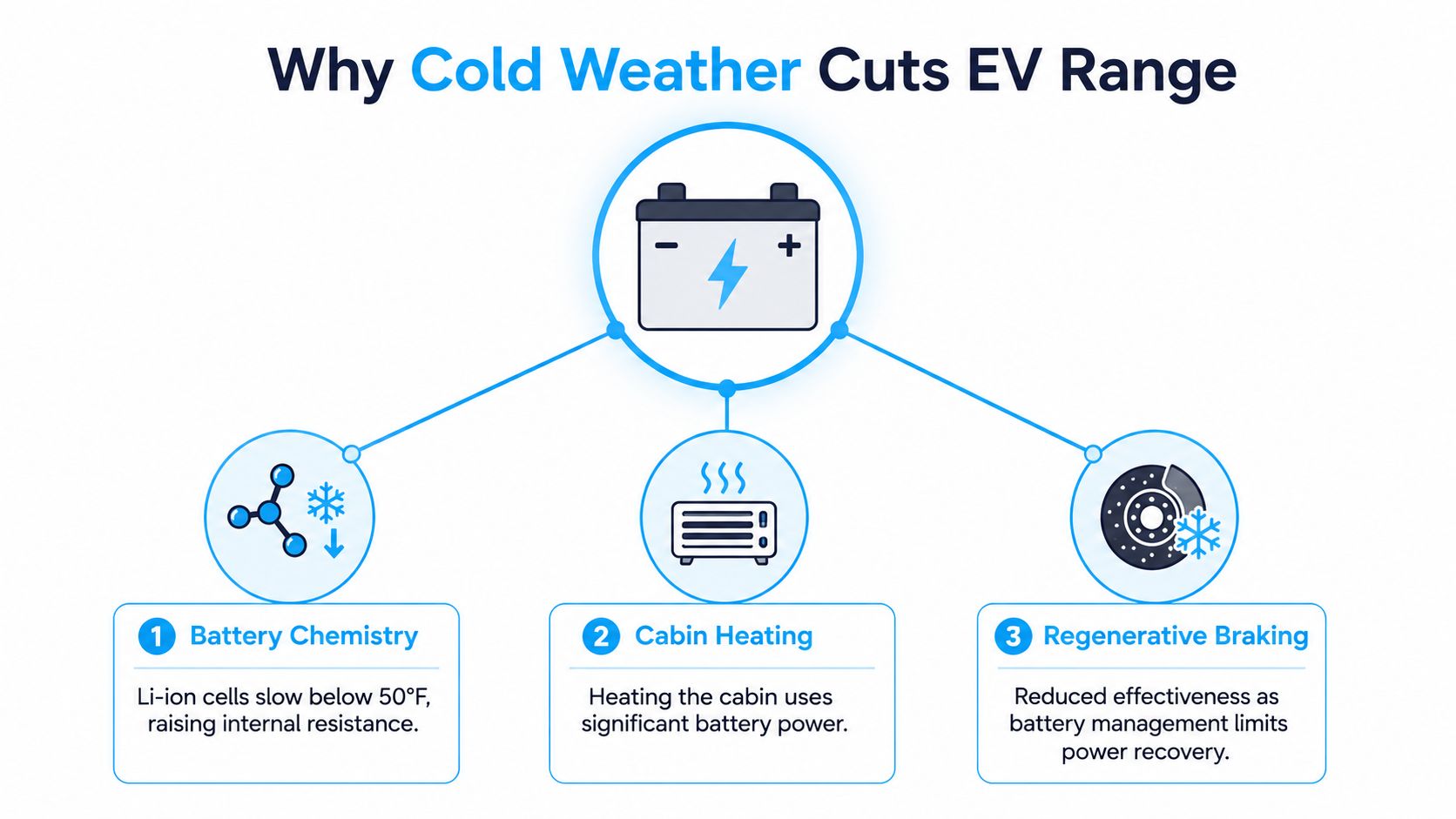
Three mechanisms combine to shrink winter range: slower battery chemistry, cabin-heating demand, and greater resistance from cold air and roads. Their effect varies with the vehicle's thermal design, the route, and highway speed, so one average winter percentage cannot describe every cold morning.
Battery chemistry becomes less cooperative
A cold lithium-ion battery works like a thickened fluid moving through a narrow pipe. Electrochemical reactions slow and internal resistance rises, so the pack may deliver and accept energy less effectively. Drivers can notice lower available power, weaker regenerative braking, or a range estimate that falls soon after starting.
The effect is generally temporary rather than evidence of permanent capacity loss. The battery-management system may reserve energy to warm the pack before permitting full performance. For more detail on the difference between total capacity and energy available to the driver, see EV battery capacity and usable energy.
Heating creates a second electrical bill
A combustion vehicle can use waste heat from its engine. An EV must draw electricity to heat the cabin while also bringing the battery and drivetrain toward suitable operating temperatures. Resistive heaters turn electricity directly into heat. Heat pumps move heat and can use less energy in suitable conditions, although their advantage depends on temperature and system design.
The difference becomes clearer on short journeys. Before the car travels far, energy may go to warming the cabin, clearing the windscreen, and conditioning the battery. A heat-pump-equipped model can therefore retain more usable range than a similar vehicle relying mainly on resistance heating.
Tires and air add resistance
Cold air is denser, and cold tires roll less freely. Winter tires can improve safety and traction, yet their tread and rubber compound may increase energy use. Snow, slush, and wet roads add resistance as the vehicle pushes through or displaces surface material.
Highway speed magnifies these losses. Aerodynamic demand rises quickly with speed, while battery warming and cabin heating continue in the background. A model that feels efficient around town may need a much larger charging buffer on a cold motorway trip, especially with headwinds, snow, or a full cabin load. The true winter number therefore reflects model design, heat-pump hardware, geography, and speed together.
How Lab Range Ratings Compare to Real Winter Driving
EPA and WLTP figures help buyers compare vehicles under standardized conditions, but neither number is a cold-weather trip forecast. Laboratory ratings smooth the differences between warm and cold operation, climate-control use, road surfaces, traffic, and wind.
The most important comparison is between a mild testing reference and a real winter operating condition. At 20°F, the U.S. Department of Energy analysis found a 41% BEV range reduction in typical cold conditions, while the comparable ICE reduction was 10% Consumer Reports. The result reflects both slower battery reactions and the additional electrical load from heating.
A simple planning example
Suppose two EVs both carry a 300-mile official rating. One has efficient thermal management and travels on a dry route at moderate speed. The other uses more cabin heat, faces a headwind, and spends the trip at motorway speed. Their winter results won't be identical, even though their laboratory numbers match.
That is why a buyer should read the specification sheet as a comparison tool, not as a promise. A useful electric-car specifications guide can help organize battery size, charging hardware, efficiency, and rated range, but the winter estimate still needs to reflect the driver's conditions.
| Planning factor | What it changes |
|---|---|
| Temperature | Colder conditions increase battery and heating demand |
| Route speed | Higher speed increases aerodynamic consumption |
| Cabin heating | Resistive heat can draw substantial electrical power |
| Trip length | Short trips devote more energy to warming the vehicle |
| Thermal hardware | Heat pumps and active battery management can improve retention |
A practical estimator should therefore combine temperature, speed, route type, and HVAC use. A single percentage is easy to remember, but it can mislead in both directions. It may make a well-managed EV look worse than it performs, or encourage a driver to attempt a highway journey with too little reserve.
The official number answers, “How does this vehicle compare under a standard test?” Winter planning asks, “How much energy will my route require today?”
Which EVs Hold Their Range Best in Winter Tests
Winter results are shaped by vehicle design, not temperature alone. Two EVs can face the same cold morning yet lose different amounts of range because their heating systems, battery controls, insulation, software, and body shapes manage energy differently.
The clearest comparison is model-specific. The Norwegian evaluation recorded a 5% loss for the Polestar 3 and about 24% for the Tesla Model 3, according to the BCAA winter EV performance study. Those figures are useful, but they are not a universal ranking. A highway journey, short urban trips, or a route with frequent cabin heating can change which design performs better.
Three design features separate stronger performers
Heat-pump systems use heat from the vehicle's surroundings and components to warm the cabin, rather than relying only on a resistive heater. That difference matters most on cold trips where cabin heating runs continuously. An analysis of 18,000 vehicles across 20 models found that EVs with heat pumps retained 83% of normal winter range, compared with 75% without heat pumps EV Ratio.
Battery thermal management affects both driving and charging. A vehicle that can warm its battery before departure or before a fast-charge stop has better control over available energy and charging speed. The hardware matters, but so does the software that decides when to heat the pack and how aggressively to limit power while it is cold.
Body shape and vehicle size then influence the result. A heavy SUV generally uses more energy to accelerate, while a low-drag model can spend less energy pushing through air at speed. City testing places greater weight on repeated heating and acceleration. Highway testing exposes aerodynamic drag, sustained speed, and the battery's ability to maintain output.
| Model or group | Test source | Conditions | Range loss | Key design factor |
|---|---|---|---|---|
| Polestar 3 | Norwegian winter test | Cold-weather road testing | 5% | Strong overall thermal management |
| Tesla Model 3 | Norwegian winter test | Cold-weather road testing | About 24% | Vehicle efficiency and route conditions |
| Canadian test range | BCAA winter evaluation | Sub-freezing comparative testing | 14% to 39% | Model-specific architecture |
| Heat-pump vehicles | Analysis of 18,000 vehicles | Winter operating comparison | 17% retained-range advantage versus non-heat-pump group | Heat-pump hardware |
Geography changes the practical lesson. A fast Norwegian motorway trip can reveal aerodynamic weakness, while a Canadian route with repeated heating demand may expose cabin-efficiency limits. Buyers should compare tests that resemble their own temperatures, roads, speeds, and trip lengths, then treat the published range as a starting point rather than a winter guarantee.
Driving Habits That Protect Your Range in the Cold
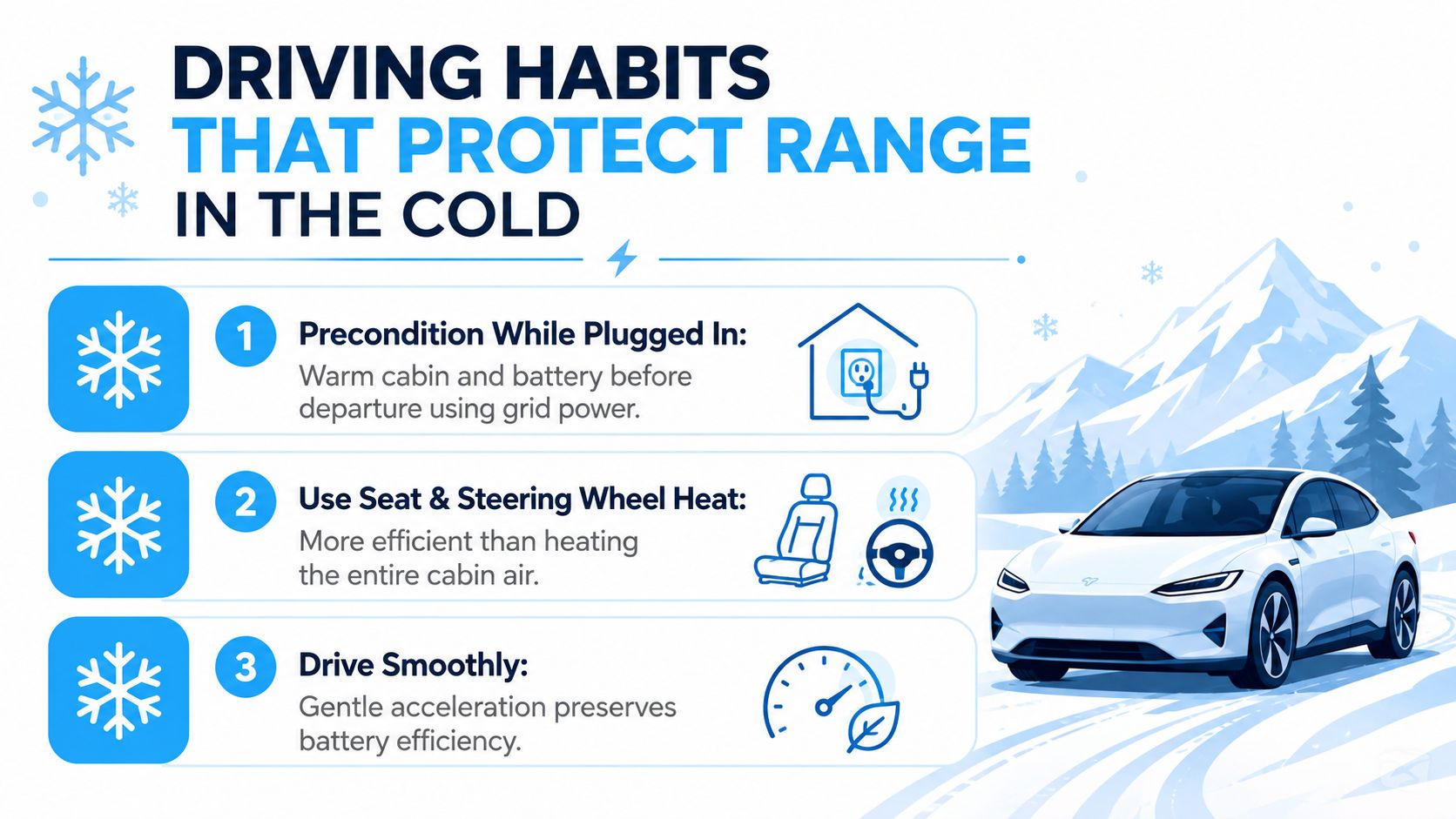
A winter commute can lose range before the car leaves the driveway. Precondition the cabin and battery while the vehicle is plugged in, allowing grid electricity to provide much of the energy needed for warm-up instead of drawing it from the traction battery. Set a departure time when the vehicle supports scheduling, especially before a morning commute or a long trip.
Reduce the largest cabin load first
Use the heat pump if the vehicle has one. It moves heat rather than creating all of it directly, so it generally needs less battery energy for cabin heating. Heated seats and the steering wheel warm occupants directly, letting the cabin remain at a moderate temperature without sacrificing comfort.
Keep the windscreen clear and safe, then limit heating to what the trip requires. Targeted defrosting, a reasonable temperature setting, and direct occupant heating usually consume less energy than running every heating function at maximum for the entire drive.
Make the first part of the drive gentle
Select an efficiency or eco-driving mode if it smooths acceleration. Apply the accelerator progressively while the battery is cold, then increase the demand after the vehicle reaches its normal operating temperature. This matters more on short trips, where warm-up energy represents a larger share of total consumption.
Regenerative braking can be limited at the start because a cold battery cannot accept as much energy. Leave extra following distance and brake smoothly instead of relying on maximum regeneration immediately. The result is better control and less dependence on abrupt friction braking.
Keep rolling resistance and drag under control
Check tire pressure regularly because cold air lowers it. Fit tires suited to the road, recognizing that high-grip winter tires may use more energy in exchange for traction and braking performance. Safety takes priority over a small efficiency gain.
Remove snow and ice before departure. The added material increases weight, can disturb airflow, and may create extra resistance around the wheels. On a highway, clean bodywork also helps preserve the low-drag advantage that efficient EVs depend on.
Morning routine: Plug in, precondition, use seat and steering-wheel heat, check tires, clear snow, then drive gently until the pack warms.
Charging Strategies for Cold Weather Trips
Cold weather affects charging as well as driving. A cold battery may accept power more slowly, so the vehicle can spend longer at a fast charger before reaching the same state of charge. The charging system limits power when necessary to protect the cells, particularly when the pack hasn't reached a suitable temperature.
The best preparation is to schedule departure and use the vehicle's battery-preconditioning function when available. If the navigation system can recognize a DC fast charger as the destination, it may warm the battery on the way there. That uses energy, but it can improve the charging session and make the stop more predictable.
Build a winter charging plan
- Start with a useful reserve: Leave with enough charge for the route, weather variation, and an unexpected detour.
- Warm the pack before the stop: Plan to arrive at the charger early enough for the vehicle to precondition the battery.
- Choose practical station locations: A charger near the motorway exit can reduce unnecessary time spent driving or waiting with a cold-soaked pack.
- Allow extra session time: Don't assume a mild-weather charging curve will appear on a freezing day.
- Use a simulator before leaving: Model the route with the forecast temperature, expected speed, and planned charge stops.
For a broader explanation of charging behavior and charging-power limits, see how to charge an EV faster. The central idea is simple: a charger can't always deliver its advertised peak if the vehicle's battery is cold or already near a high state of charge.
Avoid treating the charger as your only safety margin. A cold-weather route should include a realistic arrival buffer, because wind, snow, traffic, and heating demand can all move the consumption estimate in the wrong direction. The goal isn't to predict every watt perfectly. It's to make the trip resilient when conditions are worse than the forecast.
Choosing and Using an EV in a Cold Climate
Start with the climate you experience, not the climate shown in a brochure. A driver who sees occasional frost has different requirements from someone who regularly travels through sub-zero conditions, and a commuter who can charge at home has more flexibility than a driver who depends on public fast charging.
Match the vehicle to the winter
Mild winter: If temperatures stay above freezing most of the time, a standard EV with a suitable battery and dependable charging access may meet daily needs without specialized winter hardware.
Moderate winter: If the vehicle regularly operates through freezing mornings and cold afternoons, prioritize a heat pump, good battery preconditioning, efficient software, and tires suited to local roads.
Severe winter: If sub-zero conditions are routine, choose a model with strong thermal management, a meaningful range reserve, and charging performance that has been tested in cold weather. AWD can help traction where conditions require it, but it doesn't remove the range penalty.
A 2025 U.S. weather analysis from Vaisala reported the worst median range performance in North Dakota on January 20, 2025, with a 59% drop, while another New Mexico location represented the high point, producing a 77% spread between extremes. The same analysis shows why geography alone isn't enough. Route type and speed can change the result, with cold motorway driving producing much worse outcomes for some vehicles than warmer or mixed driving.
Use a repeatable operating checklist
- Schedule departure: Let the car warm itself before you unplug.
- Keep the pack connected when practical: This gives preconditioning access to grid power.
- Check tire pressure: Cold conditions can alter pressure and efficiency.
- Use direct occupant heating: Seat and steering-wheel heat can reduce the need for high cabin settings.
- Store the vehicle indoors when possible: A sheltered starting point can make the first part of the drive easier.
- Drive smoothly: Gentle acceleration and moderate speed protect efficiency.
Don't buy a large battery solely to hide poor winter planning. Compare thermal hardware, real-world efficiency, charging behavior, and the routes you drive most often. A larger pack can provide useful reserve, but the right vehicle is the one whose winter behavior matches your climate and charging access.
Cold Weather EV Questions Buyers Ask Most
Does fast charging damage an EV battery in winter?
Normal winter DC fast charging is a supported use of an EV. A cold battery may accept power more slowly because its battery-management system limits charging until the cells warm. Repeatedly arriving with an extremely cold pack, without giving the vehicle time to prepare, can make charging slower and less efficient.
Set the charger as the destination in the vehicle's navigation when it supports battery preconditioning. The system can then warm the pack before you arrive, much like warming an engine before asking it to work hard.
How long should I precondition?
There is no universal timer. The right lead time depends on the vehicle, outdoor temperature, whether it is plugged in, and the battery's state of charge. A brief cabin warm-up improves comfort, but it may leave the battery too cold for efficient fast charging.
For a morning departure, schedule enough time for the car to prepare the cabin and battery while connected to power. Follow the manufacturer's instructions if they specify a preconditioning schedule.
Do heat pumps make a meaningful difference?
Yes, particularly on trips where cabin heating uses a large share of the energy. Heat pumps move heat rather than creating all of it through resistive heating, so they can reduce the energy required in cold conditions.
The benefit varies by vehicle. Heat-pump design, battery heating, software, vehicle efficiency, highway speed, temperature, and route elevation all affect the range a driver sees. A heat pump can improve winter performance, but it does not erase the effects of a large, inefficient vehicle or a fast motorway trip.
Should I leave my EV plugged in overnight in extreme cold?
Leaving the vehicle connected can give it grid power for scheduled preparation and battery management, where the system supports those functions. Use the manufacturer's recommended charging equipment and settings. A high state of charge is not necessary for every overnight stay.
Set a daily charge limit that matches your normal driving, then raise it before a longer trip when needed. Winter reliability comes from preparing the car before departure, not from leaving it running or idling for heat.
A buyer comparing EVs should look beyond one official range figure. Battery heating, heat-pump hardware, charging behavior, vehicle efficiency, local temperature, terrain, and usual highway speed can shift the practical result substantially. The best choice is the model whose cold-weather behavior fits your routes and charging access.
EV Stats helps buyers compare electric vehicles through specifications, range, efficiency, independent-test context, and charging data. Visit EV Stats to compare models and use its charging tools before choosing a vehicle or planning a cold-weather trip.