

EV battery degradation is often treated as a problem that starts only when range feels shorter, but that view misses the practical question owners face: how much capacity loss still fits daily driving, resale plans, and warranty coverage. A battery that retains most of its usable capacity for years behaves more like a tool with gradual wear than a part that suddenly fails.
That is why storage conditions, charging routines, and end-of-life thresholds matter as much as headline range numbers. A pack left hot for long periods ages differently from one kept in moderate conditions, and the point at which a driver notices trouble is not always the point at which the battery should be replaced.
Warranty language adds another layer. Some owners focus on whether a battery is "covered," while the more useful question is what health metric the warranty uses and how that compares with the battery's real usable range. Understanding that gap helps separate normal degradation from a problem that changes ownership costs or long-term planning.
Table of Contents
- Why EV Battery Degradation Matters
- Understanding Battery Degradation Basics
- Causes of EV Battery Degradation
- Real-world Degradation Rates
- Interpreting Battery Health Metrics
- Strategies to Slow EV Battery Degradation
- How Warranty Affects Battery Longevity
- Conclusion and Key Takeaways
Why EV Battery Degradation Matters
A small drop in battery capacity can change how an EV fits into daily life. A route that once ended with plenty of range can start to feel tighter on cold mornings, after a fast highway drive, or when the car is carrying a full load. That is why degradation matters, even when the battery is still working well.
The main point is not panic, it is fit. A battery can lose some usable capacity and still suit one driver's routine perfectly, while creating frustration for someone who needs longer trips or less charging downtime. The same battery health reading can mean very different things depending on commute length, weather, and how often the car sits parked.
Resale value is tied to that difference. Buyers and sellers both look at battery condition because it affects how confidently the car can cover a chosen route, not just how far it can go on a perfect day. Warranty questions also come up here, since owners need to know whether the battery's condition is merely a normal sign of use or a point where coverage and replacement rules start to matter. For a clear explanation of how owners often frame those questions, see common questions about EV batteries.
A useful way to judge degradation is to compare the battery against the job it has to do. A shorter household commute may tolerate noticeable fade without much inconvenience. A driver who depends on a longer daily route, repeated fast charging, or low buffer for winter travel will feel the same battery wear much sooner.
Storage conditions matter here too. A vehicle that spends long periods parked, especially in hot or cold conditions or at an unfavorable charge level, can age in ways that do not show up as dramatically as miles on the odometer. That is why battery health is best read as part of the whole ownership pattern, not as a single number standing on its own.
Understanding Battery Degradation Basics
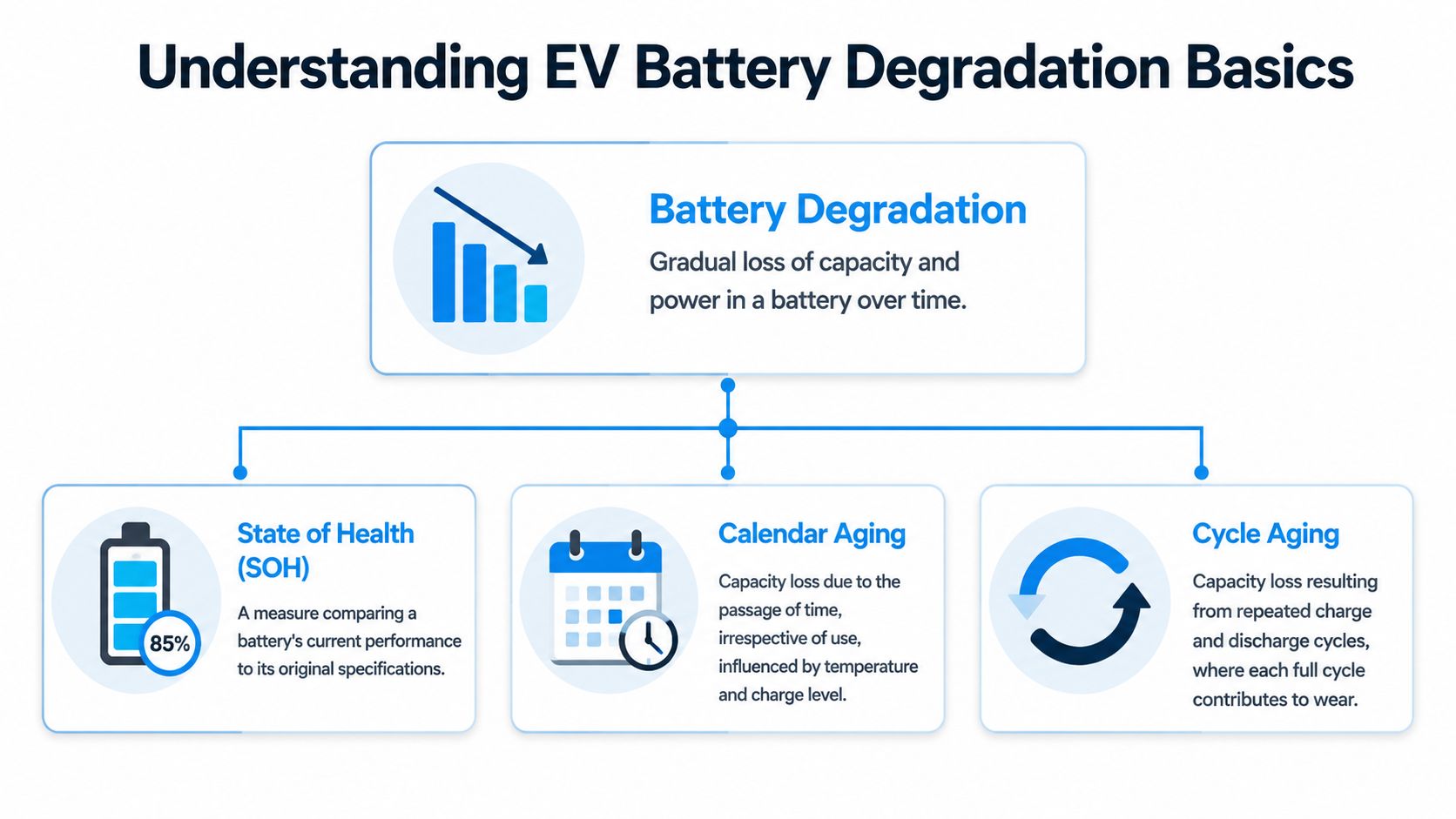
battery degradation means the pack slowly loses the ability to store and deliver energy. A simple analogy helps here. Think of a new sponge that can soak up a full bucket of water, then imagine the sponge aging so it still works, but holds a little less each year. The battery hasn't stopped functioning, it's just become less generous in how much energy it can hold.
SOH, calendar aging, and cycle aging
The most useful shorthand is State of Health, or SOH. SOH compares the battery's current usable capacity with what it had when new. If a battery has lower SOH, it usually means less range, though the exact driving effect depends on the vehicle and route.
Two different clocks affect that health. Calendar aging happens as time passes, even when the car sits parked. Cycle aging happens through repeated charging and discharging, because each cycle nudges cell chemistry and materials a little further from their original state. The storage question is often overlooked, even though parked time, temperature, humidity, and charge level all matter in real ownership, especially for seasonal storage and long idle periods mosfe.com research-gaps article.
Modern EVs use battery management systems to reduce damage from everyday use. These systems keep cells from reaching the harshest extremes, even when the dashboard says 0% or 100%. That hidden buffer is one reason ordinary owners don't need to obsess over every charging session.
For readers who want a deeper primer on battery terminology, the glossary in this EV battery questions guide is a useful companion. It helps separate the numbers you see on the screen from the chemistry happening underneath.
Plain-language takeaway: a battery can age in the garage, on the charger, and on the road. The car's software limits some of that stress, but it can't stop time entirely.
Causes of EV Battery Degradation
A battery does not age from driving alone. It also changes while parked, especially when it sits hot, fully charged, or nearly empty for long periods. That is why storage conditions deserve the same attention as charging habits, because parked time can shape battery health as much as use on the road.
Driving habits that increase wear
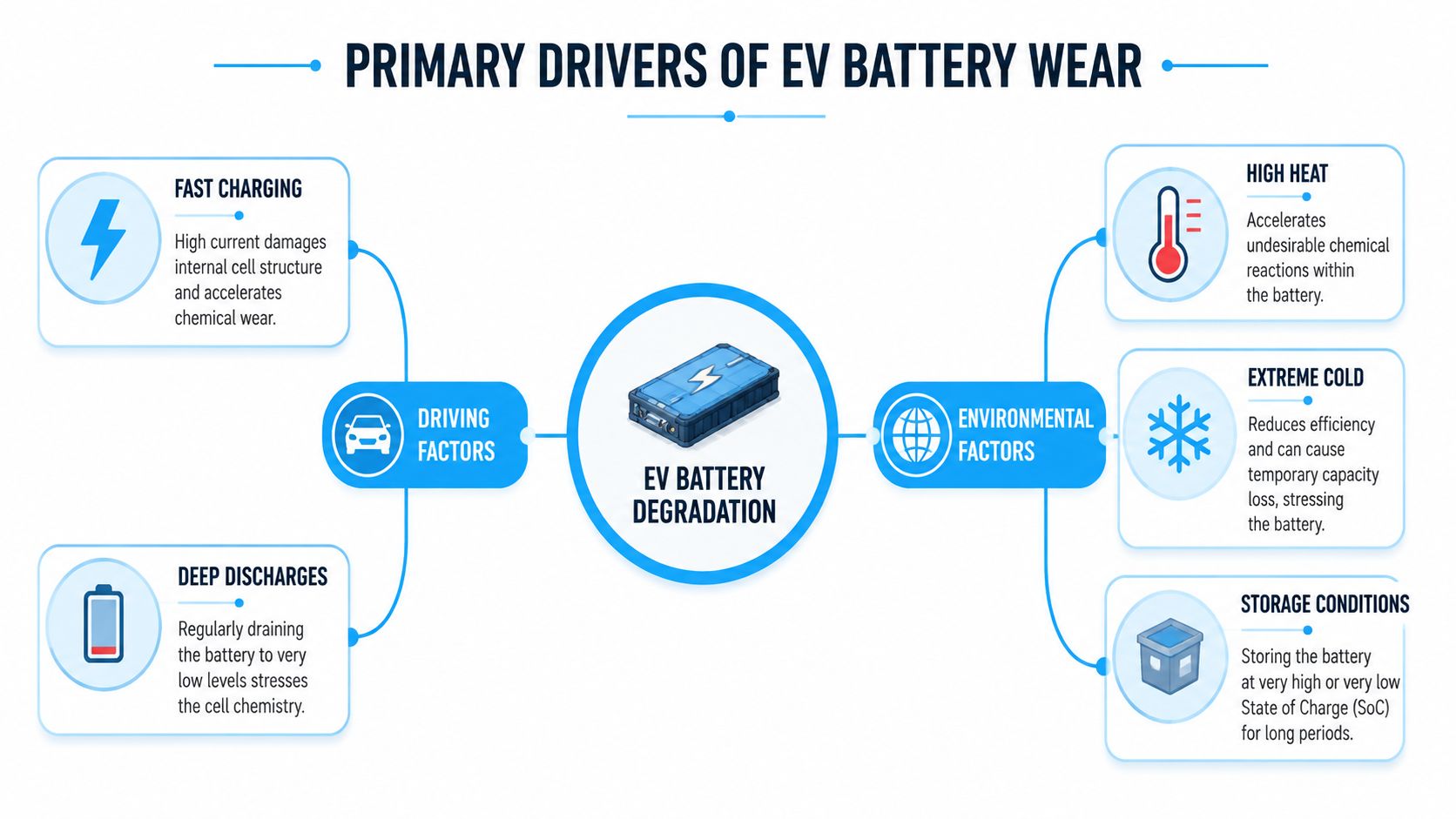
Frequent DC fast charging is one of the clearest stressors in fleet data. High-power DC fast charging can push annual degradation rates to up to 2x compared with low-power charging, and hot climates add roughly 0.4% extra fade per year. That does not mean fast charging should be avoided entirely. It means the battery pays a real cost when that charging style becomes routine, much like a machine that can handle heavy loads for a while but wears faster when the heavy load becomes its everyday job.
Deep discharges also matter, but the picture is more nuanced than many owners expect. Most modern EVs use software buffers that soften everyday use, so normal commuting does not push the pack into its harshest limits. The harder cases are repeated trips into extremes, especially when the battery is held there for long stretches rather than returned to a moderate range.
For a clearer overview of how usable battery capacity is tracked in practice, see this guide to EV battery capacity. The key point is that display numbers and underlying cell condition are related, but they are not the same thing.
Environmental and storage effects
Heat speeds up the chemistry inside cells, so a car parked in a hot environment ages differently from one parked in a cooler one. Storage matters because a vehicle does not need to move to lose capacity. A battery left idle for a long time at a high or very low charge level faces a different kind of wear than a battery that cycles regularly.
Practical rule: if the car is going to sit for a while, aim for stability, not perfection. Avoid long idle periods in extreme heat or at extreme charge levels when you can.
Cold weather deserves nuance. It can reduce usable range right away, but the longer-term issue is how temperature interacts with charge level, storage time, and charging behavior. Wear usually comes from overlap, not from one habit in isolation. Power, temperature, and parked time work together, and the battery responds to all three.
Real-world Degradation Rates
A practical benchmark matters because battery wear is easy to misunderstand when owners only see a dashboard number. Fleet telematics from Geotab gives one of the clearest real-world views, since it tracks vehicles in daily use instead of lab conditions. Its updated analysis of over 22,700 vehicles found an average degradation rate of 2.3% per year, while an earlier 2023 analysis of 11 common models had improved to 1.8% per year before the broader dataset moved back to 2.3% in the newer result Geotab's battery health analysis. That pattern matters because it shows both steady progress in battery design and the way charging habits, vehicle mix, and usage patterns can pull the average back up again.
The numbers are easier to interpret if you treat them like a slow leak rather than a sudden drop. Small losses do not feel dramatic in a single week, but they change the amount of usable buffer a driver has on a routine trip.
What the yearly numbers look like
The table below turns annual fade into a simple capacity forecast. It is a projection, not a promise, because every pack ages differently and real-world usage does not follow a straight line.
| Year | Capacity Remaining at 2.3% Rate | Capacity Remaining at 1.8% Rate |
|---|---|---|
| 0 | 100% | 100% |
| 1 | 97.7% | 98.2% |
| 2 | 95.4% | 96.4% |
| 3 | 93.1% | 94.6% |
| 4 | 90.8% | 92.8% |
| 5 | 88.5% | 91.0% |
| 6 | 86.2% | 89.2% |
| 7 | 83.9% | 87.4% |
| 8 | 81.6% | 85.6% |
| 9 | 79.3% | 83.8% |
| 10 | 77.0% | 82.0% |
A useful way to read the table is to compare it with your own driving pattern. A household that ends most days with unused range may never feel the difference between those figures, while a route that already uses most of the pack can start to feel tighter as the remaining buffer shrinks. Capacity forecasts matter most when the trip plan is already close to the edge.
Model and market differences matter
Different packs age at different speeds, and the gap is often visible only when you compare models side by side. Independent used-EV data found 91.9% average state of health at 100,000 km, with a median of 92.1%, while the Nissan Leaf came in lower at 82.5% and models such as the Lucid Air and Hyundai Ioniq 6 were reported at 94.2% VoltChek's EV degradation statistics. A UK market survey also found cars first registered in 2024–25 retained 97% of original range on average, versus 94% for 2018–19 cars VoltChek's EV degradation statistics. Those figures point to better thermal control and pack design across newer vehicles, even though individual results still vary.
The practical question is how to read those percentages in context. A car can show a healthy-looking battery health figure and still feel limited if its usual trips leave little spare range, which is why this EV battery capacity guide is useful for translating percentage figures into usable distance. A single health number is only part of the picture, because the same percentage can mean very different things in daily use.
Interpreting Battery Health Metrics
Dashboard numbers can be misleading if you misinterpret them. State of Charge, or SOC, tells you how full the battery is right now. State of Health, or SOH, tells you how much of the original capacity is still available. They sound similar, but they answer different questions.
Why a single threshold can mislead
A battery at lower SOH is not automatically a dead battery. Academic reviews note that functional end-of-life thresholds vary by duty cycle, and that using a single fixed SOH number often misguides replacement decisions PMC review on end-of-life thresholds. That matters because a commuter, a rideshare driver, and a parcel fleet don't need the same remaining capacity to stay productive.
A battery reaches “end of life” for one driver long before it reaches end of life for another.
That's the key idea many owners miss. A car might still serve a low-mileage household perfectly well even if a fleet operator would already retire it. The battery has not changed its chemistry based on the owner's expectations, but the business or lifestyle threshold absolutely changes.
Reading health in context
A good reading combines SOH with the route the car must cover. If winter range loss, highway speeds, or hill climbing already reduce usable distance, the same battery health figure has less practical headroom. If the car mostly handles short city errands, the same figure may remain acceptable for years.
One more confusion point deserves attention. A full charge on the screen doesn't mean the cells are chemically at their most stressed state in the simplistic way people often assume. The battery management system is always moderating the pack in the background, so the display is only part of the picture. That's why health should be judged by actual use, not by a universal percentage that ignores duty cycle.
Strategies to Slow EV Battery Degradation
A battery that is treated well tends to age more slowly, and the habits that help are usually ordinary rather than dramatic. Keep heat, deep discharge, and long periods at an extreme state of charge to a minimum, and the pack has an easier life. The goal is not to baby the battery forever, but to avoid piling one stressful condition on top of another.
Charging habits that help
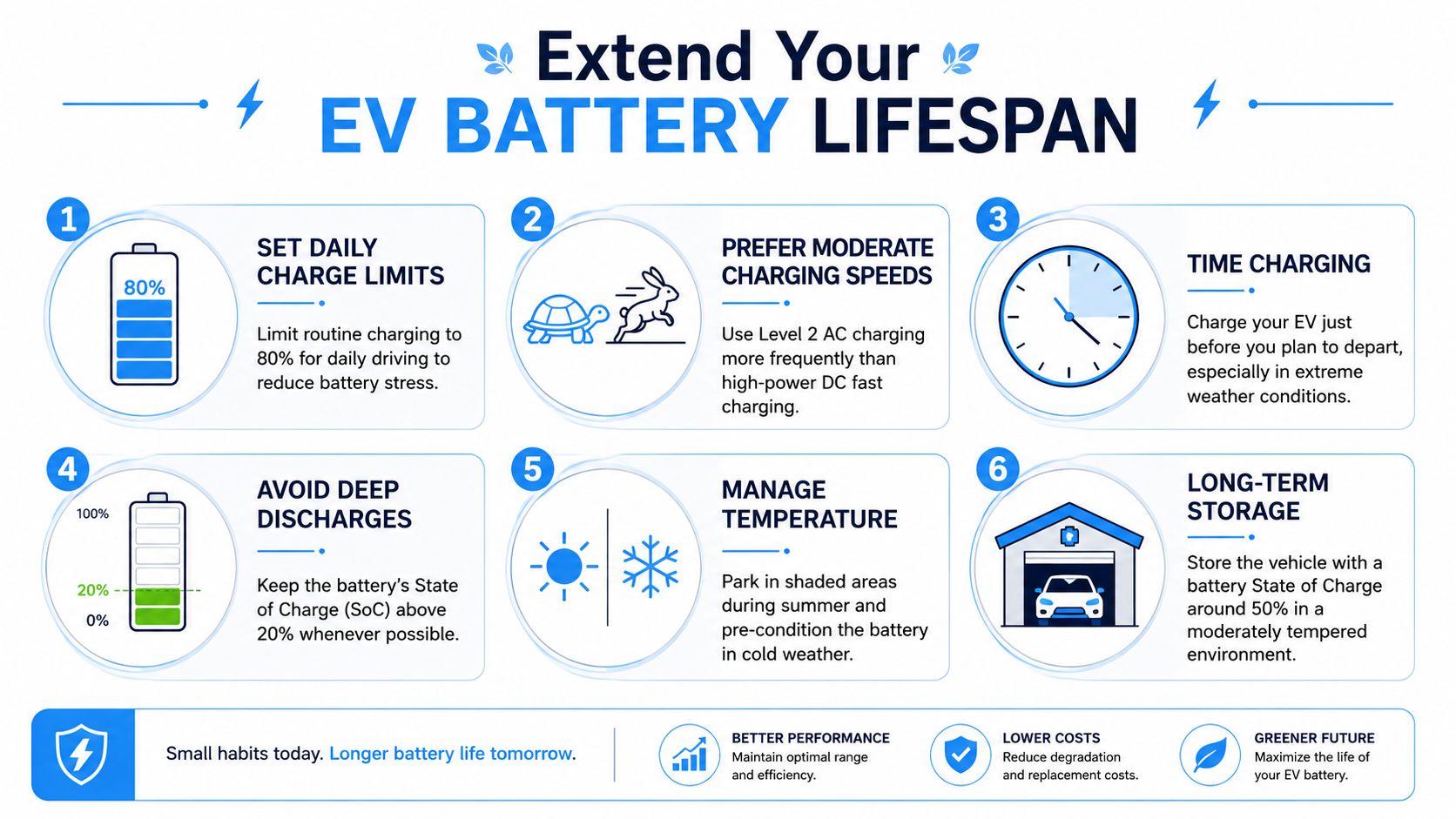
A routine charge target near 80% works well for daily use because it leaves a buffer at the top of the pack, which matters when the car does not need full range every morning. Charging more gently also helps, since higher-power DC sessions create more stress than lower-power charging in many situations. If your schedule allows it, the slower option is usually the kinder one for the battery.
One useful way to separate charging choices is by charging level, since everyday AC charging and high-power DC charging do very different jobs. If you want a clear comparison, this overview of charging levels shows how those sessions differ without turning the topic into guesswork.
Storage and climate habits that help
Heat is one of the easiest stressors to overlook. Parking in the shade or indoors can reduce exposure during long warm-weather stops, and that helps the battery avoid sitting in a hot, stagnant state for hours at a time. For longer storage, a middle-of-the-road charge level is usually the least stressful choice, because the pack does not need to remain near the top or bottom of its range for days on end.
Pre-conditioning before departure can also reduce strain when temperatures are extreme. The battery management system can then bring the pack closer to a usable temperature before the car is asked to deliver full power or accept a fast charge.
Practical rule: the battery likes predictability more than heroics. Short, sensible charging sessions and moderate storage conditions do more good than obsessing over every trip.
A lot of owners focus on the 20% to 80% rule as if it were a universal law. Ordinary use is usually less fragile than that advice suggests. The bigger risk is long exposure to extremes, not the simple fact that you sometimes charge above 80% or let the battery dip below 20%.
For charging-style comparisons, this overview of charging levels helps separate everyday AC charging from high-power DC sessions without turning the discussion into guesswork. The best charging habit is the one that fits your real schedule while keeping unnecessary stress low.
How Warranty Affects Battery Longevity
Warranty language matters because it turns battery health from a technical topic into a contract question. Owners often assume the key number is just a percentage, but warranty terms can depend on time, mileage, ownership transfer rules, and the manufacturer's definition of acceptable loss. Those details decide whether a battery problem is merely annoying or formally covered.
What to check in the fine print
The first thing to look for is the minimum capacity guarantee. Some warranties focus on whether the battery falls below a specified SOH level, while others tie coverage to defects rather than gradual wear. The distinction matters because a battery can age naturally without qualifying as defective.
Documentation also matters. Charging patterns, service records, and software updates can all help if a claim ever needs support. Even if the battery isn't failing, good records make it easier to show that the vehicle was maintained normally rather than abused.
Why warranty and use case should line up
A warranty threshold only helps if you know what “good enough” means for your own driving. If the battery still covers your commute and errands, a low SOH number may not be a practical problem yet. If the car's range no longer supports your route, the same number becomes much more important, whether or not a warranty claim is still available.
Owners should also compare warranty language against how the car is used. A vehicle that fast-charges frequently, sits in heat, or spends a lot of time parked at stressful charge levels may age differently than a lightly used garage-kept car. The best warranty strategy is to read the terms early, then keep the car's use within the habits that preserve both health and documentation.
Conclusion and Key Takeaways
EV battery degradation is usually gradual, measurable, and manageable. The key idea is that the pack does not usually fail all at once. Capacity tends to slip little by little, so the better way to judge it is by usable range, day-to-day charging behavior, and how well the battery still fits the vehicle's job.
The most useful habits are simple. Avoid making high-power DC fast charging your default when slower charging fits the routine. Keep parked cars out of unnecessary heat, since storage conditions can matter as much as driving habits. Do not judge battery value by a single SOH number without asking whether the remaining capacity still matches the commute, errands, or fleet duty cycle.
Warranty language also needs a careful read. A battery can lose capacity naturally and still function normally, while a warranty may only respond if it drops below a defined threshold or shows a defect. That is why the practical question is not just, “Is the battery aging?” It is also, “Has it aged enough to affect real use?”
If you remember one thing, make it this. Battery health is a use-case problem as much as a chemistry problem. A pack that looks tired on paper may still be perfectly serviceable for the right driver, while a modest loss can matter a lot for a long commute, heavy daily use, or a vehicle that needs dependable range every day.
If you want to compare EV models, charging behavior, and real-world range in one place, visit EV Stats. It is a practical way to turn battery degradation from a vague concern into a clearer ownership decision. Use it to check the numbers before you buy, charge, or plan your next long-term EV move.