

Battery energy density is not one number, it's at least four, and the one that matters most to an EV buyer is the pack-level figure. A battery can look impressive at the cell level and still deliver less range, more weight, and less cargo space once it's installed in a car.
Only the headline Wh/kg figure is visible. That's useful, but it hides the bigger story, because gravimetric and volumetric energy density, plus cell and pack level, all affect what you feel at the wheel and what disappears under the floor.
Table of Contents
- What Battery Energy Density Actually Means
- Gravimetric vs Volumetric Energy Density
- Cell Level vs Pack Level and Why the Gap Exists
- Comparing LFP, NMC, and NCA Chemistries
- What Higher Density Means at the Wheel
- The Gap Between Lab Records and Cars You Can Buy
- When Higher Density Is Not the Right Goal
- Buyer Questions About Energy Density
What Battery Energy Density Actually Means
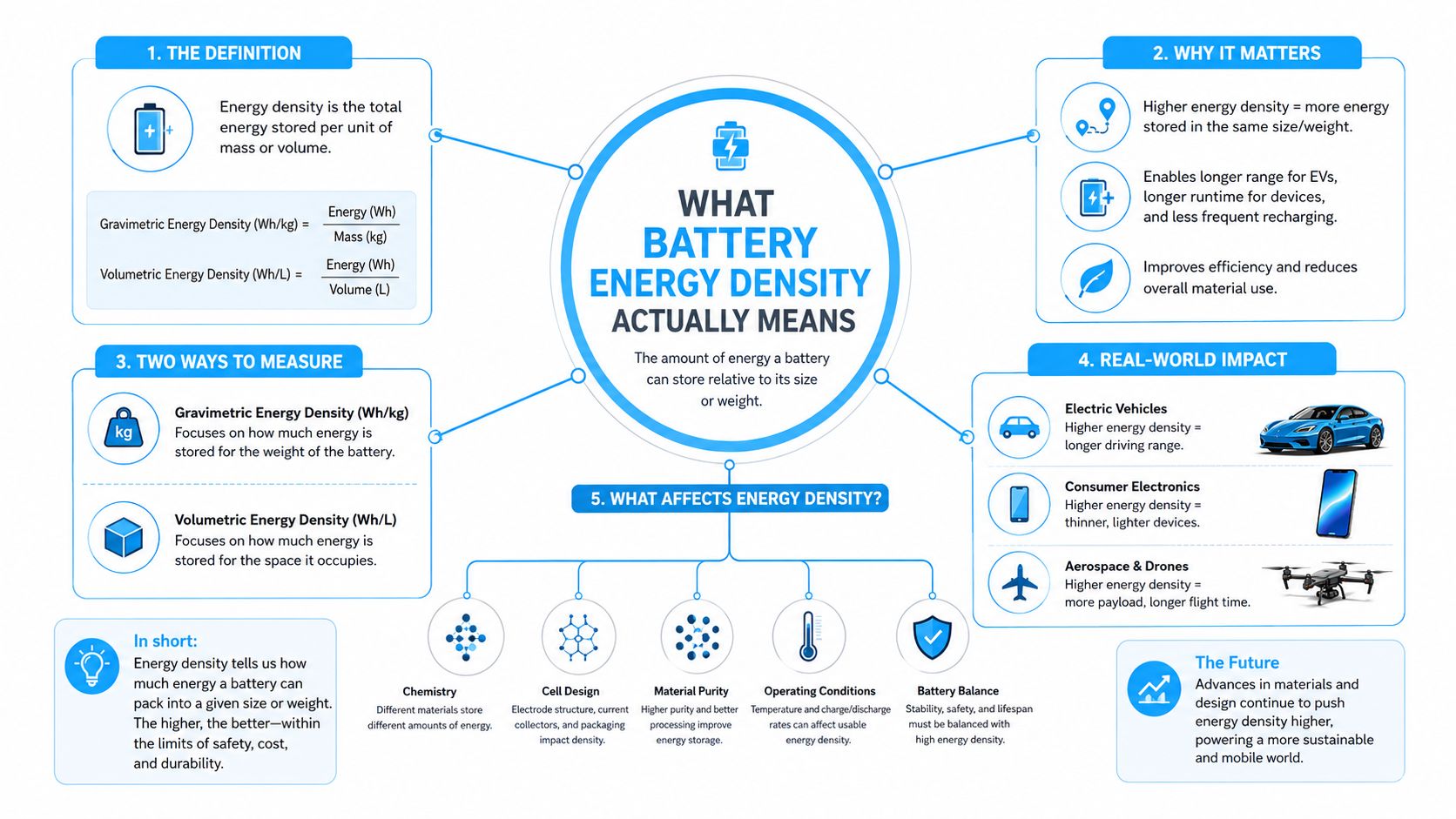
Battery energy density tells you how much energy a battery can store for its size or its mass, but that simple sentence hides a lot of trade-offs. The two units you'll keep seeing are Wh/kg for mass, and Wh/L for volume. Those numbers matter because an EV doesn't live on a slide deck, it lives in a chassis with a curb-weight target, a floor height, cooling hardware, and a cargo bay.
The four-part mental model
The cleanest way to think about it is to split the topic into two questions. First, how much energy fits into a kilogram. Second, how much energy fits into a liter. Then split each of those again into cell level and pack level. A cell is the raw electrochemical unit, while a pack is the full installed system, including the structure around it.
That's why a battery designer can point to a strong cell number and still end up with a lower number in the vehicle. The pack carries real-world penalties, like modules, cooling, wiring, controls, and the enclosure. Once those are added, the usable density drops, and that drop is what the buyer pays for in mass and packaging.
Practical rule: if a spec sheet only gives you a cell Wh/kg number, you still don't know what the car will feel like.
A useful baseline comes from the first commercial lithium-ion battery Sony introduced in 1991. Today's commercial lithium-ion cells are typically around 250 Wh/kg and 700 Wh/L, which means gravimetric energy density has risen by roughly 2.5 to 3 times from the early 1990s, while volumetric energy density has also increased severalfold, according to a recent review on battery development history (Springer review).
Gravimetric vs Volumetric Energy Density
Gravimetric energy density answers one question, how much energy you get per kilogram of battery. That is the figure that shapes vehicle mass, acceleration feel, efficiency, and payload. Volumetric energy density answers another question, how much energy fits into a liter of battery. That is the figure that decides whether the battery fits cleanly under the floor or takes space away from the cabin and cargo area.
Why the units are different
The two metrics describe different constraints, and EV buyers feel both. Gravimetric energy density is the better guide when the concern is weight. Volumetric energy density is the better guide when the concern is space.
A battery can be light and still be bulky, or compact and still be heavy. One design may score well in Wh/kg and poorly in Wh/L, while another does the opposite. Engineers care about both because the wrong tradeoff can force a taller floor, a smaller trunk, or a heavier chassis.
A quick illustration makes the split easier to see. If a pack holds 75 kWh, a higher Wh/kg design will generally weigh less, while a higher Wh/L design will generally occupy less space. One number does not tell you both things, and that is where much of the confusion starts for shoppers reading spec sheets.
Why buyers should ask both questions
A chemistry that looks strong on mass can still create packaging problems. That matters when the battery sits in the skateboard floor and competes with occupant room, suspension geometry, or cargo depth. It also matters for vehicles that need a low roofline or a shallow underbody, because volumetric density can be the difference between a clean package and one that forces compromises elsewhere.
The same logic applies when the car has to carry real cargo. A battery that uses less space can leave more room for a trunk, more freedom for seat placement, and less intrusion into the cabin. A battery that uses less weight can improve how the car feels off the line and how much load it can carry without becoming sluggish.
A battery that wins the mass contest can still lose the packaging contest.
For EV shoppers, the practical habit is simple. Ask for both Wh/kg and Wh/L, then ask whether those numbers refer to the cell or the pack. Without that distinction, you are comparing a raw ingredient to a finished meal.
Cell Level vs Pack Level and Why the Gap Exists
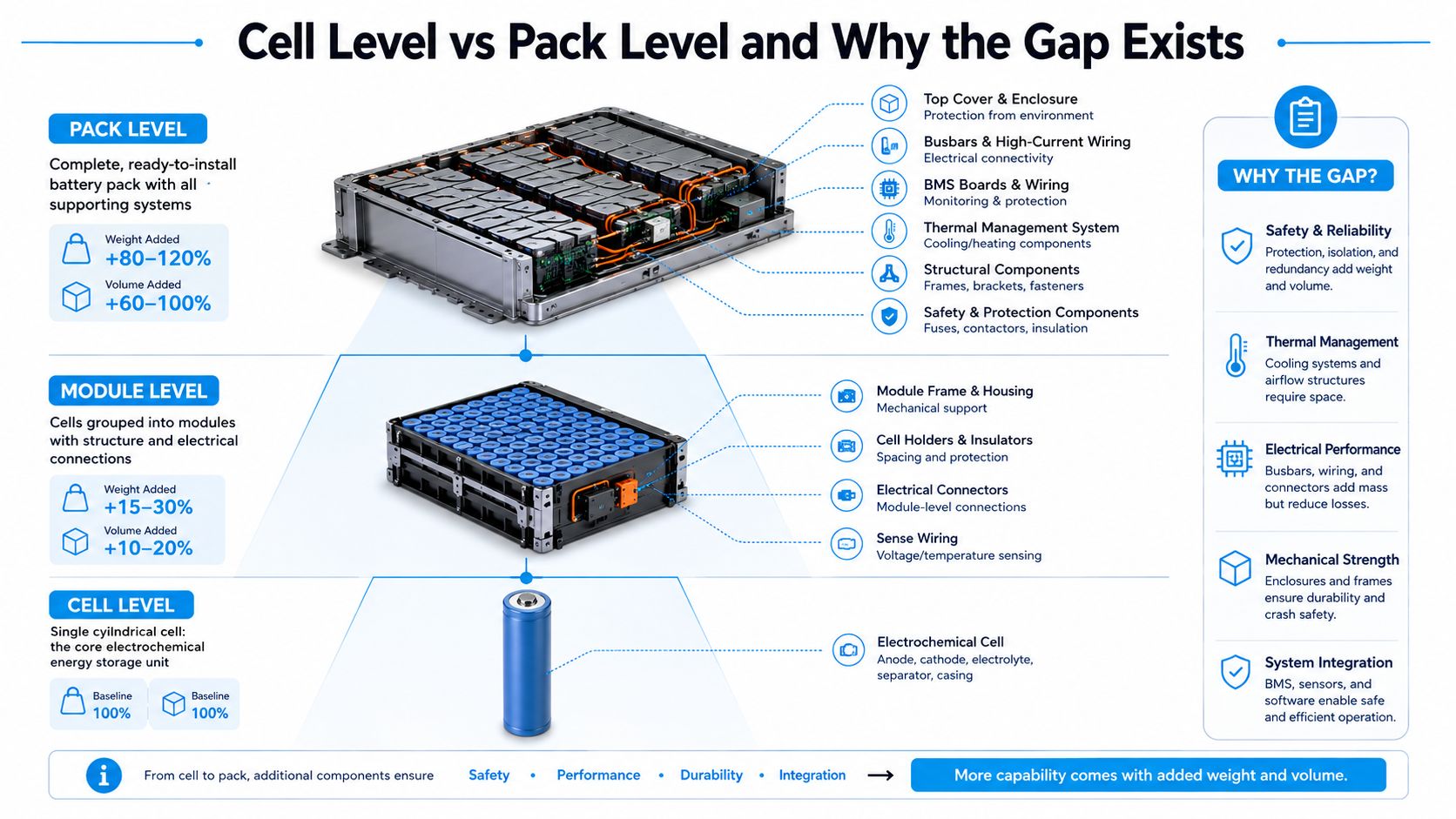
A battery cell is only the starting point. The moment cells are grouped into modules and installed into a vehicle, the system needs busbars, battery management electronics, cooling hardware, wiring, and a protective enclosure. Each of those parts adds weight and volume without adding energy, so the pack-level number always lands below the cell-level number.
Why the pack number is the one that matters
For an EV buyer, the pack is the battery. That's the system that determines how far the car can travel, how much mass the vehicle carries around every mile, and how much of the floor is consumed by the energy store. A cell that looks advanced in a lab can lose much of that advantage once it is turned into a safe, cooled, crash-protected automotive system.
The packaging penalty is also why format choice matters. Cylindrical, prismatic, and pouch cells don't integrate the same way, so two packs with similar chemistry can still behave differently once they're assembled. Structural packs and cell-to-pack designs try to reduce that overhead by removing some intermediate hardware, but they don't erase the gap completely.
Why marketing numbers can mislead
A pack number is not just a lower version of the cell number, it's the more honest version for vehicle shoppers. When a brochure highlights chemistry performance without saying whether the number is cell-level or pack-level, it's skipping the part that affects driving range and cabin space. That's why serious comparisons should use standardized vehicle specs, not just chemistry headlines.
The practical habit is to compare cars by the installed system, not the lab ingredient. That's the difference between reading a spec and understanding a vehicle.
Comparing LFP, NMC, and NCA Chemistries
Three chemistries dominate the EV conversation for good reason. LFP gives up density to gain thermal stability, cost advantages, and long life. NMC and NCA push higher energy density, which is why they're common in long-range passenger cars. The trade-off is that higher-energy cathodes generally need tighter management and come with more thermal and voltage complexity, while LFP is often chosen when durability matters more than maximum range (EpecTech cell comparison).
Side-by-side view
| Chemistry | Gravimetric (Wh/kg) | Typical trade-off |
|---|---|---|
| LFP | 90 to 120 | Prioritizes safety, cost, and long life over maximum range |
| Manganese-based Li-ion | 100 to 135 | Sits between LFP and higher-density chemistries |
| Cobalt-based Li-ion | 150 to 190 | Higher specific energy, but more management overhead |
| NMC and NCA | 200 to 300 at the cell level for commercial EV systems | Better range density, usually better for long-range passenger cars |
The reason this table matters is that chemistry choice shapes the whole vehicle. A denser cell can reduce the pack mass, which helps efficiency, but it may also require more careful thermal control. A less dense cell can be easier to manage and may support a lower-cost ownership case, especially where daily range demand is modest.
What that means in real buying terms
If you want the longest possible highway range in a passenger car, higher-density chemistries usually have the edge. If you care more about durability, cost, or thermal stability, LFP often makes more sense. The right answer depends on the car's duty cycle, not just the chemistry badge.
For a broader vehicle-level comparison, it helps to look at the battery as part of the entire drivetrain, not a standalone component. That's also where tools such as the EV battery capacity guide become more useful than a chemistry table.
What Higher Density Means at the Wheel
A spec like 75 kWh can mean very different things once it is installed in a car. If the same usable energy sits in a lighter pack, the vehicle usually spends less energy moving its own mass, which helps efficiency. If the same usable energy fits into a smaller volume, the battery can stay lower, flatter, or less intrusive in the cabin and cargo area.
A simple driving example
Take three imaginary 75 kWh packs. One uses a lower-density chemistry, one uses a mid-density chemistry, and one uses a higher-density chemistry. The higher-density pack will usually be lighter, and that lower mass can make the car feel less burdened in stop-and-go traffic and on long climbs. It can also reduce how much room the battery takes from the floorpan, which owners notice every time they load luggage.
That matters for range in two ways. First, a lighter vehicle usually needs less energy to move. Second, the same battery energy can travel farther when the car has less mass to carry. The effect is not magic, but it is real enough that buyers feel it on highway trips, especially when comparing cars with otherwise similar powertrains.
What a buyer notices
Practical rule: higher density can feel like a quieter compromise, not just a bigger number.
You may not see the Wh/kg difference while driving, but you can feel its results. The car may sit lower, carry less battery bulk in the cabin, or leave more usable cargo room. On long trips, that can matter more than an abstract chemistry label.
For people comparing trims or body styles, the useful question is not “which chemistry is best,” it is “which battery design gives me the range I want without making the car feel overbuilt.” That is the product question behind the spec sheet. For a broader vehicle-level comparison, a guide like the EV battery capacity guide helps place the battery in the context of the full drivetrain.
The Gap Between Lab Records and Cars You Can Buy
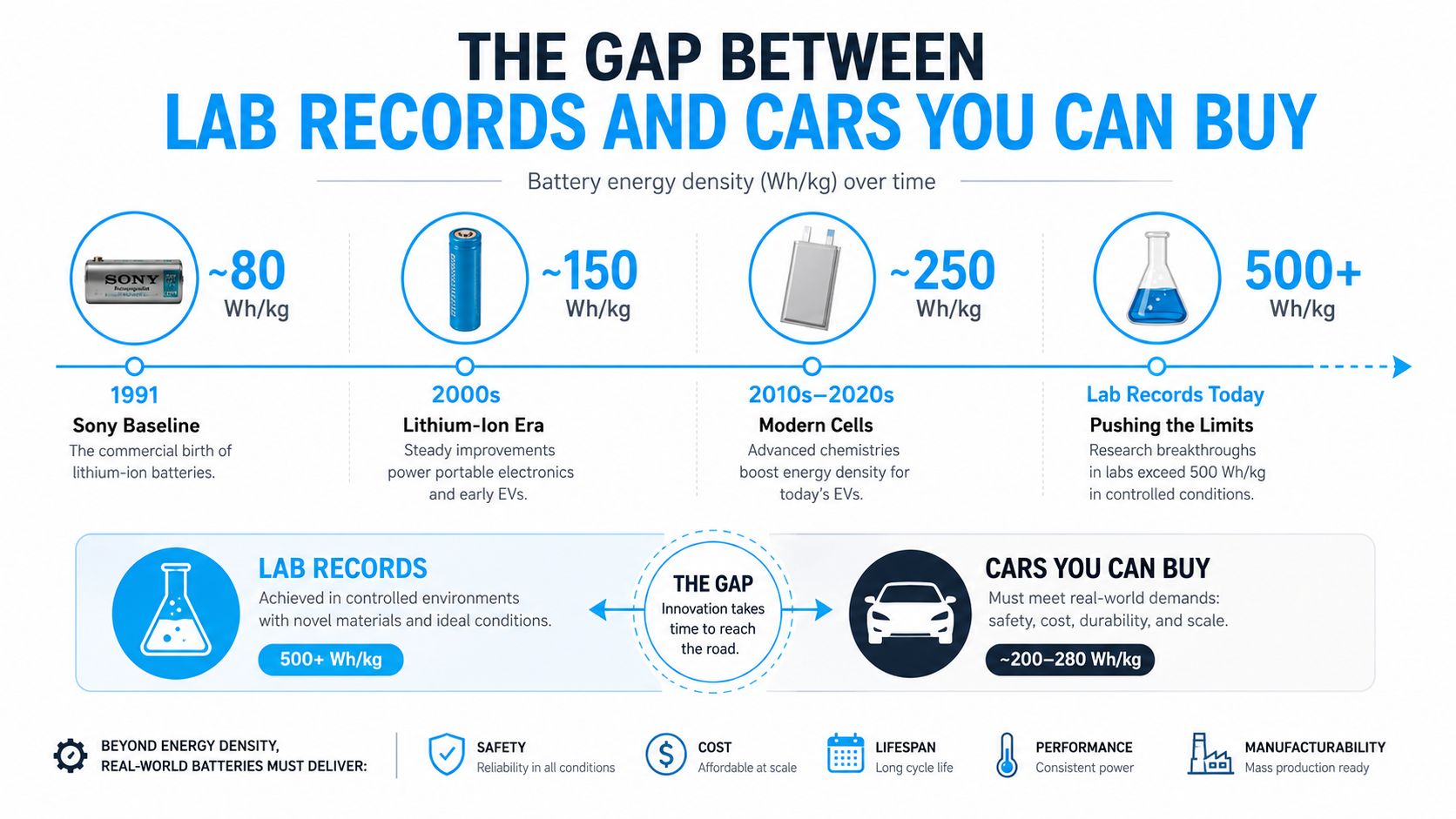
Battery energy density improves through a chain of small steps, not one dramatic jump. A recent trend compilation places early commercial lithium systems at roughly 130 Wh/kg in 1978, Sony's first commercial lithium-ion battery at about 90 Wh/kg in 1991, around 200 Wh/kg in 2014, 258 Wh/kg in 2016, and around 300 Wh/kg in 2021. Those numbers matter because they show how slowly battery performance usually moves. The trend compilation also helps show why lab headlines can feel far ahead of production vehicles.
Why the lab number isn't the car number
Prototype and laboratory reports from 2022 to 2023 describe milestones of 450 Wh/kg and 1,150 Wh/L, then 711.3 Wh/kg and 1,653.65 Wh/L in 2023. Those numbers are real, but they do not automatically become the cells in a production EV. A lab cell can be tested under conditions that favor a headline result, while a road car has to survive vibration, fast charging, safety requirements, temperature swings, and long-term cycling.
Commercial lithium-ion cells today are still typically around 250 Wh/kg and 700 Wh/L, which is why the distance between research and production still matters. The Springer review describes progress as the result of incremental chemistry and manufacturing gains, not a single breakthrough. That is the practical reason a buyer should read lab numbers carefully. A cell record can be exciting, but a vehicle spec sheet has to reflect a battery that can be built, cooled, validated, and sold at scale.
Why this gap should make buyers skeptical, not cynical
The gap does not mean progress is fake. It means battery engineering has to fit into the rest of the vehicle. A chemistry that looks extraordinary in the lab may still fall short of mass production, warranty expectations, or automotive safety margins.
Headline energy density often describes what a cell can do, not what a finished car can safely ship with.
That is why the honest conversation starts with the path from prototype to pack. A buyer cares about the battery that fits under the floor, survives daily use, and keeps performing after repeated charging. The highest record is not automatically the best choice for a car. The better battery is the one that can be manufactured consistently and delivered in a vehicle people can drive for years.
When Higher Density Is Not the Right Goal
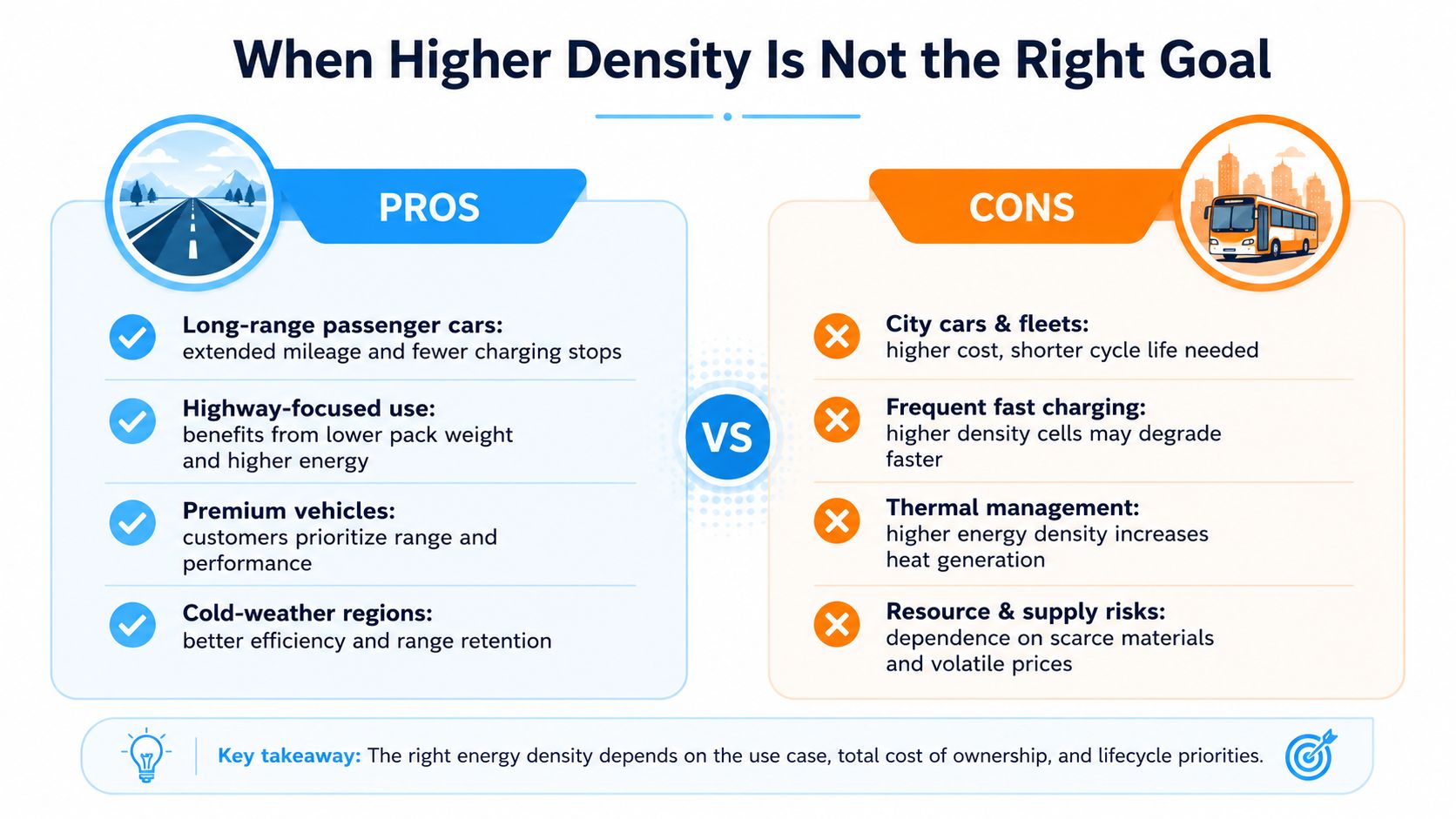
Higher density is useful when range and packaging are the bottlenecks. That's why it matters so much in long-range passenger cars. But there are plenty of use cases where a battery team should care more about safety, lifetime, cost, and installation complexity than about squeezing every last Wh/kg into the design.
Where density matters less
A recent spatial analysis argues that for large battery energy storage systems, energy density is often not critical and is overstated for grid-scale deployment (grid-scale analysis). That logic carries over to some fleet and depot-charged applications. If a vehicle returns to base every day, gets charged on a controlled schedule, and doesn't need to maximize long-haul range, then the best battery may be the one that is cheaper, safer, and longer-lived.
A simple decision filter
- Passenger cars on long trips: Higher density is usually valuable because range and weight both matter.
- City fleets and depot charging: Density can take a back seat to durability, cost, and thermal stability.
- Buses and stationary storage: System complexity and installation footprint often matter more than Wh/kg.
- Procurement decisions: Total cost of ownership should weigh chemistry, duty cycle, and pack design together.
That's also where battery degradation becomes part of the same conversation, because a denser battery that ages poorly can be a worse business decision than a less dense one that stays useful longer. The practical trade-off is covered further in the battery degradation guide.
Buyer Questions About Energy Density
Why can an LFP car sometimes post a respectable stated range even though its Wh/kg looks lower? Because range doesn't come from chemistry alone. It also comes from vehicle mass, aerodynamics, efficiency tuning, usable pack size, and how the manufacturer packages the battery into the car.
Why doesn't pack-level Wh/kg translate cleanly into road-trip distance? Because range depends on the whole vehicle, not just the battery. Two cars with similar pack energy can feel different on the highway if one is heavier, taller, or less efficient, and that's exactly why pack-level comparisons beat cell-level comparisons.
Does a denser battery charge faster? Not automatically. Density and charging speed are related only indirectly, because charging behavior depends on thermal design, cell chemistry, voltage limits, and how the battery management system protects the pack. A battery can be compact and still charge conservatively if the manufacturer is prioritizing longevity.
For readers who want to compare vehicles without getting trapped in chemistry jargon, it helps to look at full-model specs and battery packaging together. The most useful starting point is a side-by-side view of two cars with different pack designs, then checking how range, charging, and efficiency line up with the battery numbers in the battery comparison Q&A.
If you're comparing EVs, don't stop at the chemistry label. Use EV Stats to compare range, battery capacity, charging, and long-distance performance side by side, so you can see how battery energy density shows up in the actual car, not just the spec sheet.