

LFP is a lithium-ion battery with an iron-phosphate cathode, and by 2025 it accounted for over 55% of EV batteries deployed globally. That makes what is LFP a practical question, not an academic one, because the chemistry now shapes what many buyers drive, charge, and live with every day.
LFP has moved from a niche EV option to the default choice for a lot of vehicles and storage systems because it offers a different balance than nickel-rich batteries. Think of the cathode as the battery's personality, LFP is the calmer one, less dramatic under stress, more focused on longevity than on squeezing every last mile from every kilogram.
Table of Contents
- LFP Explained in Plain Language
- The Rise of LFP From Niche to Default
- Energy Density, Range, and Cycle Life Trade-Offs
- LFP vs NMC and Other EV Chemistries
- Why LFP Is Safer and What That Actually Means
- What LFP Means for Real EV Owners
- Why LFP Now Runs the Grid as Well as the Car
- Quick Answers for Buyers Choosing LFP
LFP Explained in Plain Language
LFP means lithium iron phosphate, a lithium-ion chemistry that uses iron and phosphate in the cathode instead of nickel, manganese, or cobalt. That material choice changes how the cell behaves under heat, repeated charging, and long service.
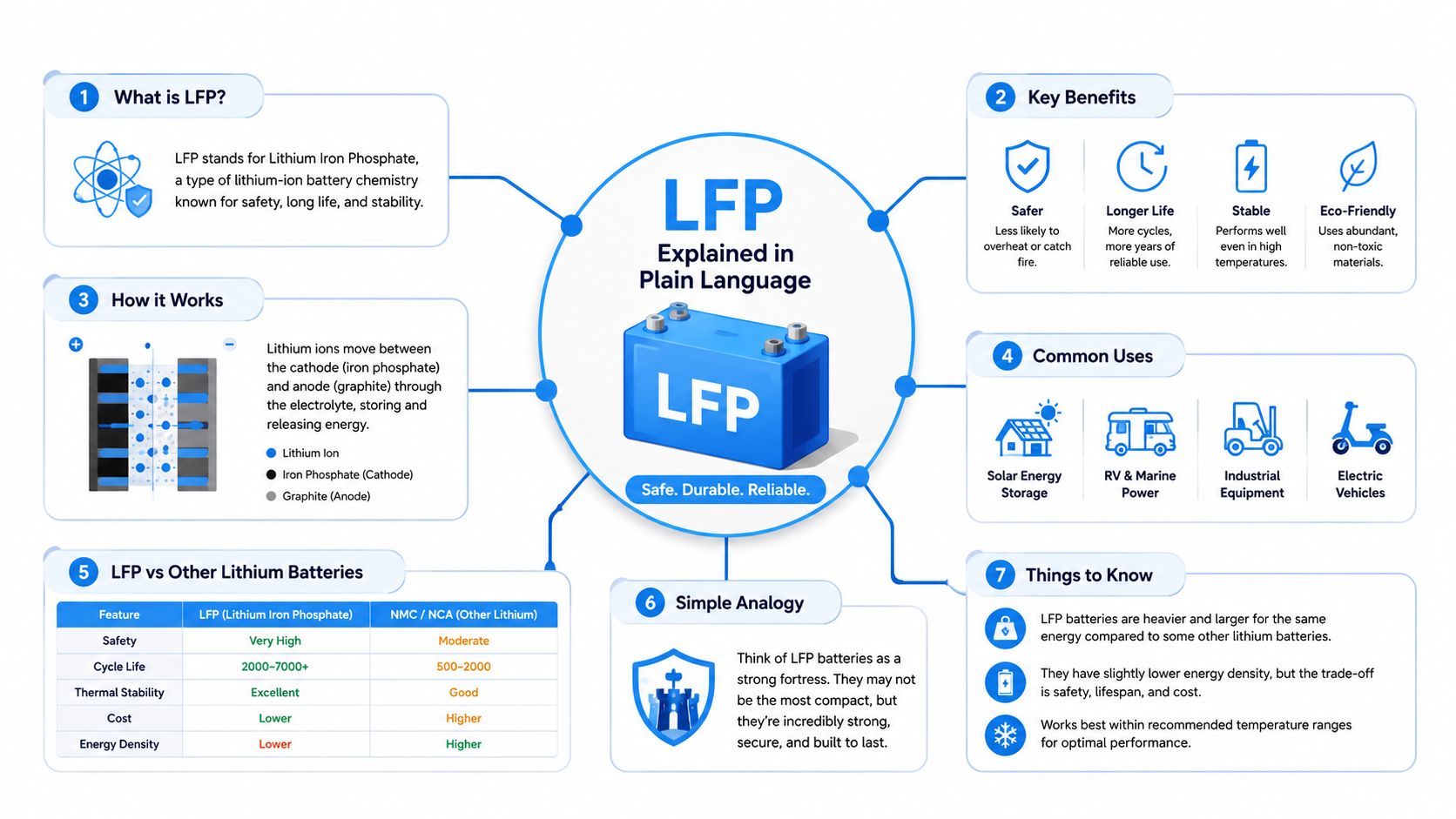
Nickel-rich chemistries usually store more energy in the same weight. LFP gives up some of that energy density, and in return it is easier to keep stable and use for repeated cycling over a long service life.
That trade-off is now common, not niche. The IEA reported that in 2025 LFP batteries accounted for over 55% of EV batteries deployed globally, which shows how widely the chemistry is being used. If you want a broader battery explainer for comparison shopping, this EV Stats battery guide is a useful companion.
For buyers, three points matter. LFP can lower battery cost. It usually lasts longer in cycle-heavy use. It generally gives up some range per kilogram compared with nickel-rich packs, so a vehicle may need a larger pack to match the same driving distance.
That is why LFP often fits drivers who charge often, keep cars for years, or want predictable ownership more than maximum range. It also helps explain why the same chemistry is attractive in stationary storage, where weight matters far less than durability and steady performance.
The Rise of LFP From Niche to Default
LFP did not become important because the chemistry changed overnight. It became important because manufacturers, especially in China, needed a battery that could scale, stay stable, and avoid the cost pressure tied to nickel and cobalt supply chains.
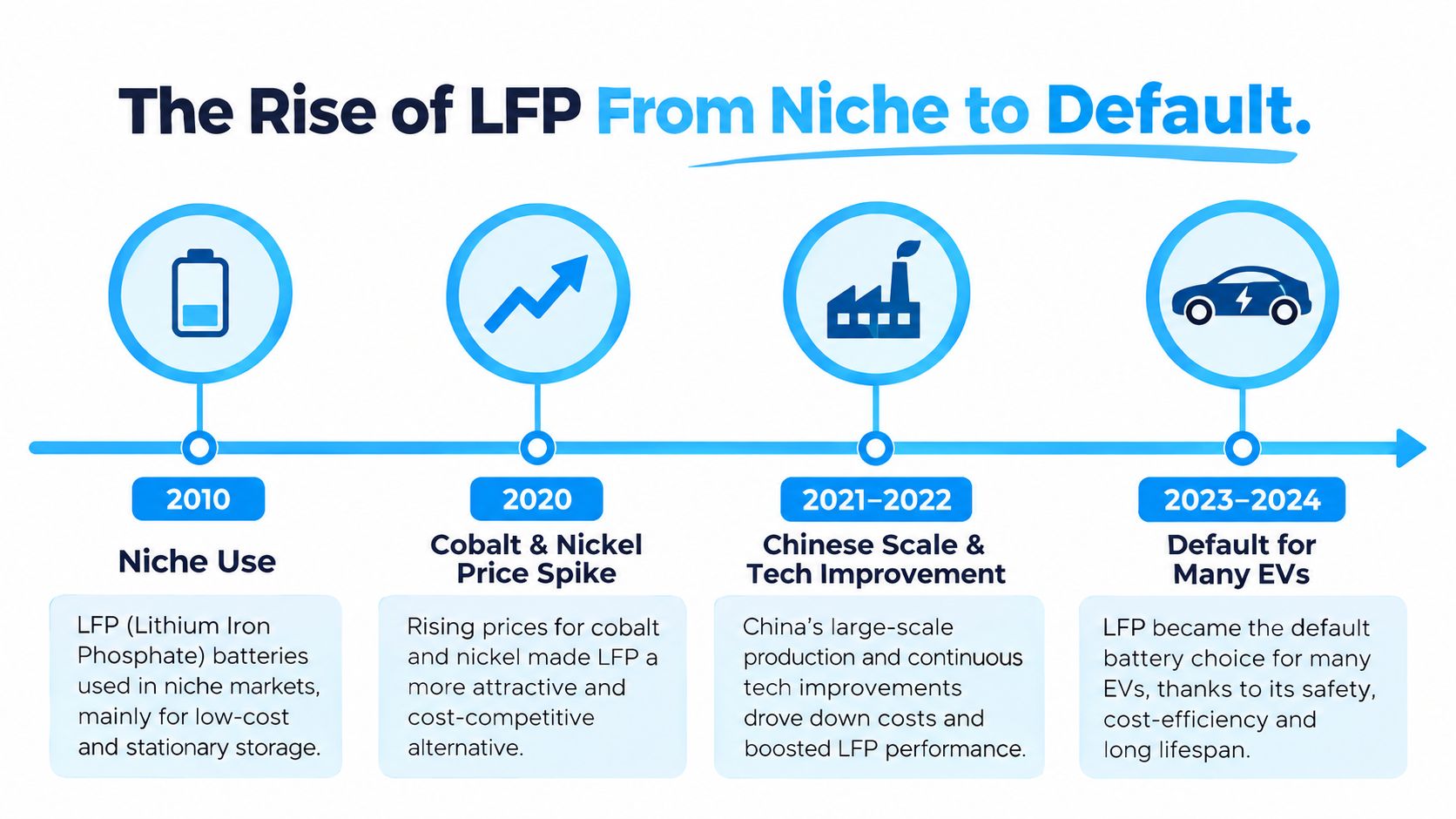
By 2023, the IEA said LFP supplied more than 40% of global EV battery demand by capacity and that two-thirds of EV sales in China used LFP. The same analysis said LFP's share in Europe and the United States stayed below 10% that year, which shows how uneven adoption still was across markets. China became the launchpad because it had the vehicle volume, cell-making scale, and standard-range models that fit LFP's strengths.
That commercial story matters because battery chemistry rarely wins on chemistry alone. It wins when automakers can source cells at scale, design vehicles around the trade-offs, and make the economics work for ordinary buyers. LFP fit that brief better than many rivals, especially for city cars, entry trims, and fleet vehicles.
The pattern also explains why the chemistry looks “sudden” to shoppers. To a driver, it can feel like LFP appeared all at once. In reality, it was gaining ground through factory decisions, model-line planning, and supply-chain investment long before most consumers noticed.
When the largest EV market makes a chemistry the default for many trims, global adoption usually follows the industrial logic, even if other regions lag behind.
Energy Density, Range, and Cycle Life Trade-Offs
LFP's main trade-off is straightforward. It stores less energy per kilogram than nickel-rich chemistries, which is why packs tend to be heavier or deliver less range at the same size. Review data places LFP at roughly 90 to 160 Wh/kg versus 150 to 250 Wh/kg for nickel-rich EV chemistries, and that gap is the reason some buyers see LFP as the “less range, more durability” option. EV Stats's energy density guide is a good next stop if you want a deeper comparison framework.
What that means in real ownership terms
If a car maker uses LFP, the vehicle may need a larger battery pack to reach the same headline range. That can affect weight, packaging, and sometimes charging behavior, but it also buys a strong cycle-life advantage. Review data commonly reports 3,000 to 5,000 cycles to about 80% remaining capacity, with the upper end possible under gentler operating conditions.
That long life comes from the chemistry's internal stability. The olivine structure is relatively resistant to damage during repeated charging and discharging, and the flatter voltage curve helps reduce stress across the cycle. In plain language, the battery wears more slowly because it isn't constantly being pushed and pulled as hard.
| Dimension | LFP | Nickel-rich (NMC/NCA) |
|---|---|---|
| Energy density | Lower | Higher |
| Pack weight for the same range | Higher | Lower |
| Cycle life | Longer | Shorter |
| Best fit | High-use, cost-sensitive, fleet, storage | Long-range trims, compact packaging |
| Range priority | Moderate | Strong |
The practical question is not which chemistry is “better.” It's which one fits your mileage pattern. If you drive hard every day, want a battery that ages slowly, and don't need the longest possible highway range, LFP is often the better fit. If you need maximum range in the smallest possible pack, nickel-rich cells still hold the edge.
LFP vs NMC and Other EV Chemistries
LFP and nickel-rich chemistries solve different problems, so buyers should compare them on the things that affect ownership, not just lab specs. Cost, range, cold-weather behavior, and longevity all matter, but they don't matter equally for every driver.
| Dimension | LFP | Nickel-rich NMC/NCA |
|---|---|---|
| Upfront cost tendency | Lower | Higher |
| Range per kilogram | Lower | Higher |
| Cold-weather behavior | More sensitive to usable range loss | Usually better at keeping usable range |
| Expected service life | Strong | Good, but typically shorter than LFP |
| Thermal safety margin | Stronger | Weaker relative to LFP |
| Best use case | Daily driving, fleets, storage, value-focused buyers | Long-range travel, compact packaging, performance-oriented trims |
The biggest advantage for LFP is that it gives manufacturers and owners a very usable battery without chasing the maximum possible energy density. That matters for cars that spend their lives in stop-start use, delivery duty, ride-hailing, or predictable commuting. It also matters when long-term value is measured by how much useful energy the pack can deliver over its life, not just how far the car goes on day one.
Nickel-rich batteries still make sense when range and packaging are the top priorities. A long-range sedan, a vehicle designed around fast highway trips, or a platform that needs a smaller pack for styling and mass reasons may still be better served by NMC or NCA.
Buyer shortcut: choose LFP when durability, thermal comfort, and cost matter most. Choose nickel-rich chemistry when you need the lightest, most compact path to long range.
Why LFP Is Safer and What That Actually Means
LFP's safety reputation comes from chemistry, not marketing. The cathode releases less oxygen under thermal abuse and shows lower exothermic reactivity, so the cell heats more slowly and thermal runaway tends to propagate less aggressively than in nickel-rich chemistries. That's why people describe LFP as more fire-resistant, not fireproof.
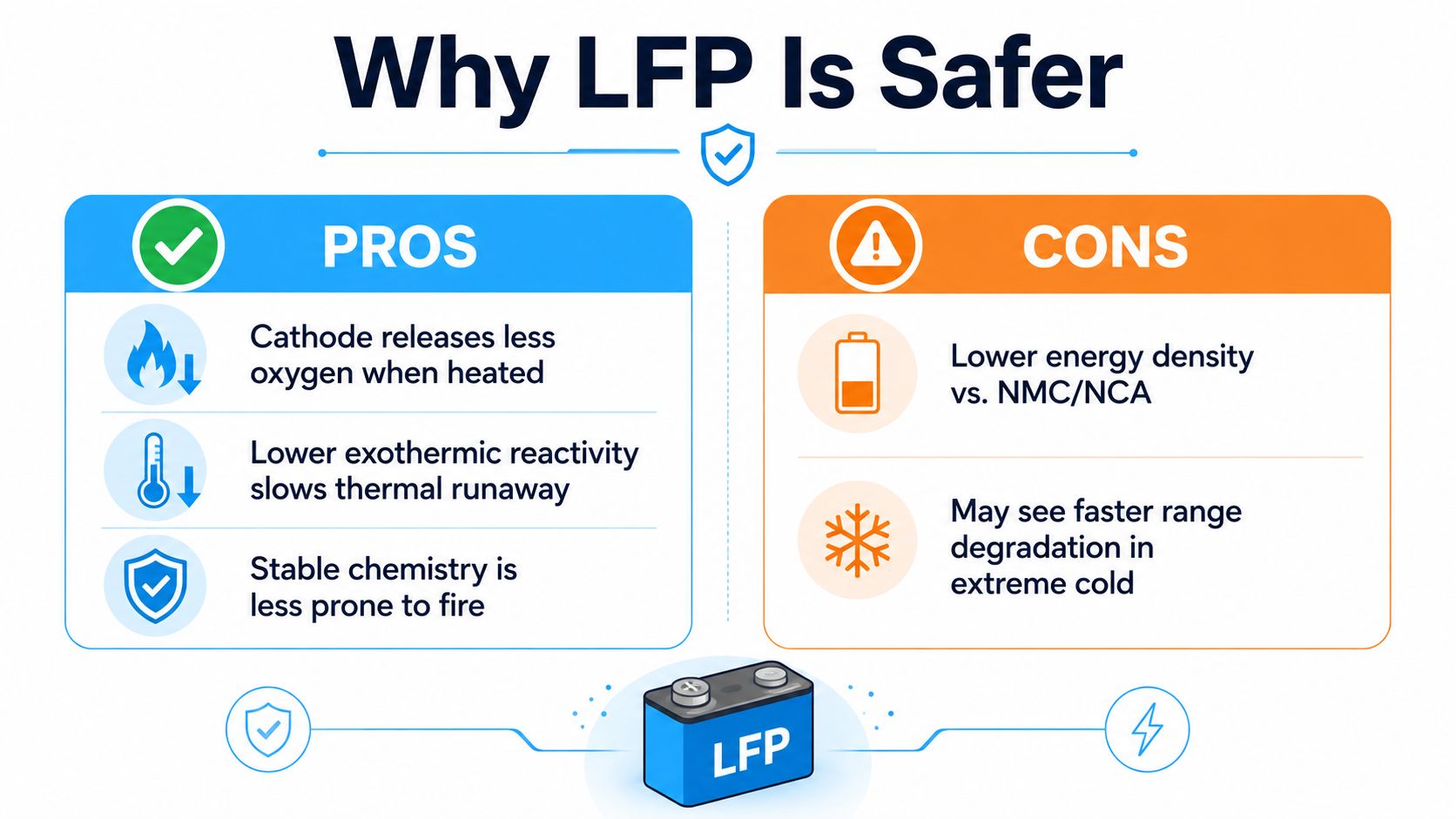
That difference is a bit like comparing a smoldering ember to a flare-up. Neither is harmless, but one has far less energy to release in a worst-case event. For an owner, that usually means a wider safety margin in abuse conditions and a chemistry that is more forgiving when the pack is stressed.
The important caveat is that “safer” doesn't mean immune. Experimental work showed that at rapid heating rates above 80 °C/min, full-cell thermal runaway in LFP can still begin below 45 °C, with heat release above 270 J/g. That tells you two things at once. LFP is strong, and pack design still matters a lot.
So the right takeaway is calibrated confidence. LFP improves fire-resistance margins, but it still depends on proper thermal management, good battery management software, and abuse detection. A well-engineered pack matters more than the chemistry badge alone.
What LFP Means for Real EV Owners
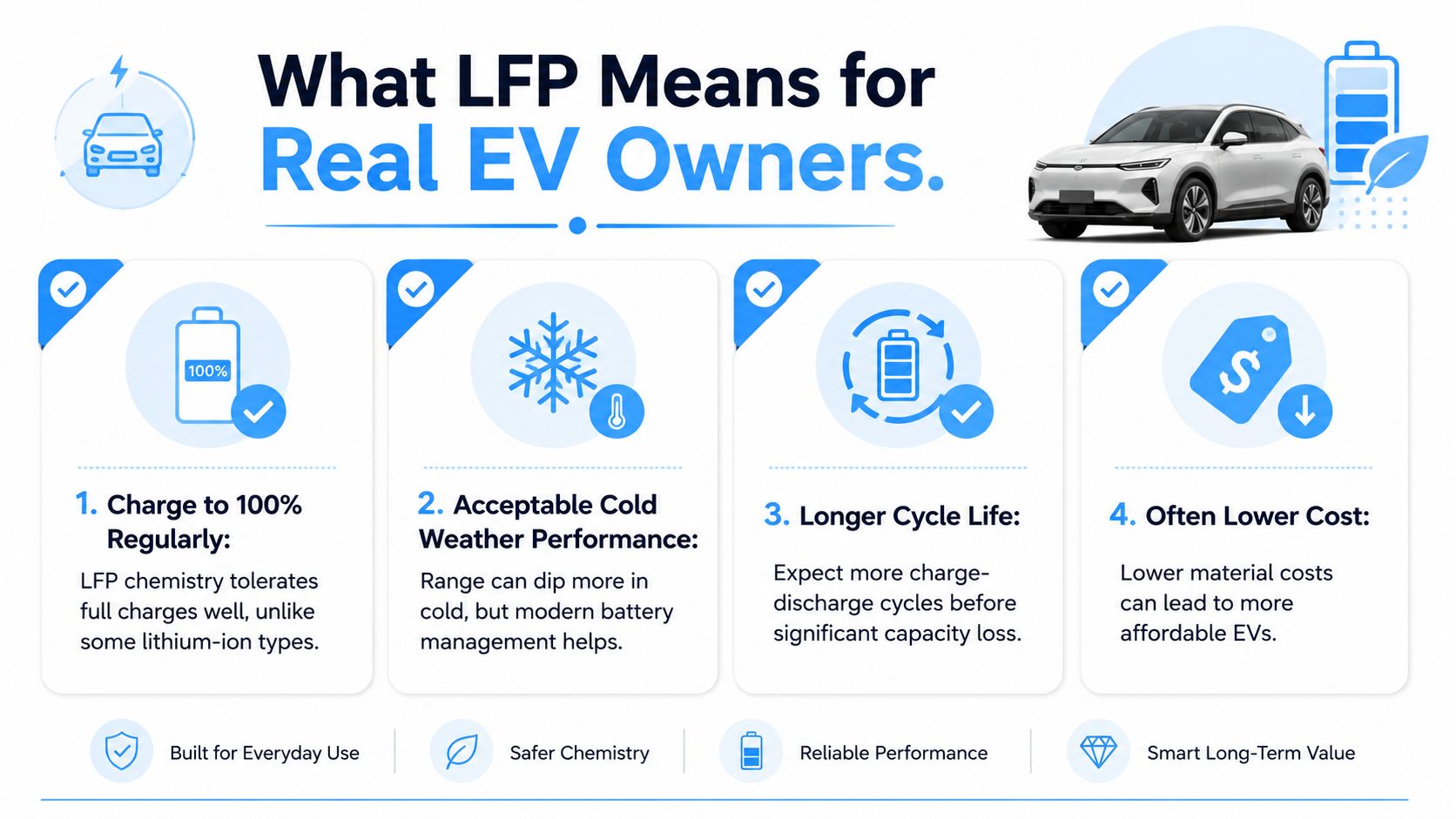
For buyers, the chemistry only matters if it changes day-to-day ownership. LFP does that in four places that come up again and again, charging habits, winter behavior, pack longevity, and whether the vehicle is doing easy miles or hard work.
Charge to 100 percent more often
LFP tolerates full charging well because of its stable olivine structure and flatter voltage curve. That matters because many owners of nickel-rich EVs try to avoid sitting at 100% for long periods, while LFP drivers usually have more freedom to top up fully when they need the range.
Expect a different winter feel
Cold weather can reduce usable range in any EV, and LFP tends to feel that more because the chemistry has less energy density to begin with. Modern battery management helps a lot, but buyers who live in cold climates should assume winter range will matter more than the brochure number.
Think in cycles, not just years
The longer cycle life changes replacement timing. A pack that is used heavily but gently can stay useful for a long time, and that's why LFP is attractive for high-utilization drivers who care about total lifetime energy throughput. This EV Stats article on battery degradation helps if you want to connect chemistry to long-term capacity loss.
Fleet use is where LFP shines
Fleet operators often care less about maximum range per kilogram and more about uptime, predictable wear, and lower operating stress. That is why LFP fits delivery vans, ride-hailing cars, and other vehicles that cycle constantly and return to charge often.
Ownership rule: if your use case is repetitive, predictable, and mileage-heavy, LFP's strengths show up faster than they do in a low-mileage personal car.
Why LFP Now Runs the Grid as Well as the Car
LFP is not just an EV chemistry anymore. The IEA reported that in 2025 it represented over 90% of global stationary battery storage installations, and that roughly 40% of total LFP deployments that year were in storage rather than EVs. That shift matters to car buyers even if they never own a home battery.
Grid storage needs the same things many EV owners want, durability, thermal stability, and controlled cost. When one chemistry dominates both cars and storage, manufacturers get scale across two markets at once. That usually helps supply-chain investment, factory learning, and cost discipline, all of which can feed back into vehicle pricing and availability.
It also validates the chemistry in a demanding environment. Storage systems cycle hard, sit for long periods, and must keep working reliably. When the same chemistry is trusted for grid assets and passenger cars, that tells buyers something useful about its real-world durability.
The bigger picture is simple. Choosing an LFP EV means buying into the battery chemistry that has become central to both mobility and stationary power. That doesn't make it the right answer for every driver, but it does make it one of the most heavily deployed battery choices in the world.
Quick Answers for Buyers Choosing LFP
Can I charge an LFP battery to 100% regularly? Yes, that's one of its main advantages. LFP chemistry is generally comfortable with full charges, so owners often use the top of the pack more freely than they would with nickel-rich batteries.
Does LFP give up range? Usually, yes, at the same pack size and weight. The trade-off is that the battery often lasts longer and can be a smarter buy if your daily driving doesn't require the longest possible highway range.
Is LFP a good choice for cold climates? It can be, but winter behavior deserves more attention. Usable range can feel tighter in the cold, so buyers in harsh climates should look closely at thermal management and real-world winter test data before deciding.
Is LFP better for fleets? Often, yes. Fleets usually care about longevity, predictable wear, and total lifetime energy throughput, which lines up neatly with what LFP does well.
How should I think about replacement timing? Think in cycles and usage intensity, not just the calendar. A heavily used LFP pack can stay useful for a long time because the chemistry is built for repeated charging and discharging.
Is this chemistry right for every EV buyer? No. Drivers who want maximum range in the smallest possible pack may still prefer nickel-rich batteries, while drivers who value durability, safety margin, and lower-cost ownership often find LFP easier to live with.
If you're comparing EVs and want to see which models use LFP, EV Stats lets you check battery type, range, and other key specs in one place. Use it to match chemistry to your commute, climate, and charging habits before you sign anything.