

You plug in your EV after dinner, expecting it to do one simple job: recharge before morning. In a conventional setup, electricity flows in one direction, from the grid to the car. With vehicle-to-grid charging, that same parked EV can become a controlled source of electricity for your home, a building, or the wider grid, provided the vehicle, charger, software, and utility rules all support the arrangement.
The idea sounds straightforward, but the details matter. A car that can power a phone or appliance through a built-in outlet isn't automatically capable of exporting energy through a home electrical panel or public grid connection. This guide follows the energy from the moment you plug in, then separates residential backup from true grid participation, explains the hardware and standards involved, and examines whether the economics work today.
Table of Contents
- Why Your EV Could Become a Power Plant
- How Bidirectional Power Flow Actually Works
- The Hardware and Standards Behind V2G
- Three Real World V2G Use Cases
- The Economics of Vehicle to Grid Charging
- Risks and Grid Side Challenges Most Guides Skip
- Is Your Setup Ready for V2G
Why Your EV Could Become a Power Plant
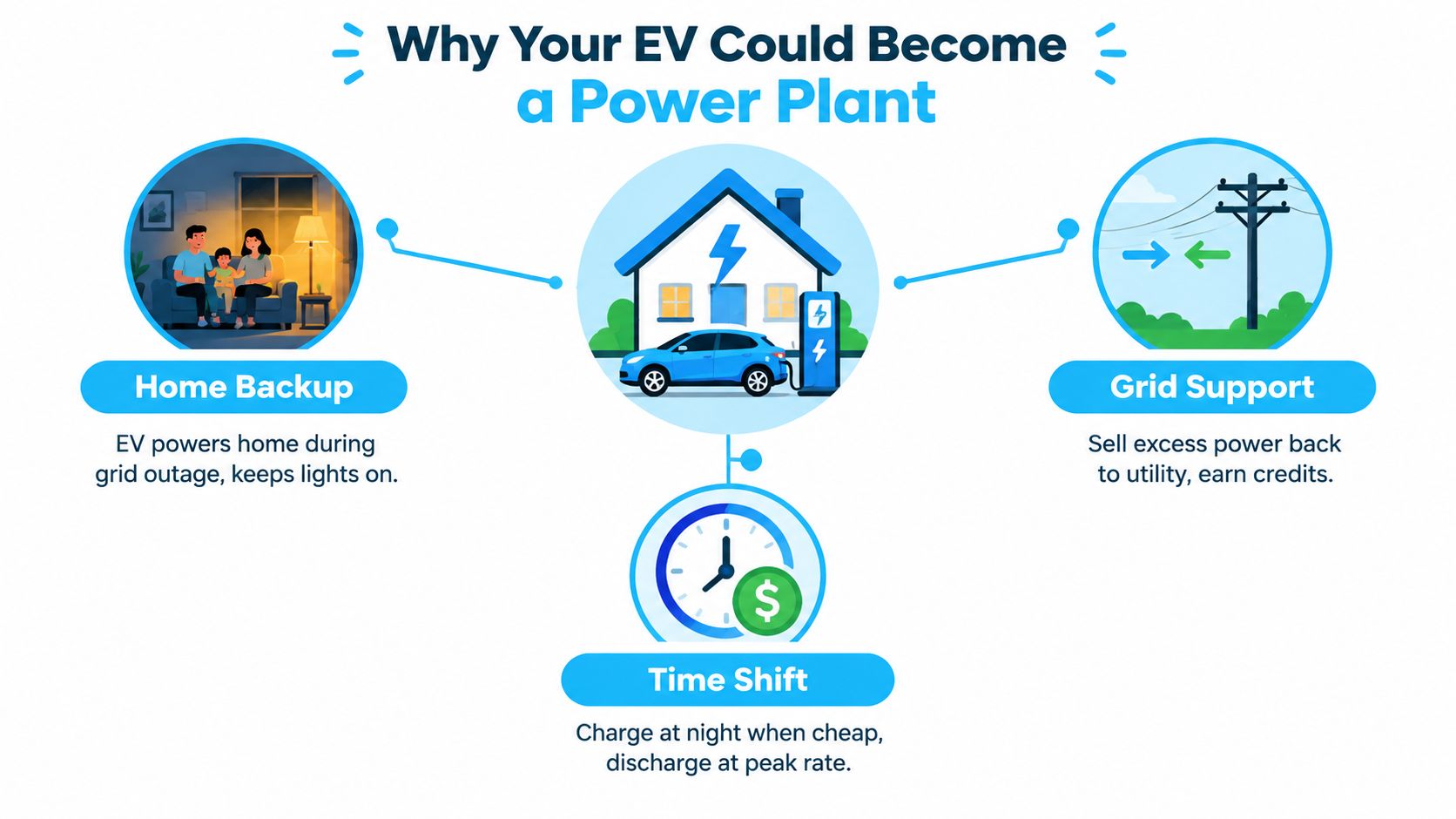
The power fails on a winter evening. The refrigerator goes quiet, the Wi-Fi router shuts down, and the family reaches for flashlights. With vehicle-to-home charging, a correctly installed bidirectional charger can separate the house from the utility line and draw power from the EV battery. Selected circuits can continue operating while the vehicle serves as a temporary home battery.
That familiar outage scenario shows the residential value first. An EV is stored energy on wheels, not merely transportation or a large electrical load. With compatible equipment, its battery can supply the home during an outage and, under different controls and agreements, support the grid while the car remains parked.
From one-way charging to controlled exchange
Ordinary EV charging works like filling a tank. Electricity travels from the grid through the charger into the battery, where it remains available for driving. Bidirectional charging adds a managed route in the opposite direction. A home energy controller, utility, or market signal can authorize the system to discharge when the stored energy has greater value.
The same principle connects a plugged-in car at home to the wider grid picture. Demand changes throughout the day, while wind and solar production varies with weather and daylight. A connected EV fleet can absorb surplus renewable electricity, lower a building's peak demand, or provide limited support during an outage.
The vehicle does not make these decisions on its own. The battery, power electronics, charger, software, electrical panel, and utility connection must coordinate within approved operating limits.
Policy makers and utilities in the United States, the European Union, the United Kingdom, and Japan have shown interest in this model. Commercial availability remains limited. An assessment of the V2G market and vehicle ecosystem identified 22 EV models with V2G capabilities in commercial use, representing less than 1.5% of EV models worldwide. Millions of EVs may be on the road, yet only a small share can export energy under real-world conditions.
Practical rule: An EV becomes a distributed power plant only when its battery, power electronics, charger, controls, and electrical connection are designed to work together.
The IEA discussion of vehicle-to-grid technology describes interest in V2G for renewable integration, grid flexibility, and EV growth. Commercial expectations are advancing faster than installed capability. Utilities, automakers, and charging companies are developing around a useful capability, but a current EV should not be assumed to earn money or power a home without verified vehicle, charger, and utility compatibility.
How Bidirectional Power Flow Actually Works
Think of an EV as a power bank on wheels, but with a key difference. A household power bank has a small inverter and powers a limited device. An EV battery stores much more energy, yet it still needs approved conversion equipment, protection controls, and a safe connection before it can supply a house or grid.
During ordinary charging, alternating current from the grid passes through a rectifier. The rectifier converts AC to DC, because the vehicle battery stores DC energy. During discharge, the process reverses. Stored DC passes through an inverter that produces grid-compatible AC for the home or utility network.
The three routes electricity can take
AC bidirectional charging uses the vehicle's onboard charger for the conversion process. The wall unit and vehicle communicate about voltage, current, limits, and operating conditions. ISO 15118-20 provides the communication framework for bidirectional power transfer between the EV and EV supply equipment.
DC bidirectional charging moves the conversion equipment outside the vehicle. The charger converts grid AC to battery DC during charging, then battery DC back to AC during export. This approach can bypass the vehicle's onboard charger, but the external unit still needs model-specific compatibility, certification, and control software.
Fleet operators may also use specialized systems. Pantograph equipment can connect buses or commercial vehicles at a depot, while inductive systems transfer energy without a conventional plug. These options suit controlled fleet environments more readily than typical driveways.
For a broader foundation on one-way charging, see this guide to how EV charging works.
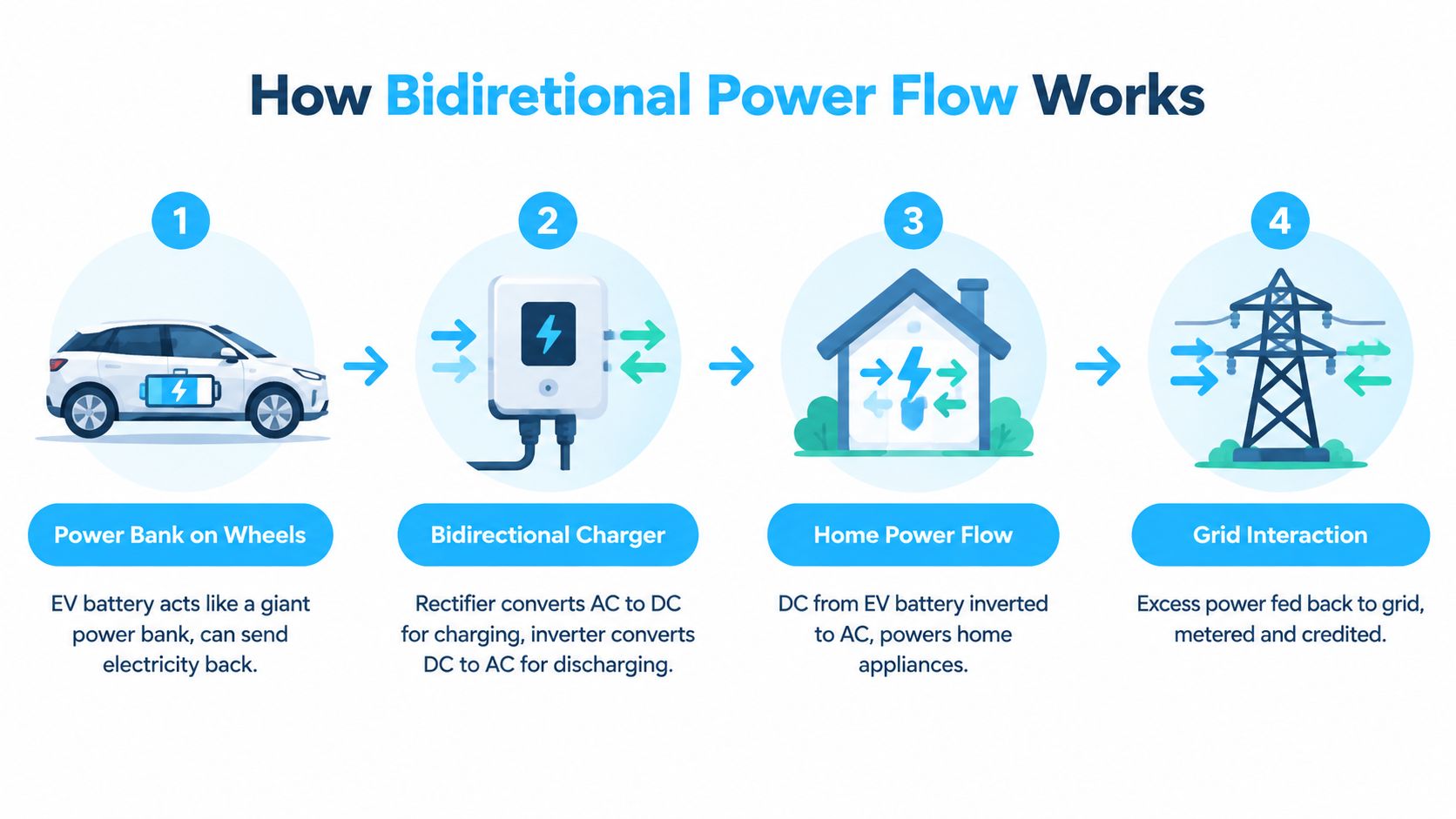
The labels describe where the energy goes
- V2H, vehicle to home: The EV supplies a house, usually through an isolation device that prevents dangerous backfeed onto a downed utility line.
- V2B, vehicle to building: The same principle serves a commercial or institutional building, often under an energy-management system.
- V2G, vehicle to grid: Exported energy enters the public network under an approved interconnection and settlement arrangement.
- V2X, vehicle to everything: This umbrella term covers external loads, homes, buildings, and grid services.
A reverse-flow event can begin with an energy price, a scheduled charging session, an outage signal, or a utility dispatch command. The control platform checks the vehicle's departure time and minimum state of charge, then decides whether the car should charge, wait, or discharge.
The complete sequence is simple to describe. The EV charges when energy is available, preserves the driver's required reserve, exports only when authorized, and resumes charging when the vehicle needs preparation for travel.
A short visual explanation of this sequence is available below.
The Hardware and Standards Behind V2G
A V2G installation has three layers to verify: the vehicle, the charger, and the site connection. A compatible cable alone isn't enough. Each layer must support two-way power, safe control, and the local rules for connecting distributed energy resources.
Start with the vehicle
First, check the exact trim, model year, connector, and software version. Some vehicles support V2H but not public-grid export. Others may require an OEM firmware update or a particular charger partner. The battery-management system and high-voltage contactors must authorize current in both directions without exceeding thermal, voltage, or state-of-charge limits.
Don't infer capability from a marketing phrase such as “smart charging.” Smart charging can delay or accelerate grid-to-car charging. Ask the manufacturer whether the vehicle supports bidirectional discharge, which external chargers are approved, and how the battery warranty treats exported energy.
Then inspect the charger and backend
AC bidirectional equipment relies heavily on the vehicle's onboard power electronics. DC bidirectional equipment places the inverter in the charger, which can support different power architectures but often requires tighter vehicle-specific integration.
The standards stack separates the responsibilities. The V2G standards presentation from the Vehicle Grid Integration Council identifies ISO 15118-20 for EV and EVSE communication, while North American deployments commonly use UL 1741 and UL 9741 certification for bidirectional equipment. OCPP 2.1 extends backend control for distributed energy resources, allowing a charger-management platform to translate utility instructions into charging or discharging commands.
For basic charger terminology, compare the different EV charging levels before evaluating equipment.
Finally, verify the site
The house or depot needs adequate panel capacity, a compatible energy-management system, appropriate metering, and a utility-approved interconnection. A transfer switch or other isolation equipment may be necessary for backup operation. The installer should also explain what happens if communications fail, the vehicle leaves unexpectedly, or the utility withdraws permission to export.
| Layer | Key standard or component | What it does |
|---|---|---|
| Vehicle | Battery controls, contactors, OEM software | Authorizes safe bidirectional operation |
| EV to charger | ISO 15118-20 | Manages communication for bidirectional power transfer |
| Bidirectional equipment | UL 1741 and UL 9741 | Supports safety and certification requirements in applicable North American deployments |
| Backend | OCPP 2.1 | Connects charger controls with energy-management and grid-service platforms |
| Site | Panel, meter, isolation equipment, utility agreement | Connects export safely to the home, building, or grid |
Three Real World V2G Use Cases
The same EV and bidirectional charger can deliver very different value depending on where the electricity goes. A homeowner may use the battery only during an outage. A depot manager may reduce a site's peak demand. An aggregator may combine many vehicles and sell a flexibility service into an organized market.
Residential backup and self-consumption
A home installation prioritizes resilience and bill management. The controller can preserve a driving reserve, use stored energy for selected household circuits, and return to charging after the high-price period or outage ends. The owner may never send power to the public grid, so the financial benefit comes from avoided purchases rather than a market settlement.
This setup needs careful electrical design. The charger must separate the home from the utility during an outage, and the homeowner must understand which circuits are supported. A vehicle that can power a home isn't automatically a whole-house generator.
Fleet depot optimization
A depot offers more predictable schedules. Vans return to a known site, charge during lower-cost periods, and remain available for controlled dispatch before their next route. A site controller can coordinate the fleet with rooftop solar, building demand, and local transformer limits.
The operator's return depends on the tariff and operational discipline. Exporting electricity may help, but avoiding a costly demand peak or absorbing on-site solar can be just as important. Fleet V2G works best when the manager knows departure requirements and can reserve enough battery energy for every route.
Wholesale grid services
An aggregator combines vehicles from multiple homes, workplaces, or depots. The combined resource can respond to a grid signal for services such as frequency regulation or peak shaving, subject to market rules, telemetry requirements, and customer opt-out conditions.
This model has the greatest software and regulatory complexity. The individual driver may receive a payment or credit, but the aggregator, utility, charger provider, and market operator each have roles in dispatch and settlement. The owner also gives up some control over when the battery cycles, within the limits set by the contract.
| Dimension | Residential V2H | Fleet depot | Grid services |
|---|---|---|---|
| Primary purpose | Backup and self-consumption | Peak management and solar coordination | Aggregated flexibility for a market or utility |
| Operating pattern | Occasional, scheduled, or outage-driven | Repeated dispatch around fleet schedules | Rapid or scheduled response to external signals |
| Settlement | Usually avoided household purchases | Site tariff savings or approved export | Program payment, credit, or market settlement |
| Main constraint | Home wiring and vehicle reserve | Route readiness and site capacity | Aggregation rules, telemetry, and interoperability |
| Best fit | Drivers who value resilience | Predictable commercial fleets | Connected vehicles enrolled with an aggregator |
The Economics of Vehicle to Grid Charging
At home, an EV may sit connected for hours after it has reached the charge level needed for the next trip. That parked battery can create value by charging when energy costs less, exporting when electricity is more valuable, or supporting the household during an outage. The financial result depends on what the owner must pay before receiving any credit.
The bill includes more than electricity. Hardware, installation, software, program participation, export limits, and battery wear all affect the calculation. A payment for availability may look attractive until these costs are included.
Recent reviews describe individual-owner revenue as typically modest and warn that it may not offset battery degradation. The same review places bidirectional charger hardware and installation at about £3,700, while suggesting that broad adoption may need hardware costs closer to £1,000 per unit. It also describes V2G as largely trial-based as of 2025. See the review of V2G economics and adoption barriers for that assessment.
Count the costs that marketing leaves out
The first cost is equipment. A bidirectional charger is more than a wall-mounted socket. It combines power-conversion hardware, isolation and protection functions, communications, metering, and software integration. Installation may also require electrical work that a conventional home charger does not.
The second cost is opportunity. Discharging an EV can leave less energy for an unexpected trip. A program that pays for availability may fit one driver's routine and frustrate another's. Battery wear has a financial value even when it does not appear as a separate invoice.
| Cost or revenue item | Current position | Target or direction | Notes |
|---|---|---|---|
| Bidirectional hardware and installation | About £3,700 in the cited review | Closer to £1,000 per unit for broader adoption | Figures and adoption context from the verified economic review |
| Owner revenue | Typically modest | Needs to exceed equipment and wear costs | Depends on tariffs, utilization, and program rules |
| Battery impact | May not be offset by individual revenue | Better controls and stronger compensation | Depth of discharge, temperature, and cycling strategy matter |
| Grid value | Growing commercial interest | More mature programs and interoperability | Market forecasts reflect expectations, not guaranteed household returns |
Market forecasts help explain why companies continue investing. The cited industry estimate valued the global V2G market at USD 5.75 billion in 2025 and projected USD 20.24 billion by 2031, with a 22.22% compound annual growth rate from 2026 to 2031. These figures describe expected market expansion, not the return from one household vehicle.
The useful question is, “Who captures the value, and does that value exceed my added costs?” A fleet with predictable schedules may gain from demand management. A homeowner with an expensive charger and limited export access may value backup more than revenue. Before enrolling, the driver should request the tariff, dispatch assumptions, minimum battery reserve, compensation formula, and warranty treatment in writing.
Risks and Grid Side Challenges Most Guides Skip
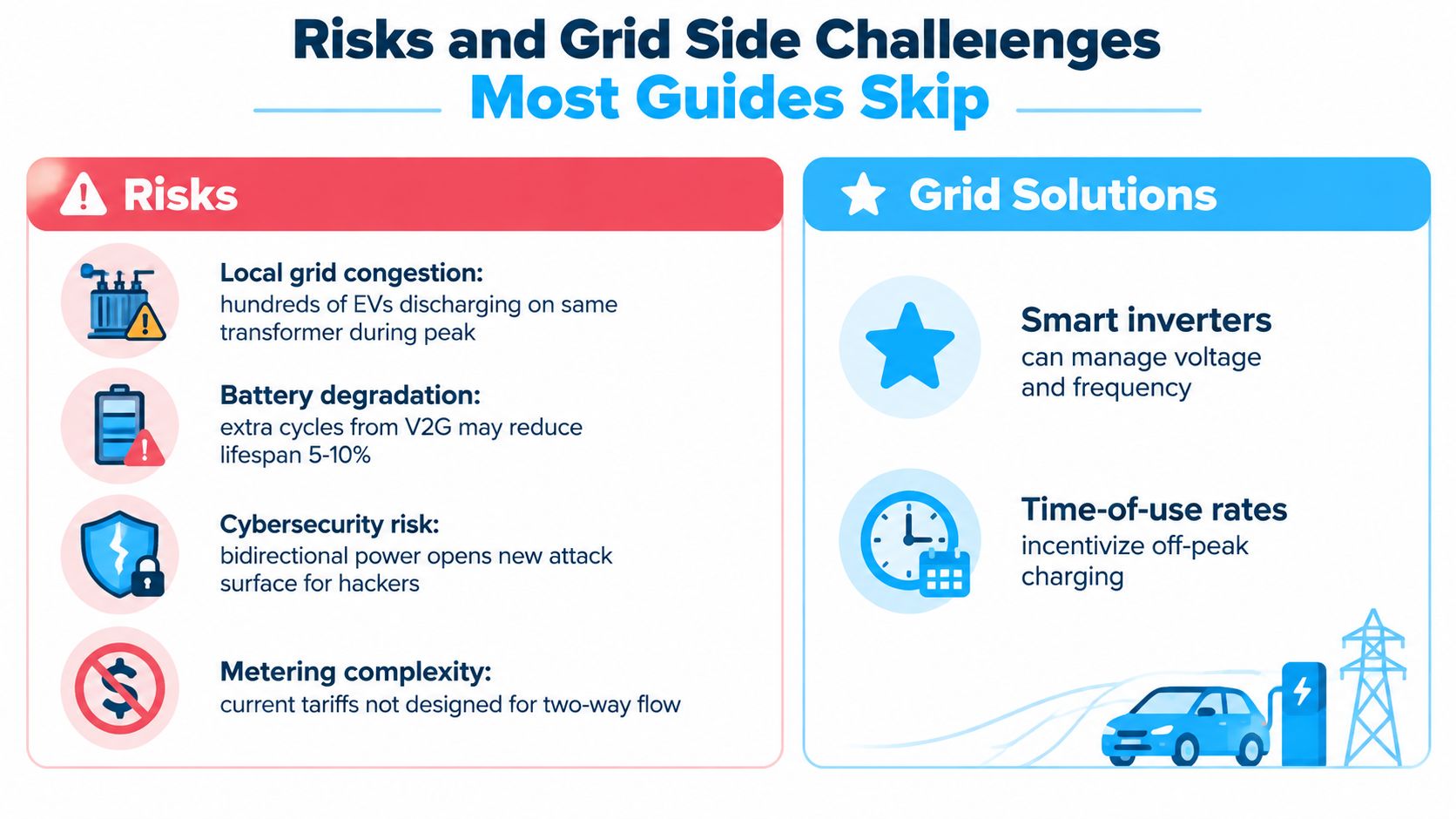
V2G can help the grid, but uncontrolled V2G can also create a new local problem. If many vehicles respond to the same price signal at the same time, they may overload a neighborhood transformer or push voltage outside acceptable limits. The important engineering question isn't only whether EVs can export power. It's whether the distribution network can coordinate that export at the location and time where it occurs.
A 2025 utility and distribution-system-operator paper warns that simultaneous EV activations can worsen local congestion. It also points to limited deployment of flexibility services, incomplete implementation of relevant European rules, and interoperability barriers. Those concerns shift the discussion from a broad promise to an operational test: does this dispatch relieve a constraint, or move the constraint somewhere else?
Four failure points deserve attention
- Local congestion: A platform may see thousands of flexible batteries, while a utility sees individual transformers, feeders, and voltage limits. Dispatch software needs network-aware constraints, not only wholesale price signals.
- Regulatory fragmentation: A vehicle exporting electricity crosses transport, electrical safety, utility, and market rules. Different jurisdictions may define metering, interconnection, and compensation differently.
- Interoperability gaps: ISO 15118-20, charger firmware, vehicle software, and backend protocols still need consistent implementation. A technically capable car may work with one charger and fail certification with another.
- Utility-side economics: Standby charges, minimum-take provisions, demand-charge structures, and slow deployment of distributed-energy management systems can reduce the customer's savings even when the equipment operates correctly.
The practical test: A V2G program should prove that its dispatch respects local network limits and the driver's mobility needs at the same time.
Cybersecurity and metering also deserve explicit treatment. A bidirectional charger can receive commands that affect real power flow, so access control, update procedures, event logs, and fail-safe behavior matter. Two-way energy also complicates billing because the meter must distinguish imports, exports, timing, and program attribution.
These aren't reasons to dismiss the technology. Utilities can use export limits, staggered dispatch, transformer monitoring, and time-based controls. Installers and program operators can improve compatibility testing and document fallback behavior. The barriers are real, but they are engineering and market-design problems rather than evidence that every V2G deployment will fail.
For a focused explanation of battery wear considerations, review EV battery degradation.
Is Your Setup Ready for V2G
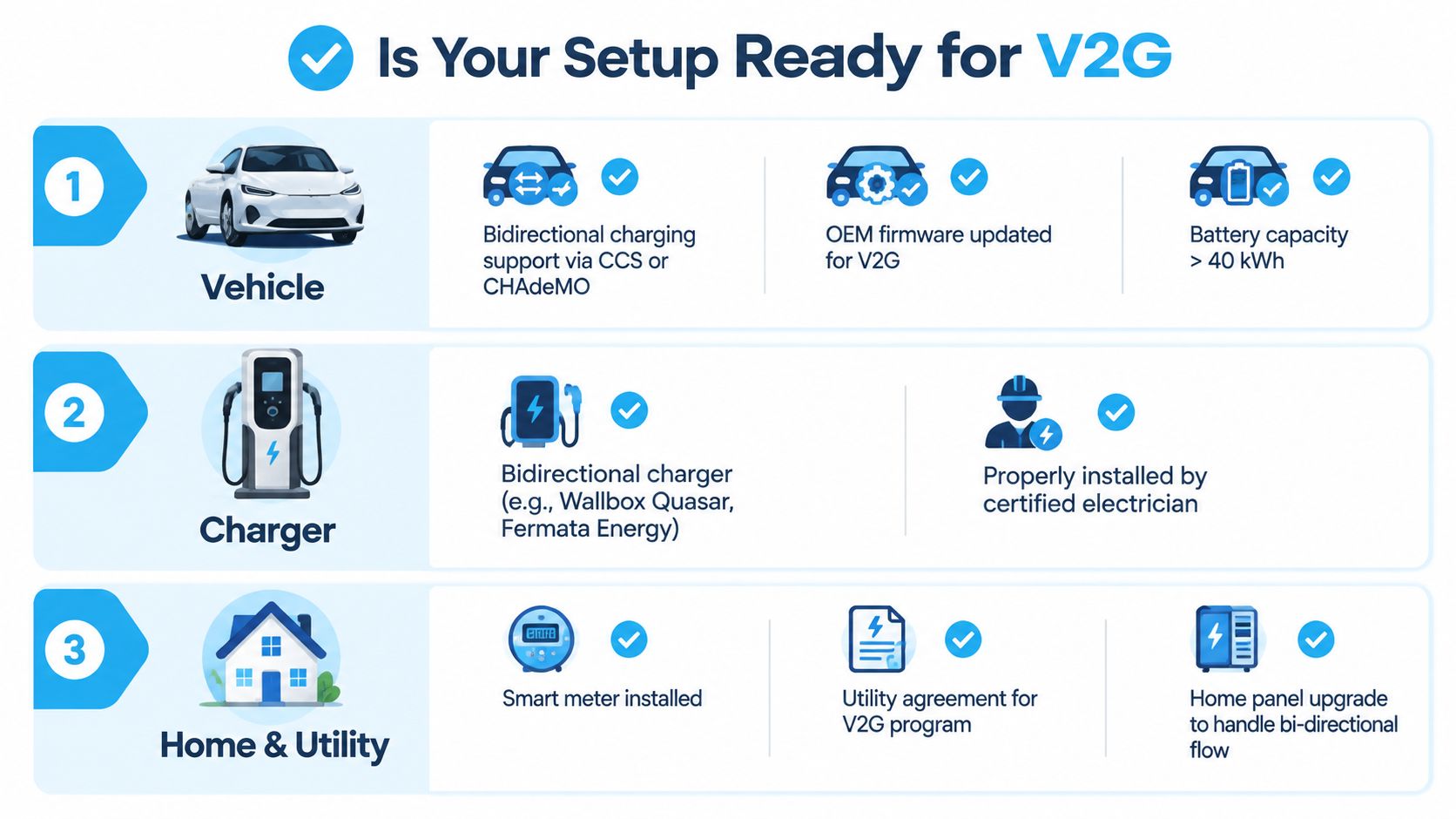
Readiness starts with the exact vehicle, not the badge on the hood. Confirm that the model and trim support bidirectional charging through the connector and charger architecture available in your region. Then ask the manufacturer whether an OEM software update is required, whether V2H and V2G are both supported, and how exported energy affects the battery warranty.
The connector matters, but it isn't the whole answer. CCS and CHAdeMO systems can support bidirectional configurations when the vehicle and equipment implement the required controls. A home that has a standard AC wallbox still may need a dedicated bidirectional EVSE, appropriate protection, a smart meter, and a utility agreement.
Use three verification tiers
Vehicle: Verify bidirectional discharge support, firmware enablement, battery warranty language, and the minimum state of charge the program requires. Don't rely on an online forum or a generic “vehicle-to-load” label.
Charger: Request the exact model number, certification documentation, supported vehicle list, islanding or transfer-switch design, and backend protocol. The installer should explain whether the charger uses AC or DC conversion and what happens if the internet connection disappears.
Home and utility: Check service capacity, panel loading, neutral and grounding arrangements, meter capability, and interconnection approval. Ask whether your tariff supports export, whether enrollment is open, and whether the utility requires an approved aggregator.
A decision matrix is useful, but it must remain model-specific. Factory-ready vehicles can still need a compatible charger and local program. Vehicles without approved bidirectional discharge generally require aftermarket DC equipment, and that path may not be supported by the manufacturer or warranty.
| Vehicle situation | Likely path | What to verify |
|---|---|---|
| Factory-enabled V2H or V2G model | Approved bidirectional charger | OEM firmware, charger compatibility, warranty, utility permission |
| Vehicle with V2L only | Appliance or limited-load use | Whether the feature can connect to a home transfer system |
| Vehicle with no published export capability | No standard V2G path | OEM support, aftermarket equipment certification, warranty limits |
| Fleet vehicle with depot controls | Managed DC or specialized system | Vehicle schedule, charger software, site capacity, dispatch limits |
Before commissioning, request the installer's compatibility record, utility approval, and backend event logs. Ask whether ISO 15118-20, OCPP 2.1, or another approved interface is active in your configuration, and clarify who handles firmware updates. Eligibility can change as automakers release software and utilities refine tariffs, so treat readiness as a current verification rather than a permanent vehicle feature.
EV Stats provides an open database of vehicle specifications, charging capabilities, prices, comparisons, ownership-cost estimates, and charging simulations that can help you narrow the vehicle side of this research. Visit EV Stats to compare models and investigate the charging data before you ask an installer for a V2G proposal.