

You've loaded the luggage, three adults are in the back, and a small trailer is attached to the hitch. The EV still drives, but its rear end now sits lower than it did in the driveway. That change affects more than appearance. It can alter headlight aim, ground clearance, handling balance, tire contact, and the airflow moving beneath the battery pack.
Rear air suspension addresses that changing condition by adjusting air pressure to keep the rear of the vehicle near its intended ride height. It can improve consistency when loads vary, but it also adds compressors, valves, sensors, air lines, and long-term repair exposure. The right question isn't whether air suspension feels better. It's whether its load control, ride quality, and EV-related advantages justify the added complexity for the way you drive.
Table of Contents
- Why Rear Ride Height Matters in Everyday Driving
- How Rear Air Suspension Actually Works
- Benefits and Real Drawbacks Worth Knowing
- Why EVs Are Pushing Rear Air Suspension Forward
- Maintenance, Failure Modes, and Real Ownership Costs
- How Real EVs Implement Rear Air Suspension
- Is Rear Air Suspension Worth It for You
- Rear Air Suspension Questions Buyers Actually Ask
Why Rear Ride Height Matters in Everyday Driving
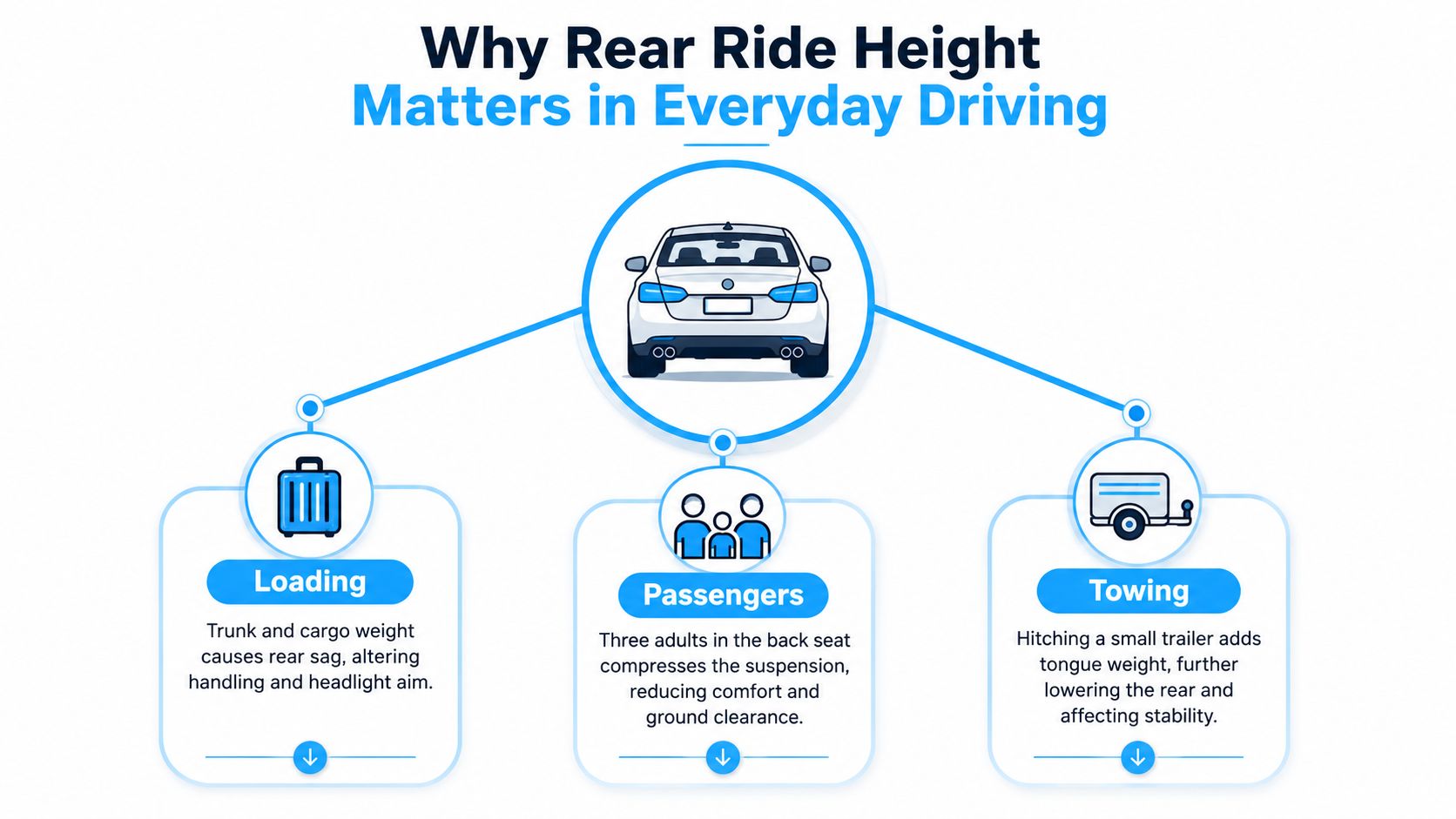
A loaded EV demonstrates the problem quickly. Put luggage in the cargo area, add passengers to the rear seat, or place trailer tongue weight on the hitch, and the rear springs compress. A lower rear end can reduce departure angle, bring the underbody closer to the road, and change the vehicle's balance during braking and cornering.
Headlight aim can also move with the body. If the rear drops while the front rises slightly, the beams point higher than intended, which can reduce useful road illumination and increase glare for other drivers. Tire loading changes too, and uneven loading can contribute to irregular wear when the vehicle spends much of its time carrying passengers or towing.
The underbody effect
Ride height is especially relevant to an EV because its battery pack usually occupies space low in the floor. A sagging rear changes the shape and clearance of the underbody, which can disturb airflow and leave less room between the pack area and road debris. That doesn't mean every change in height produces a dramatic range penalty, but it does mean the rear suspension influences conditions that matter to efficiency and protection.
The relationship between speed, load, and energy use is easy to underestimate. Drivers comparing models should look beyond quoted range and examine real-world efficiency, as explained in this guide to electric vehicle efficiency.
Practical rule: If your vehicle's load changes often, consistent ride height is a functional requirement, not just a comfort preference.
A steel spring provides a fixed mechanical response. It can be designed for a useful compromise, but it can't add or release support when the cargo changes. Rear air suspension can sense the lower body position and restore the target height, keeping the vehicle closer to the geometry its engineers intended.
How Rear Air Suspension Actually Works
Think of an air spring as a reinforced balloon held between the body and the axle. Adding compressed air increases its support and raises the vehicle. Releasing air allows the spring to settle. Unlike a simple balloon, the bellows uses shaped rubber, reinforcing layers, and mounting hardware designed to handle repeated movement and road loads.
A conventional coil spring stores energy through the bending of steel. An air spring stores energy through compressed air, and its response changes with pressure and volume. That gives engineers more control over ride height and spring behavior, particularly when the vehicle carries different loads.
Four parts do most of the work
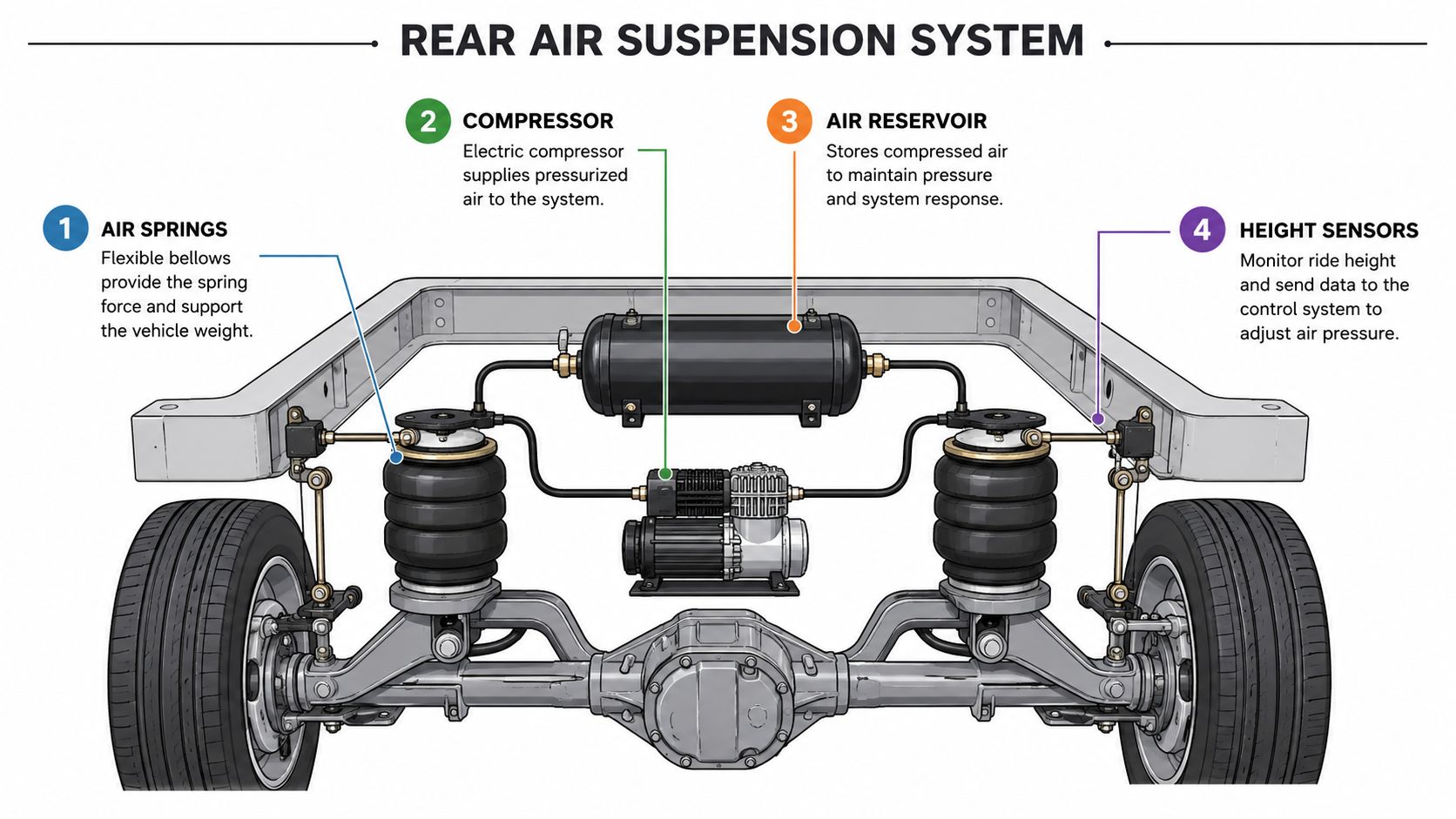
Air springs support the rear corners or axle. They replace the load-bearing role of a coil spring, although the complete suspension still needs dampers, control arms, bushings, and locating hardware.
The compressor and reservoir create and store compressed air. The compressor doesn't need to run continuously. It cycles when the controller determines that pressure must be added, while the reservoir can provide air without requiring the compressor to start for every small adjustment.
The valve block and air lines direct pressure to each spring or release it from the system. A dryer helps reduce moisture in the compressed air, and pressure relief hardware limits the consequences of excessive pressure.
The controller and ride-height sensors provide the decision-making. Sensors measure body position relative to the axle or suspension linkage. The electronic controller compares that measurement with the programmed target, then opens valves or commands the compressor.
The adjustment process can happen while the vehicle is parked or moving, depending on the system's design and operating mode. A controller may use separate targets for normal driving, access height, off-road clearance, or towing. The system's value comes from closing the loop: measure height, compare it with the target, correct the pressure, then check again.
Rear air suspension became an established technology path gradually. WABCO's air-suspension history and market overview records its first electronic air suspension system for commercial vehicles in 1986, while European passenger-car adoption accelerated after the Mercedes S-Class introduced air suspension in 1998.
Benefits and Real Drawbacks Worth Knowing
The clearest benefit is automatic load leveling. Add cargo or trailer tongue weight, and the system can raise the rear back toward its selected ride height. That helps preserve the vehicle's intended stance, keeping clearance, headlight aim, and suspension geometry more consistent than a fixed spring can manage.
Ride comfort is another advantage. Air springs can isolate passengers from sharp inputs while allowing engineers to tune the suspension for different conditions. A vehicle might offer a softer setting for broken pavement, a firmer response for quicker road transitions, or a lower setting at speed. The exact behavior depends on the vehicle's dampers, control software, tire choice, and suspension layout, not on the air bellows alone.
What the system adds
A rear air setup can be particularly useful when the same vehicle alternates between empty commuting and heavy family or trailer use. The OEM documentation for one truck application describes a Standard Ride Height for ordinary driving and an Alternate Trailer Height that lowers the rear by about 1 inch, or 25 mm, for towing. The same documentation says leveling logic may continue for 5 minutes after shutdown to help with trailer decoupling, as detailed in the manufacturer operating information.
That flexibility comes with trade-offs:
- More components: The compressor, reservoir, valves, sensors, dryer, lines, and air springs create more potential failure points than a basic coil-spring arrangement.
- Added mass and packaging demands: Engineers must find room for pneumatic hardware and protect it from water, dirt, impact, and heat.
- Higher repair exposure: A leak can involve the bellows, a fitting, a line, or a valve. A compressor may then work harder while trying to maintain pressure.
- Fallback behavior: If pressure is lost, many systems lower themselves, restrict driving, or display a warning. The vehicle may remain usable, but it won't necessarily sit at its normal height.
Heavy-duty systems show why calibration matters. A Hendrickson and NHTSA suspension document lists application-specific ride-height windows, including one comfort-air model at 8.5 to 10.5 inches and several rear-suspension feature codes calibrated around 9.0, 9.5, 10.5, 10.6, 12.5, or 13.0 inches, with tolerances of plus or minus 1/8 inch. Those figures aren't universal passenger-car settings. They show that incorrect height can affect geometry and durability.
Why EVs Are Pushing Rear Air Suspension Forward
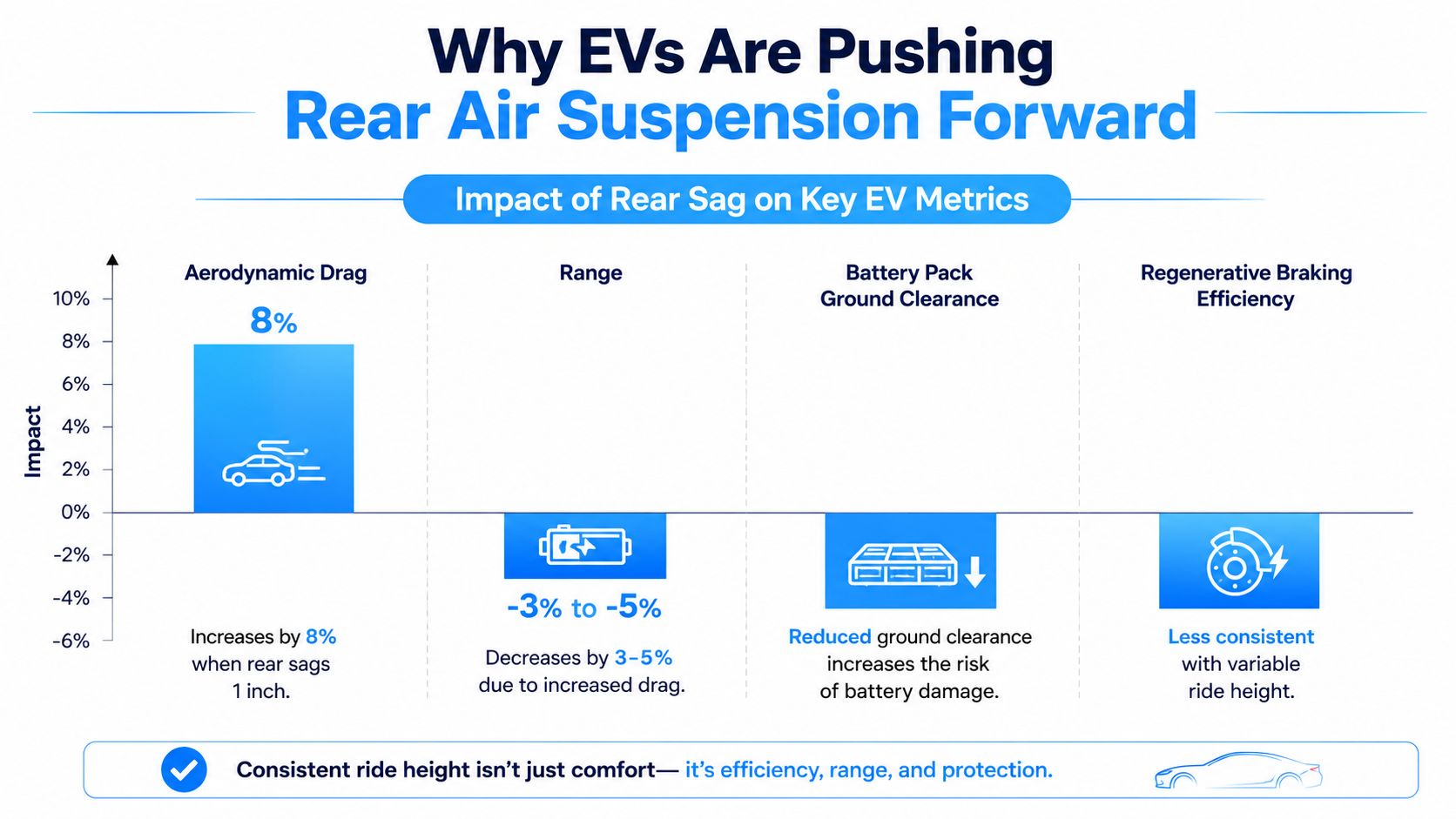
Air suspension on an EV isn't only a way to soften bumps. A stable rear height can help engineers manage the air moving under the vehicle and around the battery enclosure. Floor-mounted battery packs depend on carefully controlled thermal conditions, and the underbody also contributes to the vehicle's aerodynamic behavior at highway speed.
A sagging rear may disturb the intended airflow path. It can also reduce clearance beneath the battery pack, especially when the vehicle is loaded or towing. The practical result isn't a guaranteed, universal range penalty. It means the suspension's position becomes part of the conditions that influence efficiency, cooling, and protection.
Stability matters more for range planning
EV drivers often notice that payload and towing change energy consumption. The motor still supplies the requested power, but the vehicle may face more rolling resistance, more aerodynamic resistance, and different cooling demands. Keeping the rear near its designed height helps maintain a known configuration instead of allowing the body to settle unpredictably as load changes.
A technical discussion from Vibracoustic on air-spring suspensions for EVs links rear or full air springs with stable ride height, underbody airflow, and passive cooling support for floor-mounted battery packs. That source also describes a hybrid air-spring approach intended to improve towing and light-load ride quality without undermining everyday behavior.
Rear air suspension becomes an efficiency tool when it keeps the vehicle's aerodynamic and thermal geometry consistent under changing load.
Automakers apply the idea differently. Some prioritize a low highway stance, some emphasize comfort in heavy luxury vehicles, and others tune the system around towing or variable passenger loads. The important distinction is that air suspension doesn't create energy. It helps the vehicle retain a useful operating position while conditions change.
Maintenance, Failure Modes, and Real Ownership Costs
Rear air suspension needs condition-based inspection rather than one universal service schedule. A technician can test for leaks, check compressor operation, inspect air lines and fittings, verify ride-height sensor readings, and examine the bellows for cracking or abrasion. Dryer cartridges also matter because moisture can damage pneumatic components, although replacement timing depends on the vehicle and manufacturer.
A low rear corner after parking is often the first warning. A compressor that runs repeatedly may be replacing lost pressure. If the vehicle will not rise, the fault could involve the compressor, valve block, sensor, wiring, or control system. A scan tool can identify stored suspension faults, but a physical leak test is still needed.
The costs that matter after warranty
Repair costs for leaking air springs and failed compressors can be significant and vary by vehicle, labor rate, parts choice, local taxes, and the failed component. A used EV buyer should therefore treat the system as a repair reserve, not as a lifetime component. Air springs and compressors are separate failure points, and one fault can sometimes place extra operating demand on another.
Tire wear also affects the ownership calculation. Independent fleet data from Western Australia recorded cases where tire life fell from about 140,000 km with springs to around 70,000 km with air suspension, while other operators saw no improvement or mixed results, as described in the Western Australia air-suspension fleet report. The result depends on vehicle setup, loading, alignment, road conditions, and operating practice. Air suspension does not guarantee lower tire costs.
Use this sequence when evaluating a used EV:
- Check overnight stance: Compare both rear corners before and after a long parking period.
- Listen during startup: Repeated compressor operation may indicate pressure loss.
- Inspect the bellows: Look for cracking, rubbing, contamination, or damage around the folds.
- Verify height modes: Confirm that normal, access, towing, or low-speed settings engage and return correctly.
- Review service records: Search for compressor, air-spring, valve, dryer, sensor, and alignment work.
Climate and duty cycle change the risk. Towing, heavy cargo, rough roads, road salt, moisture, and long periods at maximum load can stress the system differently from light urban driving. Ownership cost also depends on the vehicle class: a heavy luxury EV may gain more ride-control value, while a simpler EV may make conventional springs cheaper to maintain.
Before buying, run likely energy, maintenance, and depreciation assumptions through an EV ownership cost calculator. Add a separate suspension-repair reserve, because the feature reduces some compromises but does not remove long-term maintenance risk.
How Real EVs Implement Rear Air Suspension
The same basic hardware can produce very different driving experiences. Tesla's Model S and Model X use air-spring systems with suspension linkages and electronic height control. The design suits vehicles that need a composed ride across changing passenger loads, while the software can prioritize low-speed access, normal travel, or a lower highway posture where supported by the vehicle.
Lucid takes a touring-oriented approach in the Air family, using compact air-spring modules as part of a luxury-focused chassis. The benefit isn't just softness. Engineers can combine air support with adaptive damping and electronic control to keep a large, powerful EV settled while preserving a comfortable ride over uneven pavement.
Mercedes-Benz uses AIRMATIC on the EQS as part of a broader chassis-control strategy. Ride height can coordinate with speed and drive mode, while the system works alongside damping, steering, and other electronic controls. That integration illustrates an important buying point: the air spring is only one part of the final behavior. Software calibration and damper control often determine whether the vehicle feels calm, floaty, firm, or athletic.
Rear air suspension approaches in selected EVs
| Model | System name | Rear air spring type | Key mode or feature |
|---|---|---|---|
| Tesla Model S | Adaptive air suspension | Linkage-based rear air springs | Height adjustment and load-response tuning |
| Tesla Model X | Adaptive air suspension | Linkage-based rear air springs | Adjustable ride support for a large passenger vehicle |
| Lucid Air | Air-spring suspension | Compact air-spring modules | Touring comfort with electronically managed chassis behavior |
| Mercedes EQS | AIRMATIC | Electronically controlled air springs | Ride-height coordination with speed and drive mode |
Specifications and equipment can vary by model year, market, trim, and option package. Confirm the exact build sheet rather than assuming every version includes rear air suspension. For a closer look at one high-profile example, review the Tesla Model X AWD model page and compare its suspension equipment with alternatives.
The badge tells you who built the system. The calibration tells you what it feels like.
For buyers, the useful comparison isn't “which brand has air suspension?” Ask what the system prioritizes. Tesla emphasizes adaptable support in large performance and utility EVs, Lucid leans toward long-distance comfort, and Mercedes integrates ride height into a high-end electronic chassis ecosystem. Each approach can work well, but each adds hardware and ownership considerations.
Is Rear Air Suspension Worth It for You
The answer depends on how often your vehicle's load changes and how long you'll keep it. Rear air suspension earns its place when the vehicle regularly carries people, cargo, or trailer weight that would otherwise change the rear stance. It has less value when the car remains lightly loaded and spends most of its time on predictable urban trips.
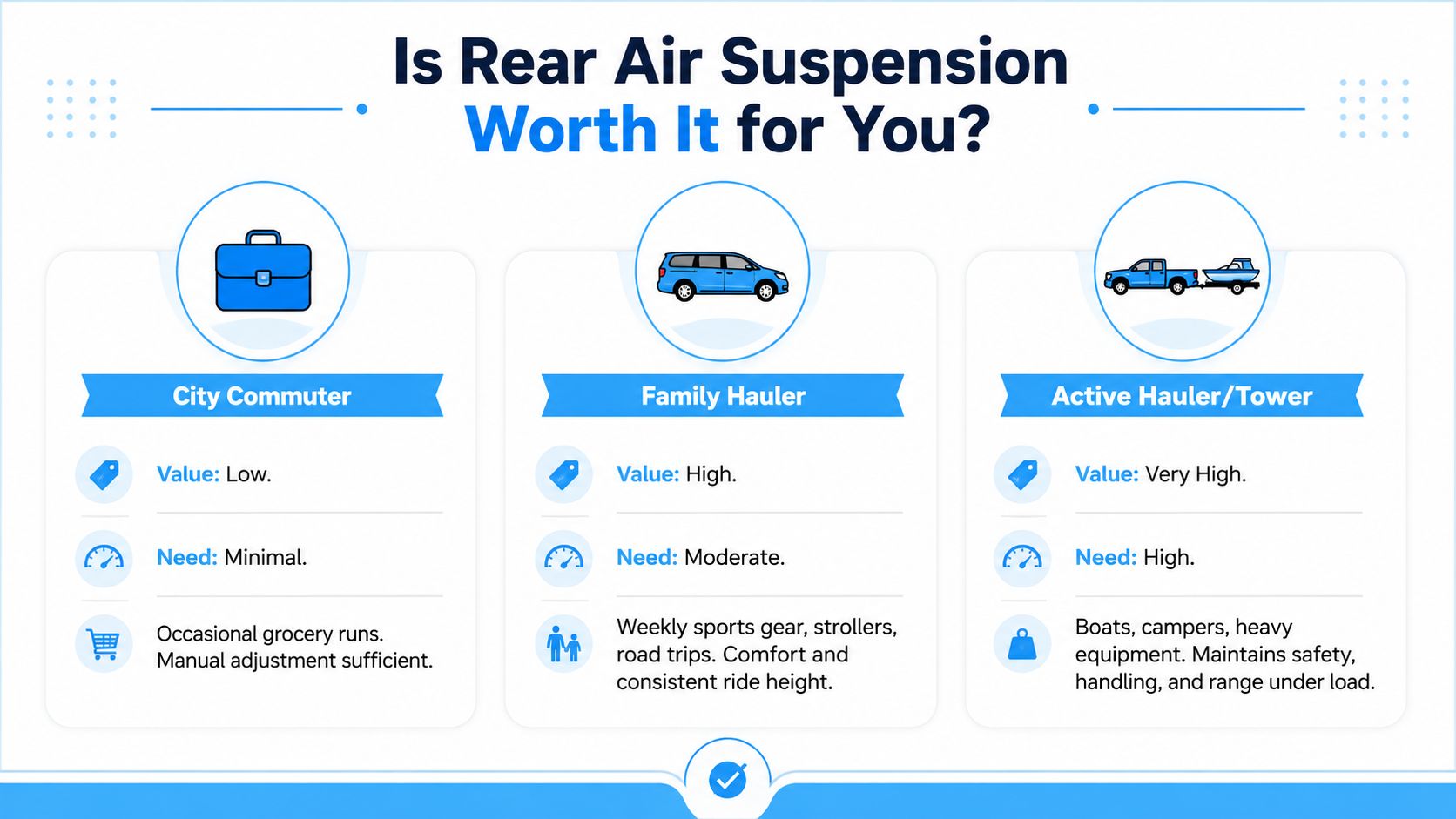
Three useful buyer profiles
The city commuter rarely fills the rear seats, carries modest cargo, and doesn't tow. For this driver, a fixed spring can provide all the practical support required. Air suspension may still add comfort or access-height convenience, but those benefits probably won't offset the added mechanical complexity on their own.
The family hauler has a stronger case. Weekly sports equipment, strollers, luggage, and full passenger loads make ride height a recurring variable. Self-leveling can preserve a more consistent driving position and reduce the compromises that a fixed spring must make between empty comfort and loaded support.
The active tower or hauler gets the clearest functional benefit. Trailer tongue weight and changing cargo can affect stance, clearance, headlight aim, and handling. Automatic leveling reduces the need to compensate manually, but it doesn't replace correct trailer loading, weight limits, tire pressures, or hitch setup.
Ownership horizon changes the decision. During a shorter, warranty-covered ownership period, the comfort and load-control advantages may be attractive because the buyer has less exposure to later component replacement. A longer post-warranty plan requires a realistic reserve for air springs, compressors, valves, sensors, alignment, and possible tire wear.
Choose rear air suspension for a repeated use case, not for a brochure feature you may never activate.
Before signing, ask the dealer to demonstrate every ride-height mode, inspect the vehicle after it has sat, and obtain the warranty terms for both air springs and compressor hardware. Then compare the model's efficiency, range, charging behavior, and ownership assumptions against vehicles with conventional rear springs.
Rear Air Suspension Questions Buyers Actually Ask
Can I retrofit it to a car that didn't have it?
Usually, a retrofit isn't a simple spring swap. A proper conversion may require air springs, mounts, compressor hardware, reservoirs, valves, sensors, wiring, control software, and calibration. The installation must also preserve suspension geometry and safe load capacity. For most buyers, choosing a factory-equipped vehicle is more sensible than converting a coil-sprung car after purchase.
Why does the rear sag overnight?
A rear corner that sits low after parking often points to an air leak, but the source can be the bellows, a line, a fitting, or a valve block. Listen for compressor activity when the car starts and look for uneven height between left and right sides. A workshop can isolate the circuit with a leak test and scan the suspension controller.
Will the vehicle disable itself if pressure is lost?
Modern systems generally protect themselves when pressure or sensor readings move outside safe limits. Depending on the design, the vehicle may stop adjusting height, display a warning, lower onto its bump stops, or limit driving. Don't treat a warning as a cosmetic issue, because continued compressor operation can turn a small air leak into a larger repair.
Does the warranty cover every suspension failure?
Coverage varies by manufacturer, market, vehicle age, mileage, and component. One warranty may treat the air spring differently from the compressor, valve block, sensor, or air line. Ask for the written terms and check whether diagnostic labor, alignment, towing, and consequential tire damage are included.
The broader ownership lesson is simple. Rear air suspension can deliver excellent load control and comfort, especially in an EV that carries changing loads. It also asks the buyer to understand its failure symptoms and budget for a more complex system after warranty.
Use EV Stats to compare EV specifications, suspension equipment, efficiency, charging performance, and real-world ownership factors across models. Visit the platform before you buy, shortlist vehicles that match your passenger and towing needs, and use its comparison and total-cost tools to test whether rear air suspension fits your driving life.