


A fleet lease vehicle can reduce exposure to uncertain EV resale values, but only when the contract reflects the operating profile. The lease math starts with battery health, and an industry analysis reports average EV battery degradation of 2.3% per year, rising to about 3.0% per year with heavy DC fast charging above 100 kW.
The popular advice is to compare the monthly lease payment with a loan payment and choose the lower number. That approach is too shallow for an electric fleet. A lease commits your business to a vehicle, charging pattern, mileage window, service model, and end-of-term decision years before those conditions are fully known.
The better question is operational: who carries the risk when utilization, battery health, charging access, or used-EV prices differ from the forecast? Leasing can move residual-value exposure to the lessor, but the lessor prices that risk through the payment and contract. Buying can preserve future upside, yet it leaves your organization responsible for the full resale downside.
Table of Contents
- Why Fleet Leasing Is Really an Operations Decision
- How Lease vs Buy Actually Works Under the Hood
- The Real TCO Drivers Most Fleets Underestimate
- Procurement Criteria That Separate a Good Lease From a Bad One
- Charging Infrastructure and Operational Planning
- Contract Terms That Quietly Reshape Your Numbers
- Modeling Scenarios With a TCO Calculator and Charging Simulator
- A Practical Roadmap for Choosing Your Fleet Lease Vehicle
Why Fleet Leasing Is Really an Operations Decision
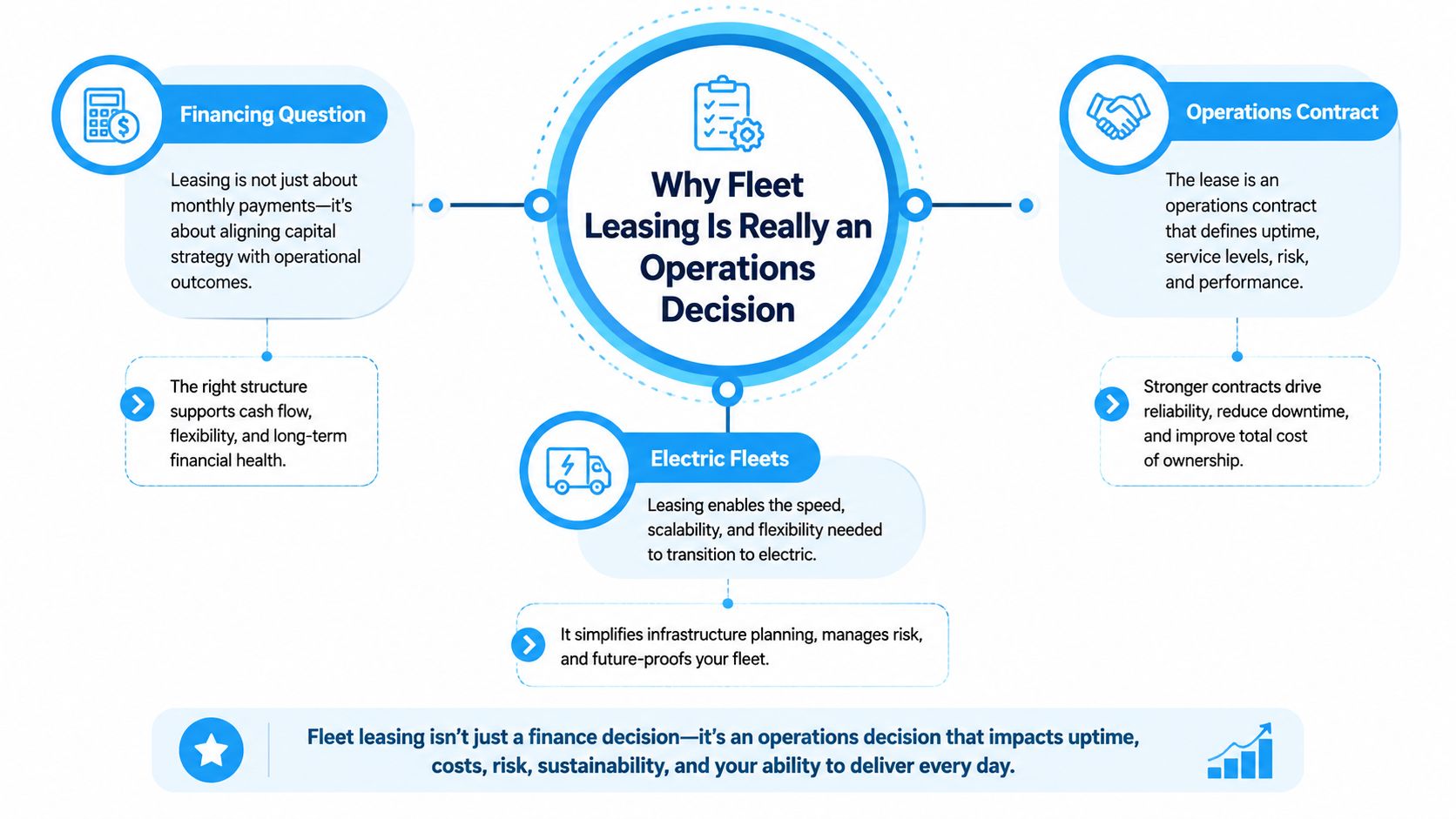
Fleet leasing isn't primarily a financing choice for an electric transition. It's an operations contract that fixes assumptions about vehicle use, replacement timing, maintenance responsibility, mileage, and disposition. If procurement compares only monthly payments, it can approve a vehicle that looks affordable on paper but fails the route, charging, or uptime requirements.
That distinction matters because EV residual value depends on more than age and mileage. Battery state of health, charging behavior, warranty coverage, and the pace of new-model improvement all influence what a lessor expects the vehicle to be worth at lease end. The history of fleet leasing shows that the industry developed around structured replacement cycles and predictable fleet management, not around cheap access to vehicles.
Battery health changes the lease equation
A lightly used passenger EV that charges mostly overnight won't age like a high-utilization delivery vehicle that depends on repeated high-power charging. The industry analysis cited above reports 2.3% average annual battery degradation, about 3.0% for vehicles relying heavily on DC fast charging above 100 kW, and roughly 0.4% additional annual degradation in hot climates. Those figures make battery management a residual-value input, not merely a technical maintenance concern. The battery-health analysis also indicates that well-managed vehicles can retain well above 80% of original capacity over a typical leasing cycle, while aggressive charging duty cycles can reduce remaining health and increase lessor risk.
The lessor won't absorb that uncertainty for free. It may appear as a conservative residual, a higher payment, mileage restrictions, battery-return conditions, or a buyout price that doesn't reflect your actual operating experience.
Practical rule: Decide the duty cycle first, then decide whether leasing or buying gives your business the better risk position.
Fleet leasing works best when the operator values predictable replacement, bundled support, and reduced exposure to resale volatility. Buying is often stronger when the fleet can operate vehicles for a long period, has strong resale expertise, or can control charging and battery use well enough to preserve value.
How Lease vs Buy Actually Works Under the Hood
The basic lease calculation is simple. The lessor finances the gap between the vehicle's capitalized cost and its expected residual value, then adds financing charges and contractual fees. A buyer finances the entire purchase and later absorbs whatever depreciation the market delivers.
Consider a hypothetical $48,000 EV. A lease with a 60% residual assigns an expected end value of $28,800, leaving $19,200 of scheduled depreciation before financing and other charges. That residual is not a guaranteed resale result. It's an assumption that reflects projected market value, expected condition, mileage, and technical risk.
A financed buyer owns the full asset. If the vehicle is worth more than expected, the buyer keeps the upside. If the used-EV market weakens or battery health falls faster than expected, the buyer carries the loss. A lessee gives up much of that upside in exchange for returning the vehicle under agreed conditions.
The residual swing matters more than the headline payment
A 10-point residual change on this hypothetical vehicle changes the assumed residual by $4,800. At a 50% residual, the scheduled depreciation becomes $24,000, rather than $19,200 at 60%. That difference can reverse the preferred strategy once financing, maintenance, energy, insurance, charging infrastructure, and end-of-term charges enter the model.
The table below is an analytical illustration, not a quoted market lease. It isolates depreciation so procurement teams can see the mechanism clearly.
| Scenario | Lease Cost (3yr) | Buy Cost (3yr) | Breakeven Residual |
|---|---|---|---|
| Hypothetical $48,000 EV with 60% residual | $19,200 depreciation component, plus financing and fees | $48,000 purchase exposure, less actual resale value | 60% projected residual |
| Same EV with a 50% residual | $24,000 depreciation component, plus financing and fees | $48,000 purchase exposure, less actual resale value | 50% projected residual |
| Buyer resale below the forecast | Contractual lease exposure remains defined, subject to terms | Buyer absorbs the additional loss | Actual resale value below forecast |
| Buyer resale above the forecast | Lessor generally retains residual upside | Buyer retains residual upside | Actual resale value above forecast |
A typical three-year, 45,000-mile commercial use case should therefore be modeled around actual expected resale value, not a generic lease payment. The breakeven point is the residual assumption at which the lease's total scheduled depreciation and fees equal the buyer's depreciation after resale. There isn't a universal breakeven residual because interest, incentives, maintenance, insurance, mileage charges, and charging costs vary by vehicle and contract.
Use lease-versus-buy analysis to answer one direct question: how much are you willing to pay to transfer resale uncertainty? If that risk premium is larger than the downside your organization could reasonably manage, buying may be the more disciplined choice.
The Real TCO Drivers Most Fleets Underestimate
The monthly payment is visible because the lessor puts it at the top of the proposal. It isn't necessarily the dominant TCO line. A fleet lease vehicle can produce an attractive payment while creating expensive operational constraints through charging, downtime, mileage, or return conditions.
Start with the full cost stack:
- Depreciation: This is the central residual-value exposure. For a lease, it appears through the capitalized cost and residual assumption. For a purchase, it remains on the fleet's balance sheet until sale.
- Energy: Electricity cost depends on route demand, charging location, tariff structure, charging losses, and the share of energy purchased at public or high-power sites.
- Charging infrastructure: Depot equipment, electrical upgrades, software, installation, and maintenance must be allocated across the vehicles that use the site.
- Maintenance and tires: EV drivetrains can change scheduled maintenance needs, but heavy vehicles and high torque can still create meaningful tire and suspension demands.
- Downtime: A vehicle unavailable during charging, repairs, or charger faults may require a replacement unit or reduce route capacity.
- Insurance and administration: Premiums, registration, telematics, driver policies, and compliance work remain part of fleet TCO.
- End-of-term exposure: Excess mileage, damage, wear, missing equipment, battery condition, and early termination can all alter the final cost.
Usage profile beats fleet averages
A fleet running 50 vehicles at 25,000 miles per vehicle per year creates a very different operating problem from a low-mileage pool fleet. The annual mileage volume is 1.25 million vehicle-miles, and each line item scales differently across that utilization. Mileage-sensitive depreciation and tire wear rise with use, while charging infrastructure may be shared across the group and become cheaper per vehicle as utilization improves.
The silent budget killers are usually the inputs procurement leaves outside the lease comparison. A depot with insufficient electrical capacity can force public charging. A delivery operation that depends on mid-shift charging can lose productive time. A high-power charging routine can accelerate battery degradation, which then affects residual assumptions and return negotiations.
Model the five-year decision, even for a shorter lease
A five-year operating view helps expose costs that a three-year quote can hide. Include the replacement vehicle, charger lifecycle, site upgrades, energy management, downtime, and the likely disposition path. Don't assume that a bundled maintenance package includes tires, roadside support, battery diagnostics, or charger repairs. Put every exclusion into the model.
The cheapest lease is the one that supports the route without forcing the fleet to buy back lost uptime elsewhere.
If the vehicle requires frequent public charging, has insufficient winter or payload range, or depends on a depot upgrade that won't be ready, the payment isn't cheap. It's merely incomplete.
Procurement Criteria That Separate a Good Lease From a Bad One
Procurement teams should score every candidate fleet lease vehicle against the work it must perform. A low lease rate can't compensate for a vehicle that misses routes, charges too slowly, or lacks service support where the fleet operates.
Use a weighted matrix, then apply hard minimums. The weights below are a starting framework, not a universal formula. A last-mile van should prioritize charging dwell time and service coverage. A regional passenger fleet may place more emphasis on range confidence and residual stability.
| Criterion | Weight | Measurement | Minimum Threshold |
|---|---|---|---|
| Real-world range | High | Tested range under expected payload, weather, and route conditions | Covers the planned route with a practical operating reserve |
| DC charging performance | High for high-utilization fleets | Peak charging rate, charging curve, and usable dwell time | Fits the available route and break windows |
| Residual-value forecast | High | Lessor residual, independent market assumptions, battery-return terms | Assumptions are documented and sensitivity-tested |
| Total cost per mile | High | Lease, energy, maintenance, insurance, infrastructure, and end-of-term costs | Beats the approved fleet benchmark |
| Service network density | Medium to high | Authorized service locations and mobile support along operating routes | Supports required uptime and recovery times |
Score the vehicle, not just the proposal
Ask the lessor to separate vehicle price, financing cost, maintenance, telematics, roadside assistance, charger support, and end-of-term assumptions. If the proposal combines everything into one payment, procurement loses the ability to identify which variable is driving the result.
Test range using actual payload and route conditions. Manufacturer figures can help shortlist models, but they shouldn't replace route-level validation. Charging performance also needs scrutiny beyond peak power. A high headline rate is less useful if the vehicle cannot sustain it during the fleet's actual charging window.
Make TCO per mile the tiebreaker
When two vehicles have similar payments, compare total cost per mile over the full lease term. Include energy, tires, insurance, maintenance, charging infrastructure, expected mileage charges, and residual-related fees. Reject a candidate that fails a critical criterion even if its blended payment looks attractive.
Procurement discipline matters here. A fleet vehicle isn't a consumer purchase with a company logo. It is a production asset, and its value depends on completed routes, available hours, predictable charging, and controlled replacement.
Charging Infrastructure and Operational Planning
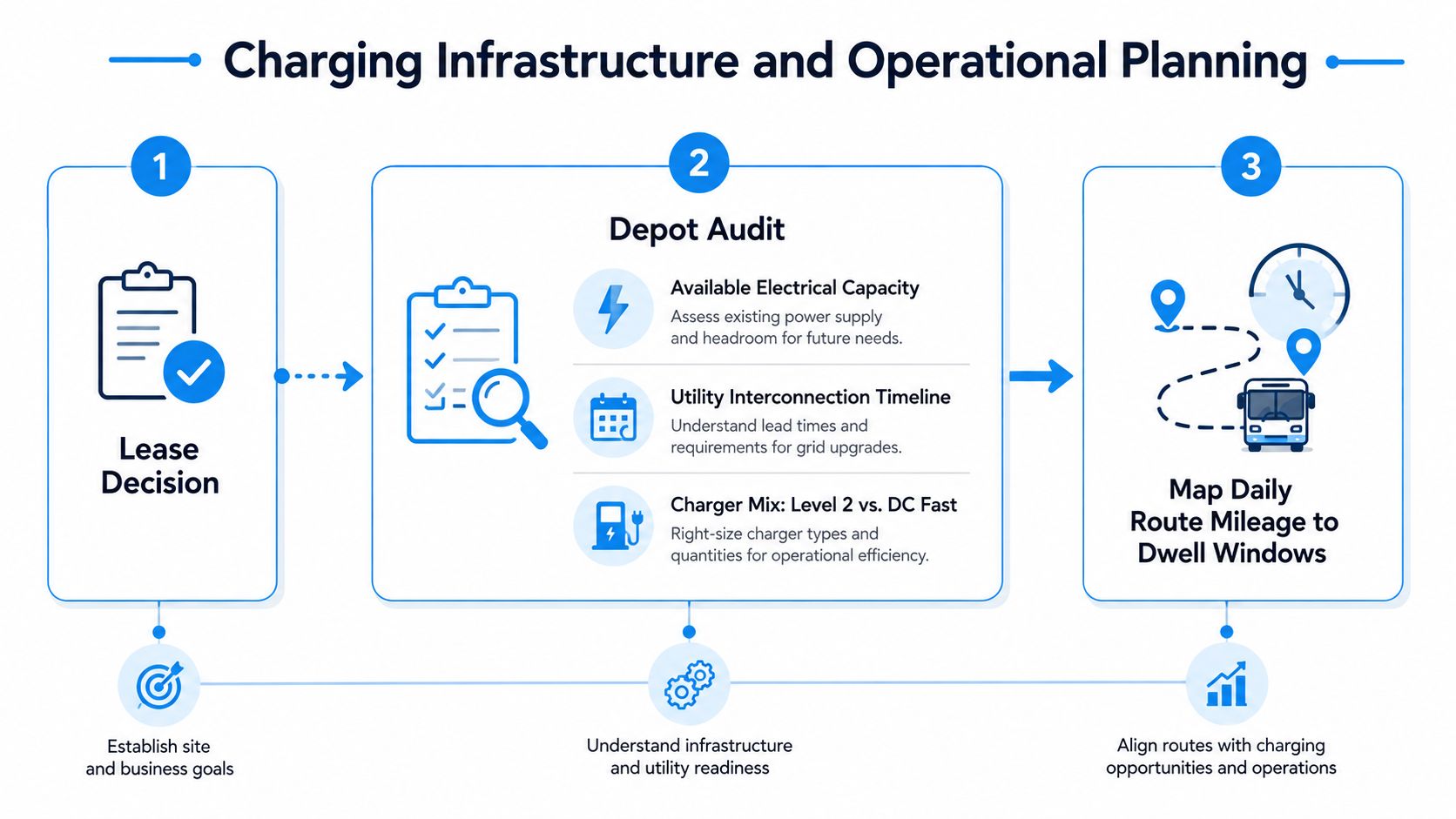
A lease decision made before a depot audit is incomplete. The vehicle may arrive on schedule while the site waits for electrical work, utility approval, equipment delivery, or software commissioning. The business then pays for an asset it can't deploy effectively.
Begin with the site:
- Electrical capacity: Confirm available panel capacity, service limits, transformer requirements, and the effect of simultaneous charging.
- Utility timeline: Establish the interconnection process and identify dependencies that could delay operations.
- Charger mix: Decide how much overnight Level 2 charging can handle and where DC fast charging is operationally necessary.
- Route dwell: Match daily mileage with parking windows, shift changes, loading periods, and mandated breaks.
- Redundancy: Plan backup capacity so one failed connector doesn't remove a vehicle from service.
Match charging power to the route
Overnight AC charging may be sufficient for predictable vehicles that return to base with long dwell periods. It won't solve every high-utilization application. A delivery fleet with tight turnaround windows may need DC fast charging, but that decision brings higher equipment cost, greater site demand, and more direct exposure to the battery-degradation pattern discussed earlier.
Use the EV charging levels guide to standardize internal terminology, then translate those charging categories into operational requirements. The procurement brief should state the required energy replenishment during each dwell window, not merely request “fast charging.”
A charging simulator or load study should show peak demand, simultaneous sessions, connector availability, and the effect of managed charging. The correct charger-to-vehicle ratio depends on route timing and dwell, but redundancy should be designed deliberately rather than added after the first failure.
The following video can support stakeholder discussions about charging planning and fleet deployment:
Pull infrastructure planning forward before signing the vehicle order. A leased truck without a workable charging plan is a stranded operating asset, regardless of how competitive the monthly payment looks.
Contract Terms That Quietly Reshape Your Numbers
The contract determines whether leasing hedges risk or repackages it. Procurement managers often focus on rate and vehicle specification, then skim the clauses that govern mileage, wear, early termination, and return condition. For an EV fleet, that is backwards.
| Clause | What to Watch | Negotiation Lever |
|---|---|---|
| Mileage cap | Annual allowance, total allowance, excess-mile charge, and flexibility between vehicles | Align the cap with telematics data and negotiate pooling or adjustment rights |
| Excess wear | Battery condition, tires, body damage, equipment, and documentation standards | Define objective inspection rules and battery testing procedures |
| Early termination | Remaining depreciation, fees, vehicle sale assumptions, and replacement obligations | Seek a transparent formula and options for fleet resizing |
| End-of-term buyout | Fixed residual, market-value process, fees, and purchase timing | Match the buyout to an independently modeled residual |
| Battery return standard | State-of-health threshold, diagnostic method, warranty interaction, and charging history | Require written measurement standards and dispute procedures |
Mileage is a forecast, not a formality
A mileage cap based on optimistic route assumptions can erase the expected benefit of leasing. Pull historical telematics, separate normal miles from seasonal peaks, and model route growth before choosing the allowance. If vehicles have different utilization levels, ask whether mileage can be pooled or transferred across the fleet.
Wear language deserves equal attention. “Excess wear” must define how the lessor evaluates tires, underbody damage, charging components, installed equipment, and battery health. A vague clause gives the lessor discretion precisely where the operator needs predictability.
Battery language needs technical precision
A battery state-of-health floor can sound protective while remaining difficult to enforce. The contract should specify the test method, acceptable diagnostic equipment, testing conditions, measurement date, and treatment of manufacturer warranty coverage. The fleet should also retain charging records and maintenance documentation.
Early termination is another major risk. The liability may reflect remaining depreciation rather than merely the remaining payment schedule, so a fleet reduction can cost far more than expected. Compare the buyout formula with the projected market value before signing.
Contract test: If a clause can't be modeled from your operating data, it isn't clear enough to approve.
Modeling Scenarios With a TCO Calculator and Charging Simulator
A serious EV fleet decision needs two linked models. The first is a TCO model that converts mileage, energy, maintenance, depreciation, financing, infrastructure, and residual assumptions into a comparable cost per mile. The second is a charging model that tests whether the depot can replenish the fleet without creating unacceptable demand, dwell, or uptime problems.
Use the EV Stats TCO Calculator to structure the ownership comparison, then export the important assumptions into a procurement workbook. Keep lease and buy scenarios side by side, and show the residual assumption as a sensitivity rather than burying it in a single forecast.
For a hypothetical 30-vehicle last-mile fleet, compare a 36-month lease, a 60-month purchase, and a hybrid structure in which 60% of vehicles are leased and 40% are owned. The figures below are deliberately qualitative because the brief doesn't provide vehicle prices, electricity rates, financing terms, or charger costs.
| Cost Line | 36-Month Lease | 60-Month Buy | Hybrid 60/40 |
|---|---|---|---|
| Depreciation | Scheduled through the lessor's residual assumption | Fleet carries actual depreciation and resale outcome | Risk split between contractual residuals and owned assets |
| Energy | Depends on route efficiency and charging location | Same operating requirement, with longer vehicle exposure | Compare by vehicle assignment and duty cycle |
| Maintenance | May be bundled, but exclusions must be verified | Fleet pays directly or through a service plan | Apply the correct responsibility to each group |
| Charging capex per vehicle | Allocate shared depot investment across leased units | Allocate across owned units and expected holding period | Test whether mixed replacement timing changes utilization |
| Residual risk premium | Reflected in payment, residual, and return terms | Retained by the fleet | Partially transferred and partially retained |
Test the assumptions that can reverse the decision
Shift the residual assumption by 5 percentage points in the model and observe whether lease breakeven changes. That sensitivity is more useful than a single “best estimate,” especially for EVs exposed to uncertain used-vehicle pricing or demanding charging schedules.
Then run the charging cases. An AC-only depot may work for vehicles with long overnight dwell. Adding DC fast chargers may increase flexibility and route capacity, but it can also alter peak power, infrastructure cost, energy tariffs, and battery-use patterns. The model should show those trade-offs rather than treating charging as a fixed utility bill.
Focus review meetings on three outputs:
- Peak kilowatts: Can the site serve the fleet within electrical and tariff constraints?
- Charger-to-vehicle ratio: Can the operation recover from a connector outage or schedule conflict?
- Cost per delivered mile: Does the vehicle complete productive work at an acceptable total cost?
The best scenario isn't necessarily the one with the lowest lease payment. It's the one that delivers required routes with a risk profile procurement can defend.
A Practical Roadmap for Choosing Your Fleet Lease Vehicle
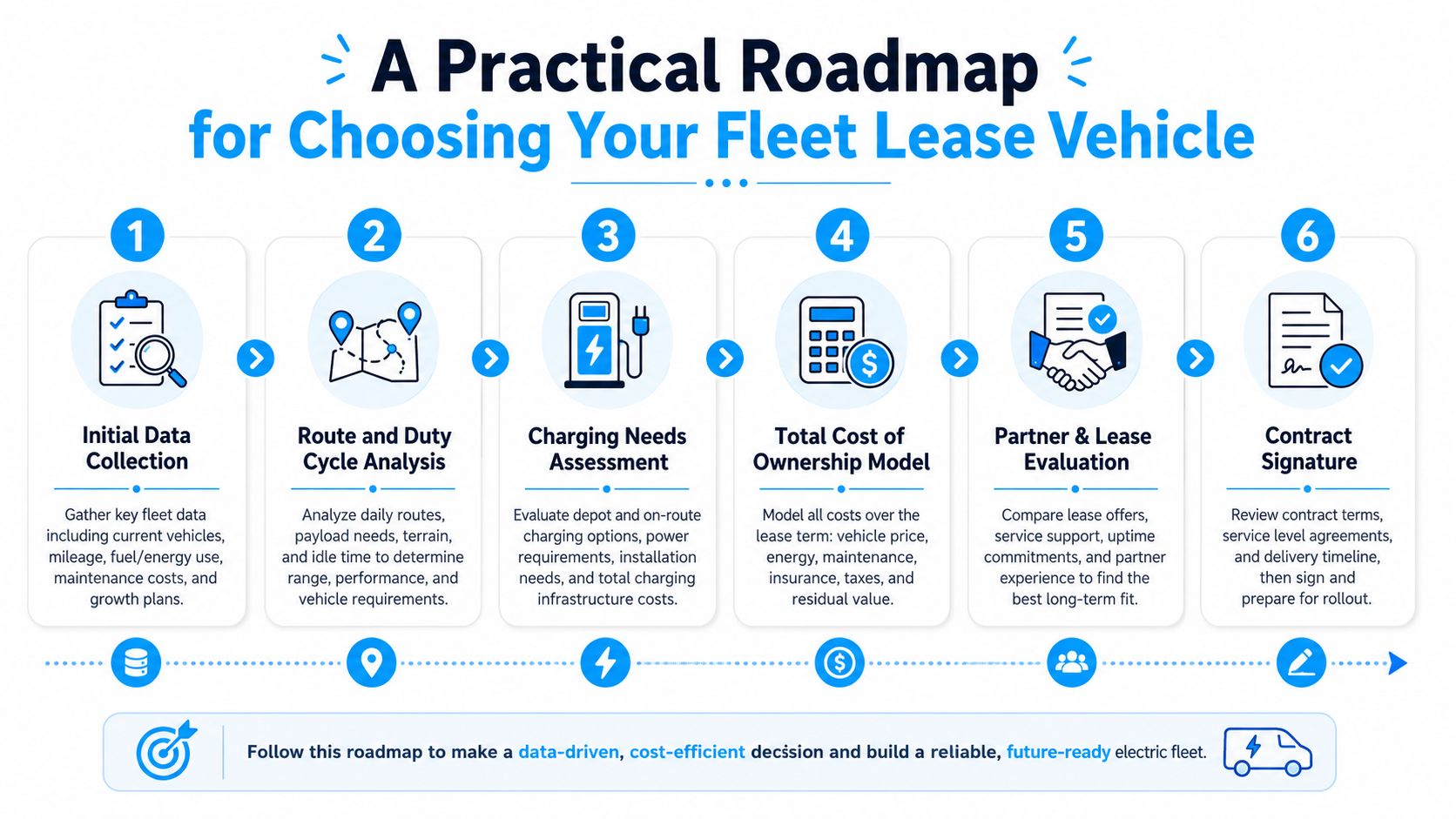
Use a staged approval process. Don't let a vehicle quote start the conversation, because the quote can anchor the team before it understands the routes, depot, or battery duty cycle.
- Collect operating data. Pull telematics for mileage, route duration, payload, dwell windows, depot location, and downtime. Separate vehicles by job rather than averaging the whole fleet.
- Analyze duty cycles. Identify which routes can use overnight AC charging and which require mid-shift replenishment. Mark seasonal constraints and high-utilization assignments.
- Assess charging needs. Validate electrical capacity, utility interconnection timing, charger mix, software, access control, and contingency plans.
- Build the TCO model. Compare lease, buy, and hybrid structures using sensitivity tests for residual value, energy cost, mileage, maintenance, and infrastructure.
- Run the vendor RFP. Score candidates on real-world range, charging performance, service coverage, TCO per mile, uptime support, maintenance scope, and end-of-term flexibility.
- Review and sign the contract. Confirm mileage treatment, battery testing, wear standards, early termination liability, buyout formula, data access, and return procedures.
The EV fleet solutions resource can help teams organize vehicle selection and charging questions, but the final approval should remain tied to your own telematics and depot data. A fleet lease vehicle is ready for signature only after the charging schedule, route performance, and residual-risk assumptions have been validated together.
Buy instead of lease when your organization can hold vehicles for the long term, manage resale confidently, and control battery use without needing a lessor to absorb uncertainty. Lease when predictable replacement and transferred residual exposure are worth the contractual premium, and when the agreement protects the operating model.
EV Stats gives procurement teams structured EV specifications, real-world range context, charging performance data, side-by-side model comparisons, TCO estimates, and charging simulations for fleet decisions. Visit EV Stats to compare candidate vehicles and test whether your preferred lease structure works for the routes and depot you operate.