


You're already past the easy part. The vehicles are on the spreadsheet, the board wants a plan, and the pilot looked fine, but now questions are sitting on your desk, how much grid do we need, what will demand charges do to us, and how do we avoid building a depot that works for five vans but breaks at fifty?
That's where ev fleet solutions either become a working operating model or stall out as a good idea with a bad electrical bill. The market has already moved into execution, not theory, with one study valuing EV fleet management solutions at USD 12.5 billion in 2025 and projecting USD 42.3 billion by 2034, while another projects USD 9.10 billion in 2025 to USD 32.25 billion by 2030. The estimates differ by scope, but the direction is the same, fleets are buying software, charging control, and operational planning because electrification now touches routing, energy, maintenance, and uptime all at once. Intel Market Research on EV fleet management solutions
Table of Contents
- Why Fleet Electrification Is No Longer Experimental
- Selecting the Right Electric Vehicles for Your Duty Cycles
- Designing Charging Infrastructure That Matches Operations
- Building a Total Cost of Ownership Model That Holds Up
- Implementing Software and Operational Changes
- Your EV Fleet Deployment Checklist and Common Pitfalls
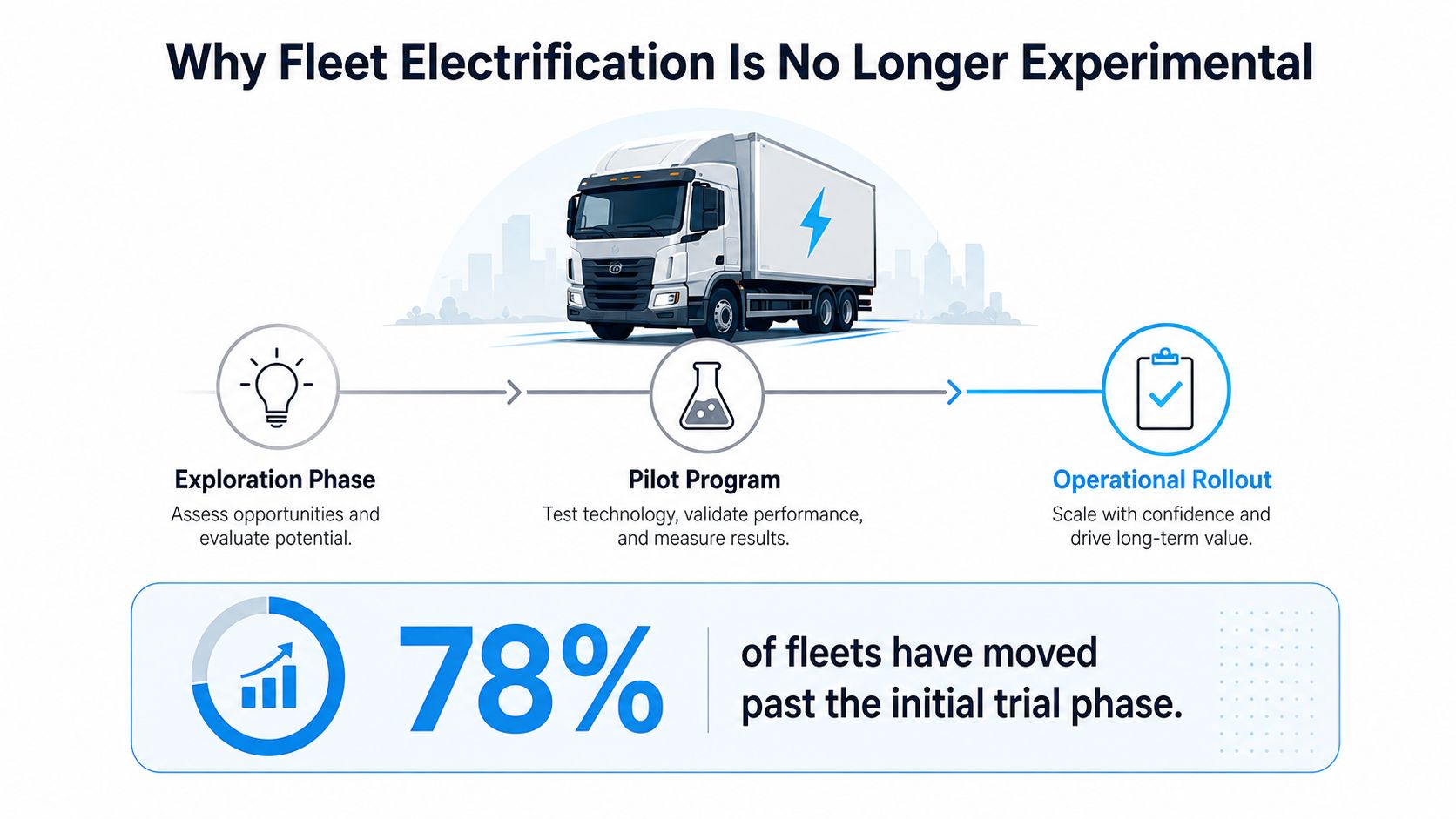
Why Fleet Electrification Is No Longer Experimental
A fleet manager staring at a mixed depot knows the old question is gone. The decision now is not whether electrification is real, it's how to convert a business that was built around diesel habits into one that can schedule charging, manage battery state, and keep vehicles moving without blowing up the budget.
The adoption signals are strong. In a 2026 global fleet barometer, 66% of companies said they already use or plan to deploy EVs within three years, and 99% said they are implementing or planning charging policies to support electrification. In the same survey, 31% ranked TCO as their top fleet challenge, which tells you where the pressure really sits, finance wants a model that survives scale. Element, Arval, and SMAS global fleet and mobility barometer
What changed for fleet operations
The operational shift is bigger than the vehicle swap. The International Energy Agency reported that more than one in five new cars sold in 2024 was electric, and global EV sales in 2025 were expected to surpass 20 million, which means the ecosystem around charging, procurement, and support is becoming normal rather than niche. Fleet teams are feeling that shift in procurement cycles, utility conversations, and depot planning. Element, Arval, and SMAS global fleet and mobility barometer
Conventional fleet systems were built to track location, fuel, and maintenance. EV operations add charging coordination, energy management, route planning tied to battery state, and cost tracking across electricity, maintenance, and downtime. If your software can't see those variables together, it's not ready for a mixed fleet.
Practical rule: if dispatch, maintenance, and facilities are still making decisions in separate systems, electrification will feel harder than it needs to be.
The fleets that move fastest don't buy more chargers first. They define which jobs can be electrified with today's routes, how much dwell time exists at the depot, and what their utility can support without a costly rebuild.
Selecting the Right Electric Vehicles for Your Duty Cycles
The wrong vehicle choice causes more pain than the wrong charger. A van with a battery that looks fine on paper can fail a route if the daily schedule includes highway stretches, cold-weather operation, or payload swings that leave no margin for charging delays.
Start with duty cycle, not badge or range claim
Use actual route data first, then compare vehicle candidates. The U.S. DOE guidance says the first step is to assess candidate vehicles' driving and duty requirements, then address policies, incentives, and cost considerations. That sequence matters because it keeps the conversation grounded in what the vehicle must do every day, not what the brochure says it can do. U.S. DOE electric fleets guidance
A practical shortlist usually starts with four filters:
- Daily miles: match the vehicle's realistic range to the route, not the best-case figure.
- Payload weight: heavier loads reduce usable range and can change the segment you should buy for.
- Charging access: overnight depot charging and mid-day top-ups are not interchangeable.
- Route shape: dense urban work is very different from regional highway duty.
Read range figures like an operator
WLTP and other standardized figures are useful for comparison, but they're not the whole story. Use them as a baseline, then adjust for highway driving, winter conditions, and accessory loads. If you need a deeper model of model-to-model range differences, this electric car range comparison is the kind of comparison work that helps teams avoid wishful thinking.
For light commercial fleets, the question is often whether the van can finish the route and return with enough buffer to protect against late dispatch, reroutes, or temperature swings. For pickup trucks, battery size becomes a business decision, not just a spec decision. Blink's fleet guidance notes common examples like the F-150 Lightning with 98–131 kWh batteries and the E-Transit around 68 kWh, which shows why the battery pack and dwell time need to be part of the same conversation. Blink fleet charging guidance
The right selection process ranks vehicles by duty fit, then by charging speed and value. That's where standardized comparison tools earn their keep, because a side-by-side view surfaces trade-offs that are easy to miss when teams rely on one vendor deck at a time.
Use comparisons to cut guesswork
A comparison should answer three questions fast, how far can the vehicle realistically go, how quickly can it recover energy, and does the charging standard fit the depot? If the answer to any of those is weak, the route design or vehicle class probably needs another pass.
Don't start with the most ambitious route. Start with the route that already has predictable return-to-base behavior, then expand from there.
Designing Charging Infrastructure That Matches Operations
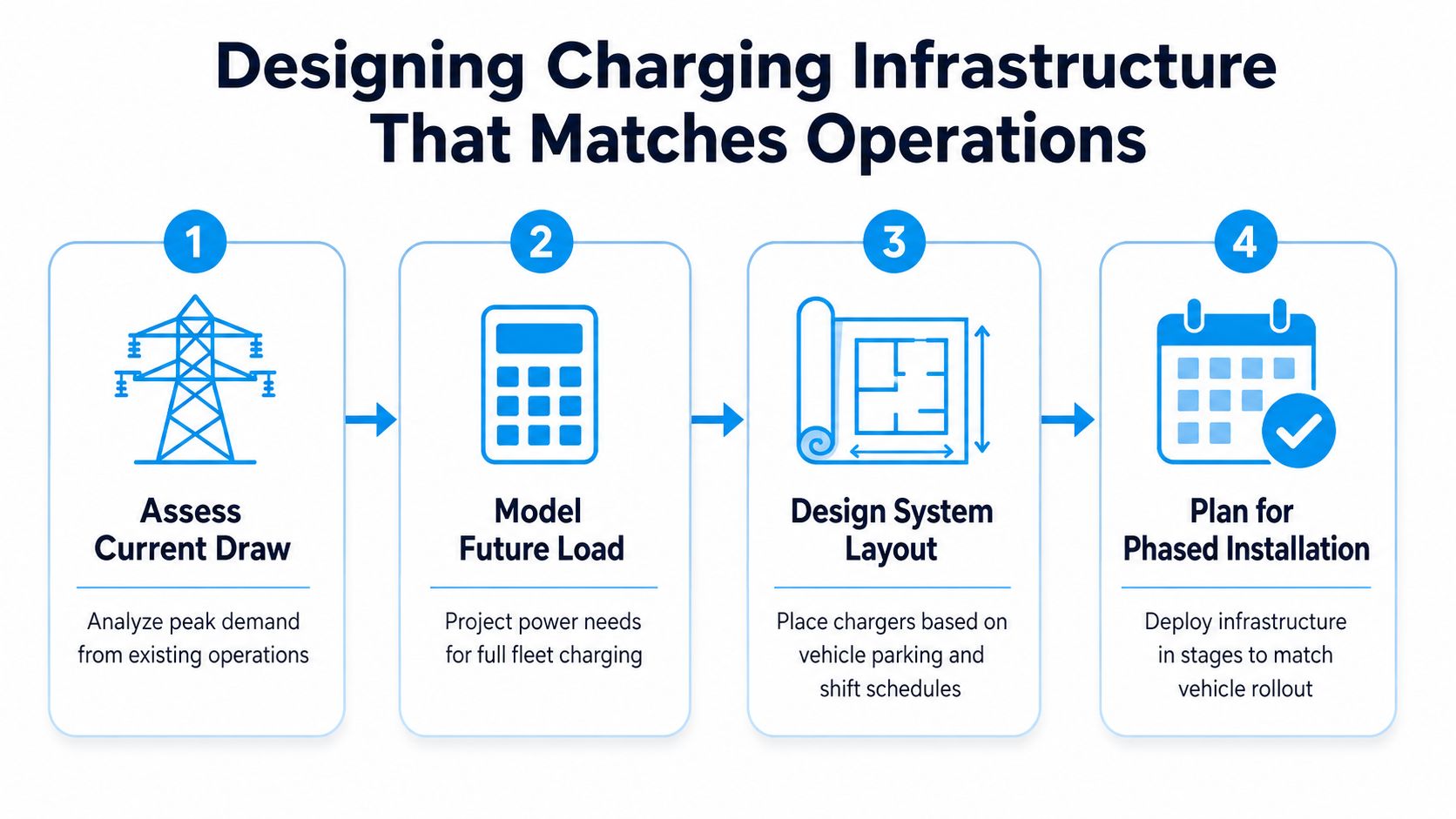
A pilot can look clean on paper and still stall the moment the site team asks about service upgrades, panel room space, or trenching costs. The vehicles may be ready, the drivers may be on board, and the deployment can still slow down because the depot was never mapped against actual electrical capacity.
Depot charging versus opportunity charging
For most fleets, Level 2 charging fits routine overnight replenishment, while DC fast charging belongs in the smaller set of cases where turnaround speed matters. If your team is still sorting out the difference between charging speeds, a guide to EV charging levels helps frame why L2 usually fits depot use and DCFC is better suited to short dwell windows. Blink's fleet guidance recommends L2 for daily depot charging and a 40 kW DCFC for quick turnarounds, which is a useful reminder that most depots do not need every stall built for the fastest possible session. Blink fleet charging guidance
That choice should come from dwell time, not wishful thinking. A vehicle that sits overnight can be scheduled very differently from one that cycles through the yard between shifts. Opportunity charging at public stations can work for the right route, but it usually serves best as a targeted support option, not the backbone of the whole operation.
The electrical side needs the same discipline. A credible technical benchmark for many fleet charging projects is 200 to 800 amp service, with conductor sizing, panel capacity, and grounding checked before equipment is ordered. The same guidance also points to a single-port Level 2 unit supporting up to 80 A / 19.2 kW on 208/240 VAC, with built-in load management and ISO 15118 / OpenADR support for smarter site control. The IET fleet operations infrastructure guidance
Size for real duty cycles, not just vehicle count
Ten vehicles on paper do not equal ten simultaneous charging sessions in practice. That mismatch is where many first deployments get stuck, because the depot looks large enough until everyone returns at once and the load spikes. The U.S. DOE says the first step is to assess driving and duty requirements, while McKinsey notes fleet charging must align with customer demand, power prices, traffic conditions, and charging-station availability. In other words, the right design starts with operations, not the number of plugs you can fit on a wall. U.S. DOE electric fleets guidance
Phased installation usually works better than a full buildout. It lets teams validate parking geometry, cable reach, driver behavior, and load management before they commit to the next round of capital. It also gives facilities teams time to clear the boring problems, which are often the ones that delay go-live.
What good infrastructure planning looks like
A solid design plan usually has three layers. First, the utility and electrical engineer verify the service path. Second, operations defines which vehicles charge where and when. Third, procurement buys hardware only after the first two layers agree on the load profile.
Do not order hardware before the load model is stable. The cheapest charger is expensive if it arrives before the service upgrade is ready.
Building a Total Cost of Ownership Model That Holds Up
A fleet electrification project is won or lost in the spreadsheet, but only if that spreadsheet reflects how the site runs. If the model skips demand charges, utility upgrades, charger commissioning, or the way charging behavior changes once more vehicles plug in at the same depot, the first year can look acceptable and the second year can turn messy fast.
Model the full cost stack
The core categories are familiar, but each one hides details that change the outcome:
| Cost Category | EV Considerations | Common Pitfalls |
|---|---|---|
| Energy | Time-of-use rates, off-peak charging, site load behavior | Assuming electricity is always cheap |
| Maintenance | Fewer moving parts, less brake wear, less routine engine service | Using ICE maintenance assumptions without adjustment |
| Depreciation | Different resale patterns and replacement timing | Treating EV residuals like diesel residuals |
| Infrastructure | Chargers, civil works, electrical upgrades, commissioning | Leaving out soft costs and utility coordination |
| Demand charges | Peak power exposure from simultaneous charging | Modeling only kilowatt-hours, not peak draw |
The pressure point is finance, not enthusiasm. Fleet operators need a model that stands up to utility tariffs, depot constraints, and the cost of scaling from a pilot to a working fleet. In the broader EV market, that tension shows up in procurement decisions and in the way teams judge whether a deployment is affordable over time.
For a useful reference on the variables that should sit inside your own workbook, the EV cost savings calculator is a practical starting point.
Where EV economics break down
Demand charges are the most common blind spot. If several vehicles begin charging hard at the same time, the site can create a peak that dominates the monthly bill. Dynamic load management and time-of-use scheduling matter because they control that peak exposure, not because they are nice software extras.
Infrastructure amortization needs the same discipline. A depot upgrade can look reasonable if it is tied to a narrow use case, but the same site may need to absorb future growth, longer dwell windows, or new routes that change the load profile. Pilot success can be misleading here. A small fleet with easy overnight dwell time can hide the tariff and grid limits that show up once utilization rises.
One more test helps separate a real model from a hopeful one. If the economics only work when every vehicle charges slowly, every route behaves perfectly, and nothing breaks at the depot, the assumptions are too soft to trust.
Implementing Software and Operational Changes
Hardware alone doesn't manage an EV fleet. The work sits in the software layer and the daily routines that tell drivers, dispatchers, and depot staff what to do when the battery, route, or charger changes.
Build the operating system around charging
The core stack usually includes telematics, charging management, and energy controls. EV fleet management platforms centralize vehicle data, charge point status, battery state of charge, route assignments, and energy usage into one view, which is the only practical way to coordinate charging with dispatch at scale. Monta EV fleet management overview
The features worth evaluating are practical, not flashy:
- Battery-aware routing: dispatch should know which vehicles can take which routes without risk.
- Smart charging schedules: charging should avoid unnecessary peak demand.
- Real-time monitoring: vehicle and charger health should be visible before a unit goes down.
- Load balancing: simultaneous charging should respect site limits.
- Reporting: managers need energy, uptime, and session data in one place.
Train people before the fleet grows
Driver training matters because one missed plug-in can ripple through a route plan. Depot staff need simple rules for plug-in protocols, fault escalation, and what to do when a vehicle returns with less range than expected. Dispatchers need to stop treating EV assignments like diesel assignments, because range-aware route planning is a separate discipline.
The rollout also needs funding discipline. Utility programs, grants, and local incentives can offset infrastructure costs, but they usually come with timing and documentation requirements. Teams that wait until after procurement to chase incentives often miss the cleanest path to support.
Keep the operational sequence tight
The sequence that usually works is simple. Validate route fit, install the minimum infrastructure needed for the first operational cluster, connect software to vehicle and charger data, train staff, then scale in phases. The mistake is trying to launch software, hardware, new driver rules, and new depot layouts all at once.
Your EV Fleet Deployment Checklist and Common Pitfalls
A good deployment checklist prevents a pilot from turning into a stranded asset. It also gives leadership clear gates, so capital only moves forward when the operational and electrical pieces are ready.
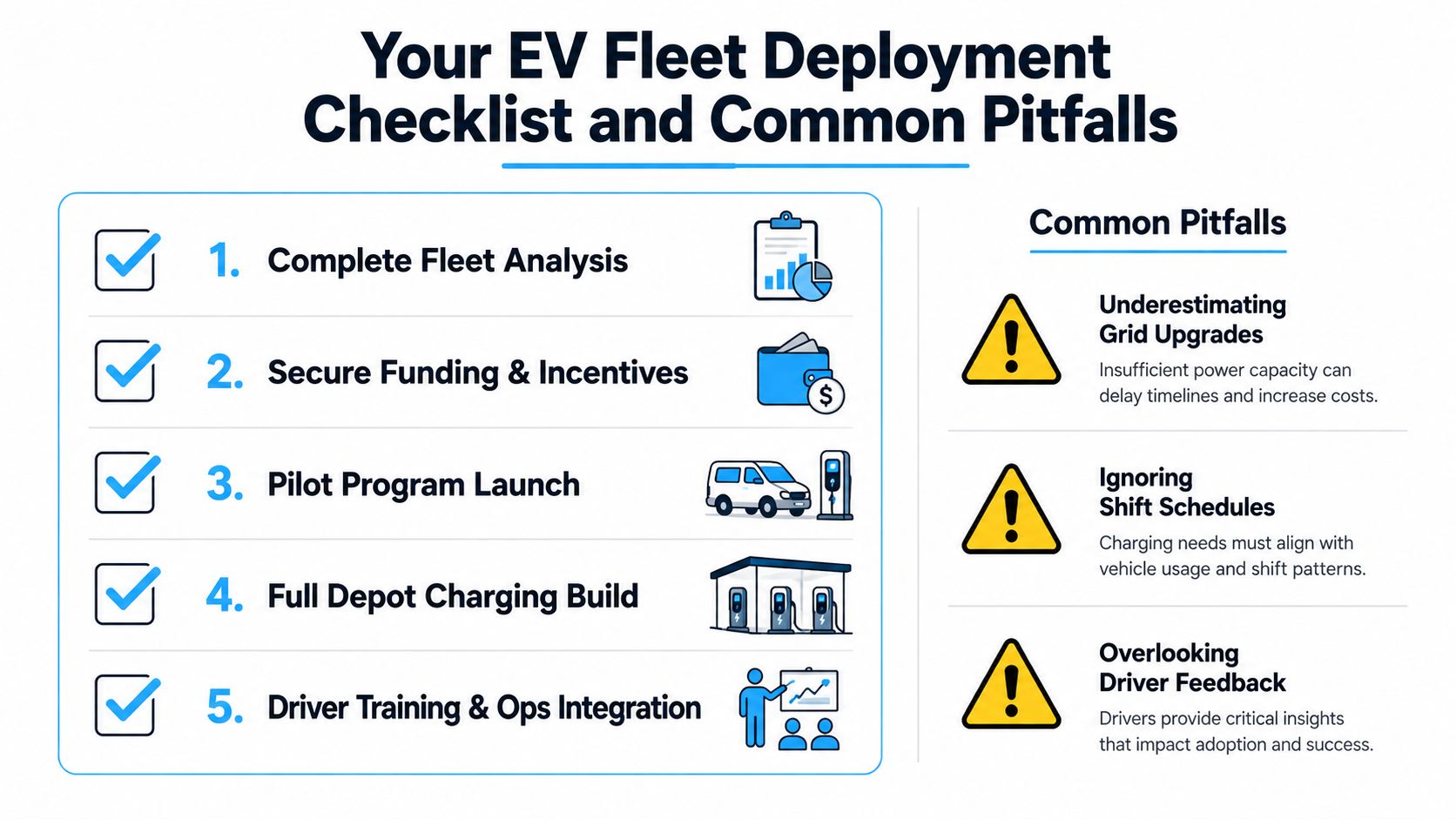
Checklist that holds up in the field
- Complete fleet analysis. Verify routes, dwell time, payload, and depot return patterns before vehicle commitments.
- Secure funding and incentives. Align procurement timing with grants, utility support, and internal capital approvals.
- Launch the pilot program. Test real routes, real charging windows, and real driver behavior.
- Build full depot charging. Confirm service capacity, layout, and load management before expanding.
- Finish driver training and ops integration. Make sure dispatch, depot staff, and maintenance teams are using the same playbook.
Common pitfalls that stall the rollout
Underestimating grid upgrades is the classic failure. The vehicle plan may be sound, but the utility timeline, service work, or panel constraints can slow everything down. Ignoring shift schedules is next, because a vehicle that works for a day shift may fail when the same unit is expected to cover late dispatch or a second run.
Overlooking driver feedback causes quieter damage. Drivers know when a charging bay is awkward, a route is too tight, or a plug-in process creates friction. Teams that ignore that feedback end up solving the same issue twice, once in operations and again in rework.
The pattern is clear. Pilot success matters, but it doesn't prove full-fleet readiness unless the infrastructure, software, and operating procedures are all aligned. When those pieces move together, the fleet scales. When one lags, the rollout slows.
If you're planning an electrification program and want a clearer way to compare vehicles, charging fit, and ownership costs, visit EV Stats. It's built to help fleet and procurement teams cut through inconsistent specs and make better rollout decisions. Use it to pressure-test your shortlist before you commit capital.