

Home-charged EVs in the U.S. typically cost about 4 to 7 cents per mile in 2025, while comparable gasoline cars are often 12 to 16 cents per mile on fuel alone. The catch is that your real number can move a lot if you rely on public charging, lose energy in charging, or drive a less efficient model.
A useful way to think about electric car cost per mile is that the headline average is real, but it's only the starting point. The drivers who save the most are usually the ones who charge mostly at home, pay close attention to vehicle efficiency, and avoid treating a single national average like a personal forecast.
Table of Contents
- Numbers Behind Electric Car Cost Per Mile
- How to Calculate Your Own Cost Per Mile
- The Charging Loss Factor Most Calculators Ignore
- How Charging Location Changes Your Cost Per Mile
- Why Vehicle Efficiency Matters More Than You Think
- Your Action Plan for Accurate EV Cost Estimation
Numbers Behind Electric Car Cost Per Mile
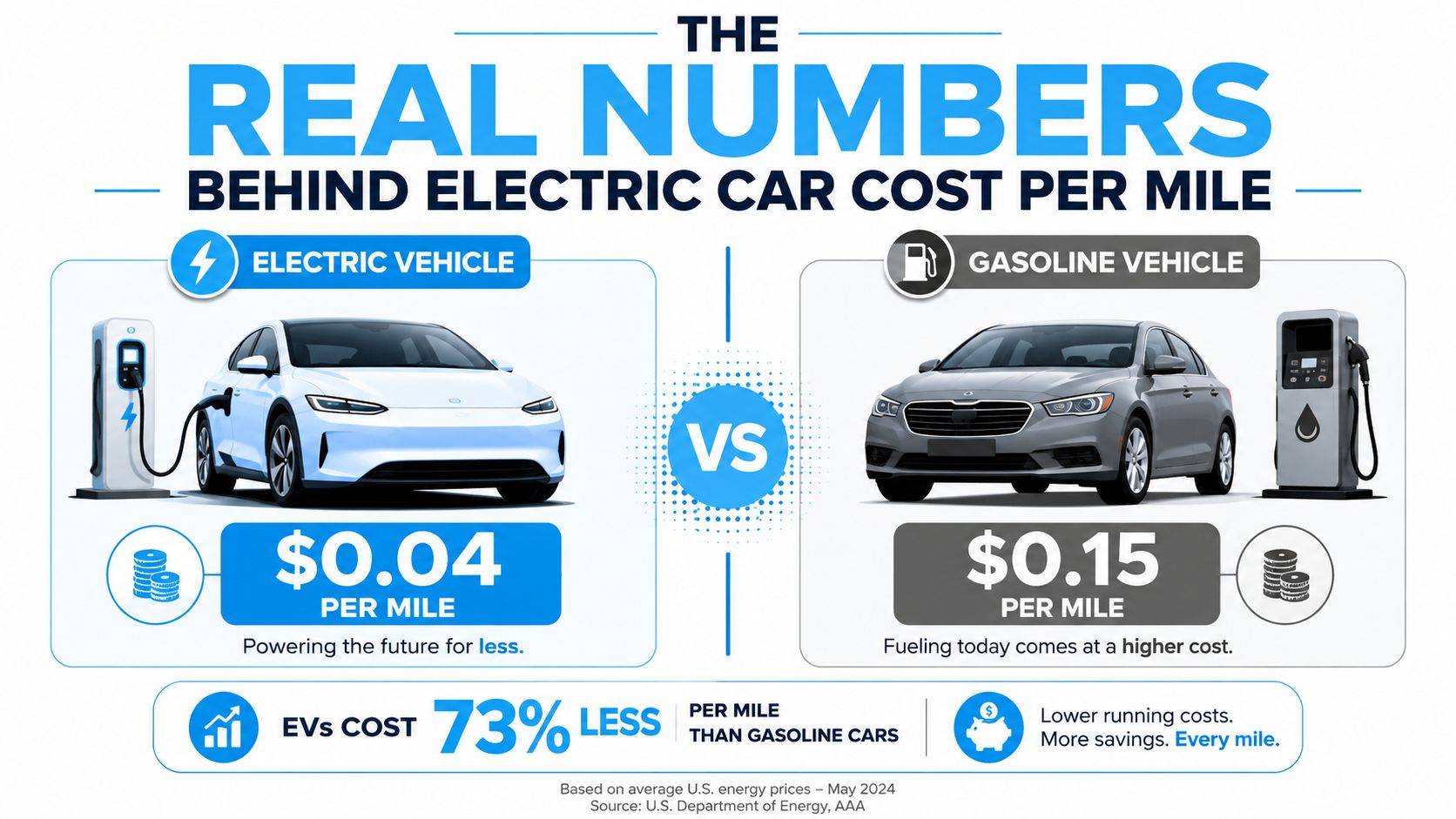
The benchmark that matters most is simple. Home-charged EVs in the U.S. typically land around $0.04 to $0.07 per mile, while gasoline cars often sit around $0.12 to $0.16 per mile on fuel alone, according to a 2025 analysis of running costs (recharged.com). That same analysis also framed the EV advantage as roughly 50% to 75% lower per mile for drivers who mostly charge at home.
Why the average helps, and where it misleads
Averages give you a market-level benchmark, but they flatten the details that drive your actual bill. A compact SUV priced at about $0.05 per mile for electricity versus $0.13 per mile for gasoline, or $729 per year versus $1,904 per year at 15,000 miles annually, shows how one vehicle class can produce a very different ownership picture from another (recharged.com).
The bigger point is that the per-mile gap can translate into more than $1,000 per year in operating savings for high-mileage households, depending on charging habits, efficiency, and local electricity prices. That is why the question is not whether EVs are cheaper on energy, it is whether your specific charging pattern preserves the advantage.
Practical rule: If you charge at home most of the time, the published average is a reasonable starting point. If you depend on public charging, your personal cost per mile can rise fast enough to change the buying decision.
A second benchmark comes from U.S. technical guidance. The Alternative Fuels Data Center example shows that an EV with efficiency of 3 miles per kWh costs about 3.3 cents per mile when electricity is 10 cents per kWh (INL AFDC cost reference). That simple relationship explains why two drivers with the same car can see different bills. The car is only half the equation.
How to Calculate Your Own Cost Per Mile
The cleanest formula is straightforward. Cost per mile = electricity price per kWh × energy used per mile. If you prefer the EPA-style version, you can work from kWh per 100 miles or miles per kWh, then convert to a per-mile figure.
Start with your real electricity rate
Use the rate that hits your bill. For a home charger, that's often not just the advertised supply rate, because delivery charges and time-of-use pricing can change the effective cost. The key is to use your all-in $/kWh, not a simplified headline rate.
Then use the vehicle's actual efficiency
Efficiency is usually easier to read as miles per kWh. A more efficient EV uses less electricity for each mile, so its cost per mile falls even if your utility rate stays the same. That's why this metric matters more than brand reputation or battery size alone.
Useful habit: Track your own trip-screen average for a full month before you treat any published number as your personal baseline.
The internal logic is easy to test with a calculator, and a good starting point is a structured tool like EV Stats' EV cost savings calculator. Even if you don't use a tool, the same math holds.
| Vehicle Type | Efficiency (kWh/100mi) | Miles per kWh | Cost Per Mile |
|---|---|---|---|
| Highly efficient sedan | 27 | 3.7 | Lower than the average EV at the same tariff |
| Mid-range crossover | 30 | 3.3 | Middle of the pack at the same tariff |
| Large electric SUV | 40 | 2.5 | Higher than the sedan at the same tariff |
The table intentionally avoids fake precision, because your own tariff determines the exact dollar figure. What matters is the relationship. At the same electricity price, a vehicle that uses more energy per mile always costs more to drive.
One more point matters for comparison shopping. If two EVs differ meaningfully in efficiency, the cheaper car to buy isn't always the cheaper car to own. The fuel side of the ownership equation can reward the more efficient model for years.
The Charging Loss Factor Most Calculators Ignore
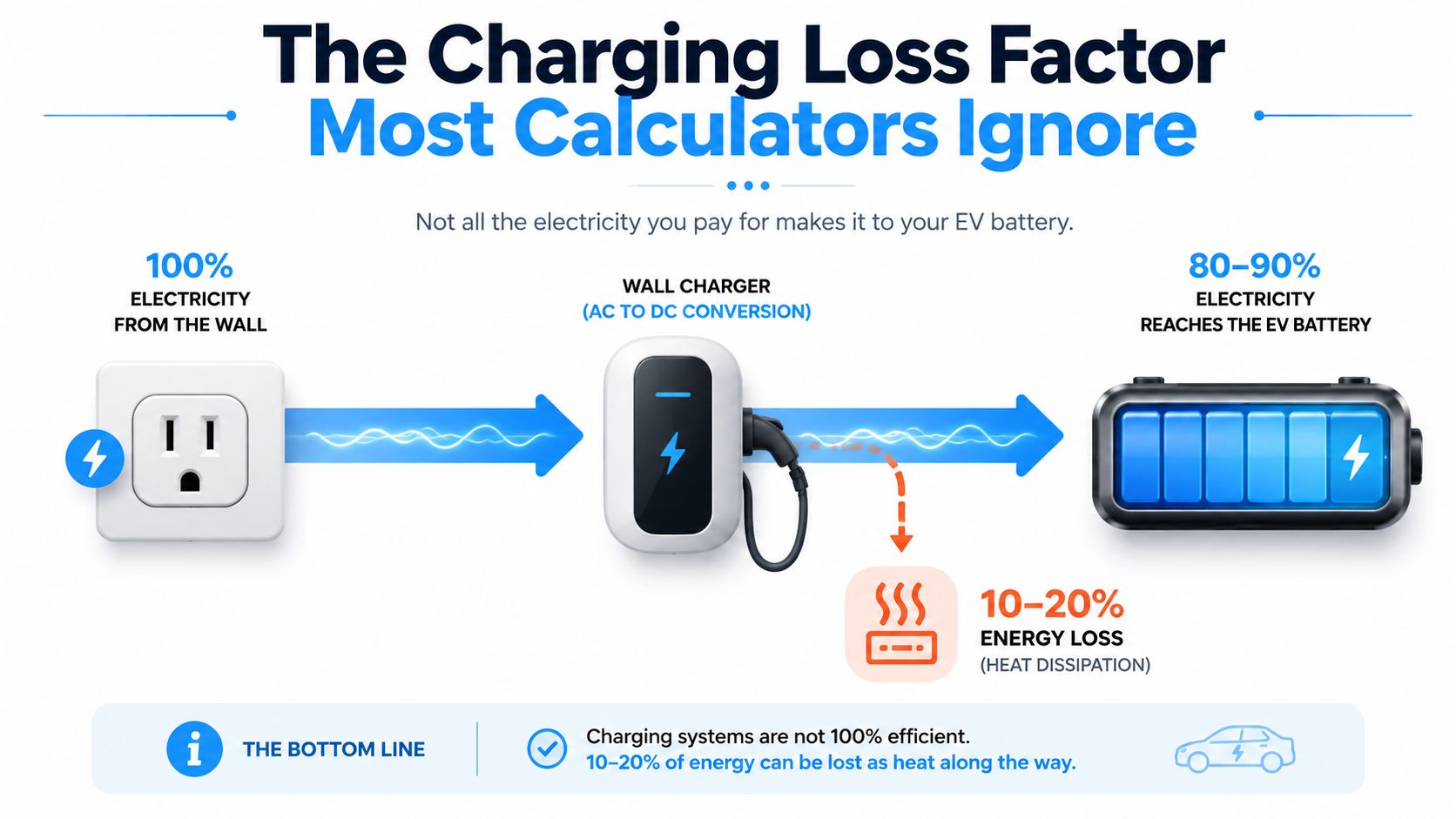
A cost-per-mile estimate can look precise and still miss the part you pay for at the wall. Real-world charging loses about 10% to 15% of energy in the wall-to-battery process because of heat, conversion losses, and battery management overhead (recharged.com). That gap matters most when drivers base their math on the car's efficiency alone.
Why charger losses change the bill you pay
The meter records the electricity that enters the charger. Your battery receives less. A formula built only from vehicle efficiency can understate what you spend, because billed energy and stored energy are not the same thing.
That difference is easy to miss if you only look at the car's sticker efficiency. The vehicle may be strong on paper, yet the charging path still wastes some energy before it reaches the battery. For drivers who mostly charge at home, the gap may stay fairly small. For people who charge often, especially across multiple sessions, it should be modeled directly.
A better estimate starts with the electricity you buy, then adjusts for charging losses before you translate that into cost per mile. The practical conclusion is simple. An EV can still be economical, but the number should reflect the energy that leaves your meter, not just the energy stored in the pack.
The best estimate is the one that matches your utility bill, not the one that flatters the car.
Public fast charging can widen the gap further, because network pricing and charging losses stack on top of each other. That is why many owners who think they know their per-mile number are still surprised when the monthly total arrives.
How Charging Location Changes Your Cost Per Mile
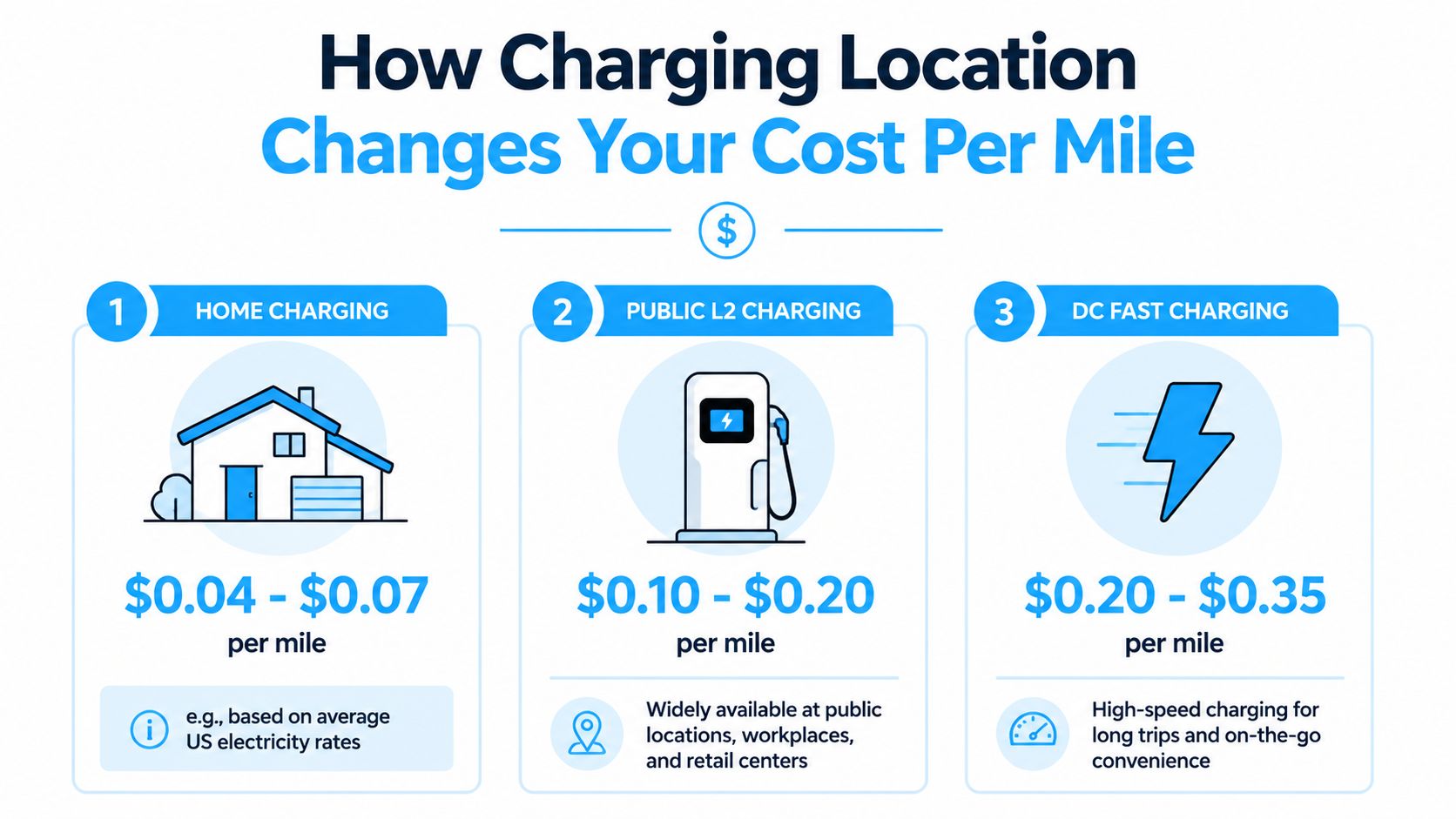
Charging location is the biggest reason one EV owner can quote a rock-bottom cost per mile while another sees a figure close to gasoline. Independent guidance from Coltura assumes 80% home charging and the remainder at public chargers priced at $0.29/kWh, which is a strong reminder that mixed charging deserves its own model (Coltura EV savings report). A single residential rate can't describe that reality.
Home, public, and mixed charging are different cost worlds
A homeowner with off-peak access usually gets the cleanest economics. UK guidance puts home charging at around 8p per mile, while petrol or diesel sits around 13p to 17p per mile as of January 2024 (UK government guidance). That doesn't prove every market behaves the same way, but it does show how much the tariff structure matters.
Apartment dwellers often face a very different profile. Public charging can push the effective rate much higher than a home tariff, and that's before any convenience premium or idle-time penalty enters the picture. For those drivers, the right question isn't “Is an EV cheap to run?” It's “How much of my charging happens at the expensive end of the market?”
Model the charging mix, not just the sticker rate
A mixed profile is usually the most realistic for fleets and long-distance drivers. Some energy comes from home charging, some from public chargers, and the blend determines the actual cost per mile. That's why benchmarks based on residential electricity alone can overstate savings for some households and understate them for others.
The cleanest way to think about it is as a weighted average. The more you move away from home charging, the more your effective cost per mile drifts upward. The same vehicle can still be cheaper than gasoline, but the margin gets thinner.
For drivers who want a broader cost context, EV Stats' charging cost guide fits well with this tariff-first approach. The point is simple. Charging location isn't a side detail, it's one of the main cost drivers.
Why Vehicle Efficiency Matters More Than You Think
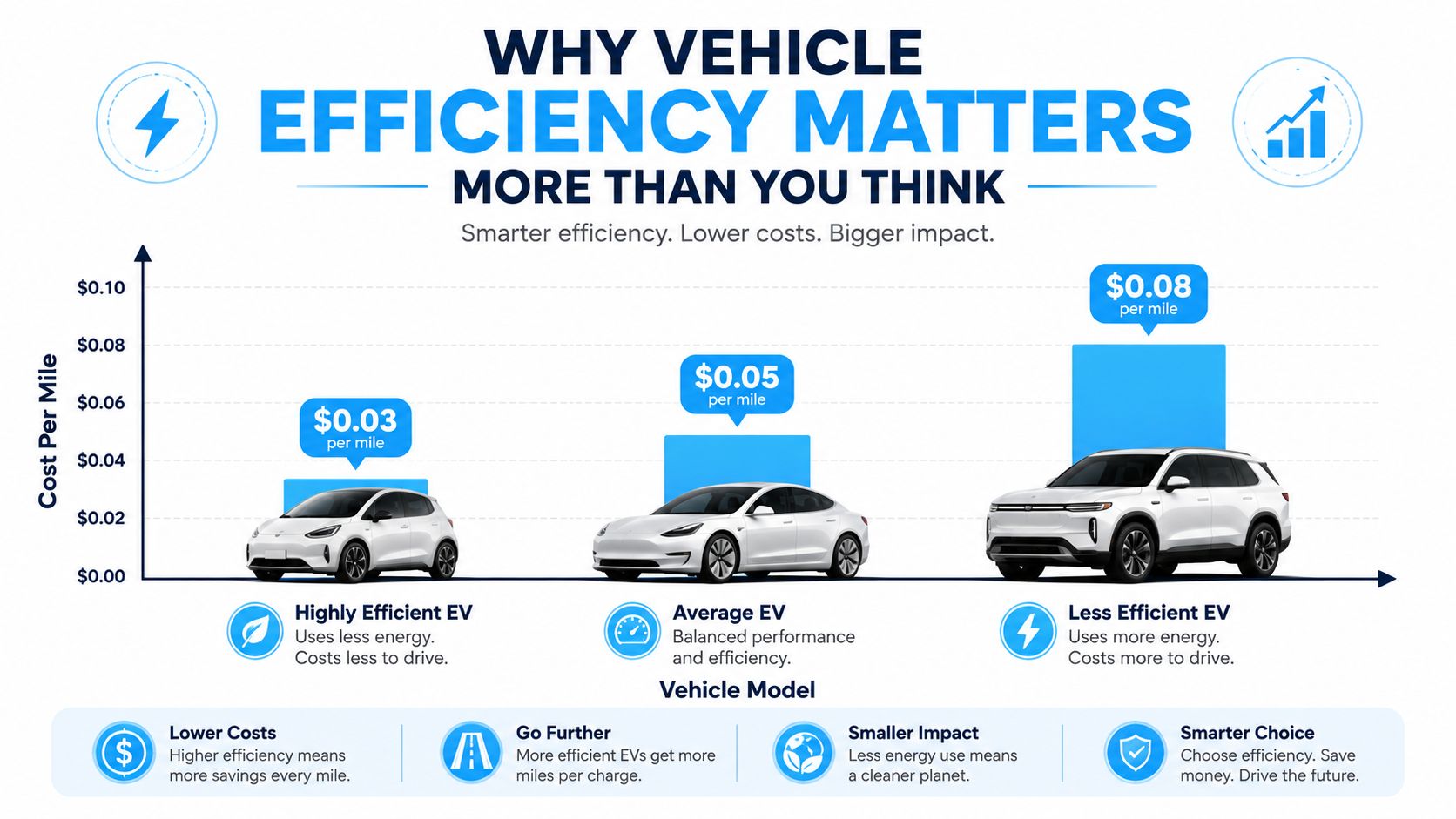
Many buyers compare EVs by range and price, then assume operating costs are roughly interchangeable. They're not. The same electricity rate can produce very different per-mile outcomes when vehicle efficiency changes, because battery size, weight, aerodynamics, and powertrain design all affect how much energy the car needs to move one mile.
Efficiency can preserve or erase the EV advantage
U.S. technical guidance shows how quickly efficiency changes the math. At 3 miles per kWh and 10 cents per kWh, an EV lands around 3.3 cents per mile (INL AFDC cost reference). If the vehicle is less efficient, the cost rises even if electricity stays cheap. That's the central reason some EVs feel dramatically cheaper to own than others.
A larger or heavier model can still be the right choice for space, towing, or comfort. It just shouldn't be mistaken for an efficiency-neutral decision. A less efficient EV may keep some fuel savings versus gas, but it can narrow the gap enough that the total ownership picture starts to look very different.
Model choice matters as much as the tariff
The same charging rate does not produce the same result across the lineup. A highly efficient sedan, an average crossover, and a heavier SUV can all sit on the same home charger and still generate distinct per-mile costs. That's why efficiency should sit next to range and purchase price on your comparison list.
Decision rule: If two EVs meet your range needs, choose the more efficient one unless you have a strong reason not to.
That logic is especially important for buyers who drive a lot. Even a small efficiency penalty compounds over time, and it does so subtly. The final bill looks like a charging problem, but the root cause may be vehicle choice.
For a structured comparison of model-level efficiency, EV Stats' efficiency guide is the right companion metric to cost per mile.
Your Action Plan for Accurate EV Cost Estimation
Start with your own numbers, not the market average. Pull your electricity rate from your bill, note your vehicle's real-world efficiency, and decide how much of your charging happens at home versus public stations. Once you have those inputs, you can estimate your true electric car cost per mile instead of relying on a figure that fits someone else's driveway.
Use this checklist:
- Record your all-in electricity price, including the rate that applies when you charge.
- Use your vehicle's live efficiency, not a brochure number.
- Adjust for charging losses, since the electricity you pay for is higher than the energy that reaches the battery.
- Blend home and public charging, especially if you live in an apartment or travel often.
- Compare against gasoline on a per-mile basis, because that's the cleanest way to judge whether the EV advantage survives in your situation.
If you want to go beyond a rough estimate, use tools that model ownership more completely. A total-cost approach can capture energy, maintenance, depreciation, and trip planning in one place, which is much closer to how real buyers make decisions.
Revisit the calculation when seasons change, your utility updates rates, or your driving pattern shifts. EV economics stay favorable for many drivers, but the margin depends on details that don't stay fixed forever.
If you want a cleaner way to model your own EV costs, compare vehicles, and test charging assumptions with real data, visit EV Stats. Its comparison tools and ownership modeling features make it easier to see whether your charging mix, efficiency, and vehicle choice really preserve the savings you expect.