

Curb weight is the vehicle's ready-to-drive mass without occupants or cargo, while gross weight is its mass after people, cargo, and added equipment are included. A sedan with a 1,600 kg curb weight and 400 kg of passengers and cargo has a 2,000 kg gross weight, which is a 25% increase over its curb weight, as shown by the additive relationship described in vehicle weight terminology.
You may be looking at a vehicle's specification sheet, standing beside a dealer's electric SUV, or loading a family car before a long trip. The number printed in the brochure describes a baseline. The number that matters on the road changes as people climb in, luggage goes into the boot, and accessories or towing equipment are added. Understanding the difference between curb weight and gross weight helps you choose the right vehicle, load it safely, and plan realistic EV energy use.
Table of Contents
- Why Vehicle Weight Changes From One Trip to Another
- Understanding Curb Weight and Gross Weight
- Comparing Curb Weight, Gross Weight, and GVWR
- How Added Weight Affects EV Performance
- Calculating Payload and Loaded Vehicle Weight
- Common Weight Misconceptions to Avoid
- A Practical Weight Check Before Buying or Loading
Why Vehicle Weight Changes From One Trip to Another
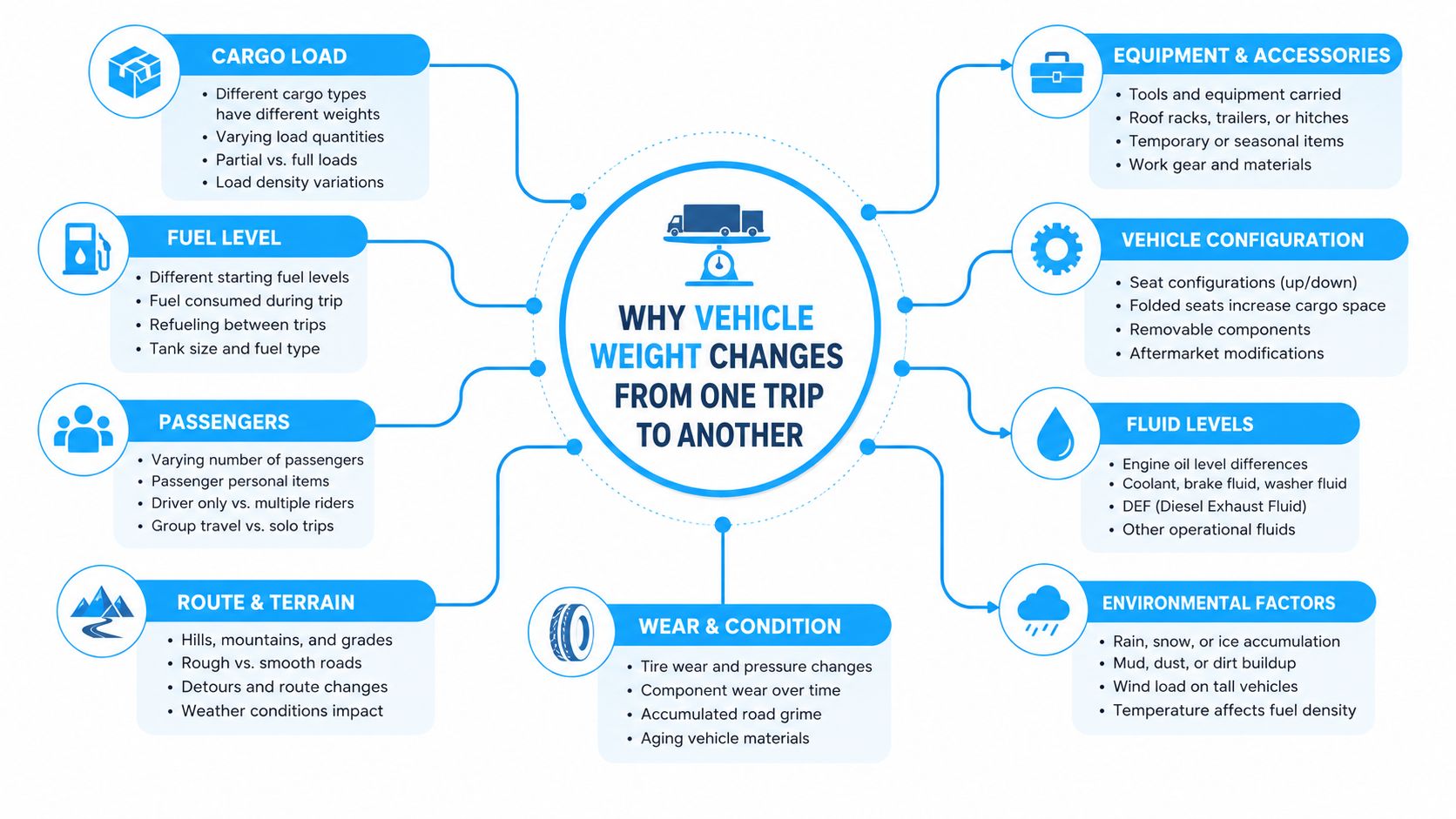
A buyer comparing an electric SUV on a dealer lot sees the vehicle close to its ready-to-drive condition. The same SUV can weigh substantially more before a family journey, once passengers, bags, a roof box, a bike rack, and charging equipment are aboard. The vehicle hasn't changed, but its actual gross weight has.
That contrast explains the central distinction. Curb weight is the fixed baseline used to describe the vehicle with its standard equipment and operating fluids, but without passengers or cargo. Gross weight is the changing condition produced by the particular trip. A fleet vehicle may have one gross weight on an empty return journey and another after collecting tools, materials, and several workers.
What adds weight between the driveway and the road
The load can include more than suitcases:
- Occupants: Every passenger increases the vehicle's loaded mass.
- Cargo: Groceries, work equipment, sports gear, and luggage all count.
- Accessories: Roof boxes, bike racks, winches, and aftermarket bumpers add mass.
- Towing equipment: A trailer's vertical tongue load rests on the tow vehicle and contributes to its gross weight.
- Fuel and operating fluids: These are already represented in the curb-weight baseline, but they remain part of the loaded vehicle.
The consequences are practical. A heavier vehicle asks more from its brakes, places greater load on its tyres and suspension, and can become less stable when the load is poorly distributed. Added mass also increases rolling resistance and can reduce an EV's real-world range. A roof box or bike mount may create aerodynamic drag in addition to the weight itself.
Practical rule: A vehicle's brochure weight describes the starting point. Your trip weight determines what the vehicle must actually control, carry, stop, and propel.
For buyers, the question isn't “How heavy is this car?” It's “How heavy will this car be when I use it?” Fleet managers need that answer for route planning and compliance. Tow-vehicle operators need it before adding passengers, cargo, and trailer load to the same platform.
Understanding Curb Weight and Gross Weight
A car can leave home with only its driver, then return carrying passengers, luggage, and equipment. Its curb weight stays the vehicle's ready-to-drive baseline, while its gross weight changes with the load. Understanding the difference helps you choose a suitable vehicle, load it safely, and plan realistic EV energy use.
The two definitions in plain language
Curb weight includes:
- The vehicle and its standard equipment
- Operating fluids
- The manufacturer's specified ready-to-drive fuel or energy condition
- Standard tools or a repair kit where included in the stated specification
It generally excludes:
- The driver and passengers
- Luggage and other cargo
- Optional equipment absent from the stated configuration
- Aftermarket accessories and modifications
Vehicle specifications should state which equipment and operating condition they use. Electric-car specification guidance shows why checking that definition matters when comparing models, especially EVs with different battery and equipment configurations.
Curb weight works like a fixed starting reading on a scale. It describes the same vehicle before the people and trip-specific load are added. Gross weight is the current reading after those additions.
Gross weight is the vehicle's mass in its loaded condition. It combines the curb-weight baseline with occupants, cargo, added equipment, and any other load supported during that trip. Because the load changes, gross weight is not a permanent specification-sheet value.
The arithmetic is straightforward:
Gross weight = curb weight + payload
For a particular journey:
Payload = gross weight minus curb weight
A vehicle with a 1,600 kg curb weight carrying 400 kg of people and cargo reaches 2,000 kg gross weight, a 25% increase over its baseline. The same calculation applies to passengers in a family car, tools in a van, or equipment in a fleet vehicle.
Why the baseline matters
Curb weight gives buyers, engineers, and fleet operators a consistent reference. Gross weight describes what the brakes, tyres, suspension, handling systems, and powertrain must manage on that trip. A vehicle that feels comfortable with a light load can require different planning when fully occupied or carrying equipment. In an EV, the added mass can also increase energy use, so one loaded trip may reduce the distance available from the same battery charge.
The distinction supports practical decisions. Buyers can compare the stated baseline with their normal passengers and cargo. Drivers can check the loaded condition before a long journey. Fleet managers can match payload and route demands to the vehicle selected.
Do not treat gross weight as a heavier version of the model. It is the current reading, preferably confirmed on a suitable scale, after the people, cargo, and equipment for that trip are aboard. GVWR is a separate manufacturer-set limit, so the measured gross weight must remain within the vehicle's permitted ceiling.
Comparing Curb Weight, Gross Weight, and GVWR
These three terms answer different questions. Curb weight asks what the vehicle weighs in its ready-to-drive baseline. Gross weight asks what it weighs right now. GVWR, or gross vehicle weight rating, asks how much total weight the manufacturer allows the vehicle to carry and operate at.
A fleet manager might use the curb weight to calculate available payload, a driver might measure gross weight at a scale, and an engineer or regulator might compare that measurement with GVWR. Confusing those roles can turn a harmless specification check into an overloading problem.
Three values, three purposes
| Attribute | Curb Weight | Gross Weight | GVWR |
|---|---|---|---|
| Meaning | Ready-to-drive vehicle mass | Actual loaded vehicle mass | Maximum permitted total vehicle mass |
| Includes occupants and cargo | No | Yes | The limit accounts for them |
| Changes by trip | Normally treated as the vehicle baseline | Yes | No, it's manufacturer-set |
| How it's established | Specification for a configuration | Scale measurement or calculation | Manufacturer or regulatory rating |
| Main use | Starting point for payload calculation | Safety and compliance check | Ceiling that gross weight must not exceed |
GVWR is not a measurement. It's a fixed ceiling defined for the vehicle. A fleet-focused explanation describes it as the maximum combined weight of the vehicle, passengers, fuel, cargo, and accessories, with payload capacity calculated as GVWR minus curb weight (GVWR and payload guidance).
Gross weight sits below that ceiling only if the current loading is appropriate. If the vehicle's curb weight rises because of optional equipment or modifications while GVWR stays unchanged, less payload headroom remains. The regulatory definition of gross vehicle weight also reinforces the need to separate actual gross weight from the rated maximum.
Find the authoritative label
The vehicle's door-jamb certification label, VIN-specific information, and owner's manual should take priority over a generic online listing. Check the label for GVWR and axle ratings, then compare those limits with the vehicle as loaded. GVWR is a safety boundary, not a target weight, and exceeding it can affect braking, tyre loading, stability, and compliance.
How Added Weight Affects EV Performance
An EV doesn't escape the physics of added mass. Its electric motor can deliver strong acceleration, but the tyres, brakes, suspension, battery, and road contact still have to manage the vehicle's full gross weight.
The first effect appears at the wheels. A heavier loaded vehicle places more force through the tyres and asks the braking system to dissipate more energy. Suspension components compress under the load, and an uneven distribution can change ride height and handling. Crosswinds, sudden lane changes, and trailer movement become more demanding when the vehicle is heavily loaded or poorly balanced.
Mass and energy use
An EV's battery supplies energy to overcome several forms of resistance. Added mass increases rolling resistance and the energy required to accelerate, while roof-mounted equipment can add aerodynamic drag at speed. That combination can reduce efficiency and shorten real-world range, although the effect varies with speed, terrain, weather, tyre condition, and driving style. EV efficiency guidance provides useful context for evaluating those variables together rather than treating a laboratory range figure as a guarantee.
Regenerative braking can recover part of the energy during deceleration, but it doesn't make added weight free. The vehicle still needed extra energy to accelerate, and braking performance still depends on tyre grip, road conditions, brake hardware, and load distribution. Cold weather can compound the planning challenge by affecting energy use and available range while the vehicle is already carrying more mass.
A useful trip calculation therefore includes the actual load:
- Begin with the stated curb weight.
- Add occupants, luggage, and equipment.
- Include the mass of roof-mounted or rear-mounted accessories.
- Account for trailer tongue load if applicable.
- Compare the result with GVWR and the axle ratings.
- Plan charging around the expected loaded efficiency, not only the advertised range.
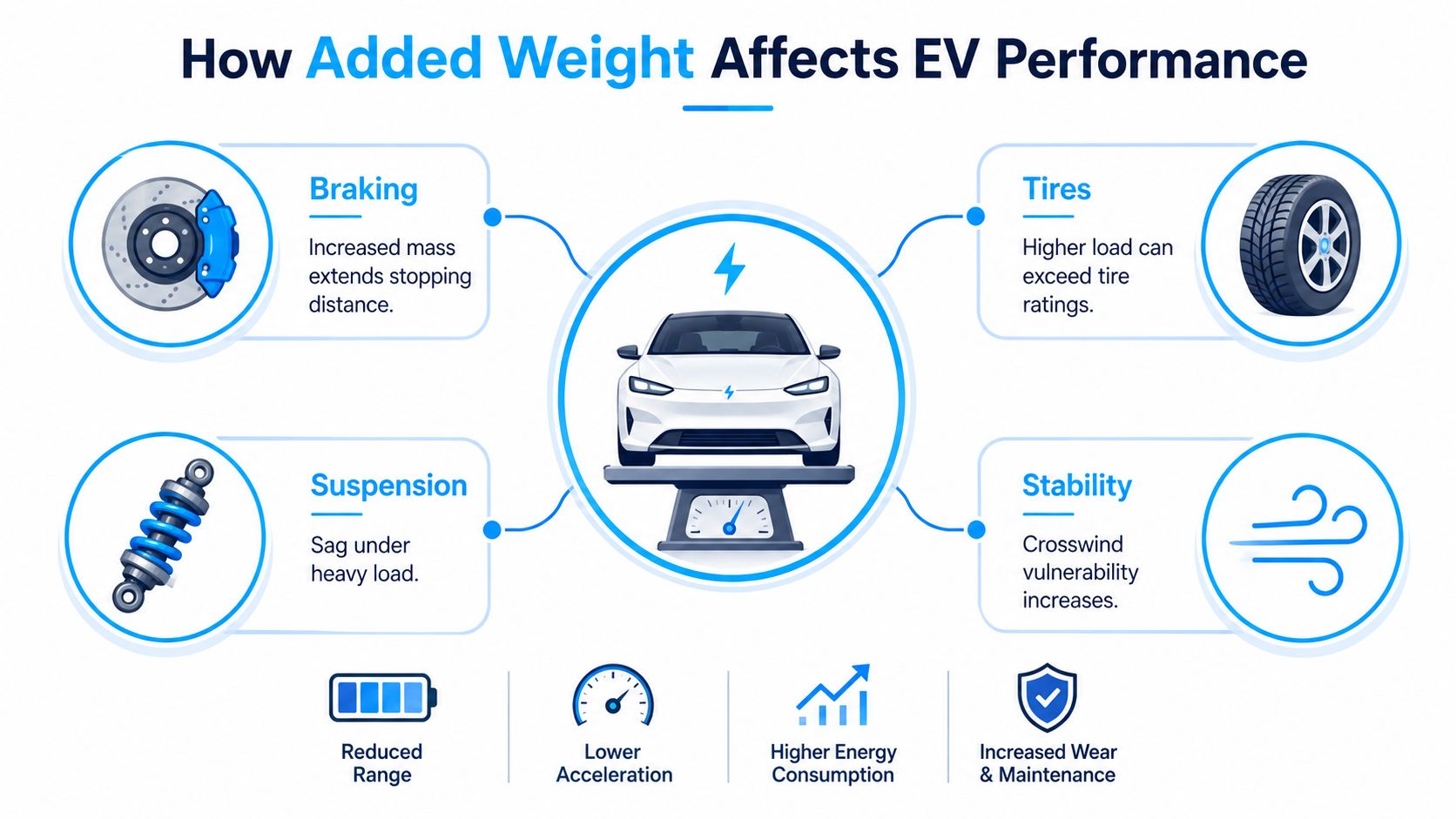
A long trip with a full cabin may require more charging stops than the same route with one occupant. Before departing, check tyre pressures against the manufacturer's loaded-use guidance, secure cargo low and evenly, and remove accessories you don't need. Those steps protect efficiency while keeping the load within the vehicle's operating limits.
Calculating Payload and Loaded Vehicle Weight
The easiest calculation starts with two numbers: curb weight and GVWR. The difference between them represents the vehicle's rated payload capacity, although the calculation still needs to account for every occupant, accessory, and load carried on the trip.
Use these formulas:
- Payload capacity = GVWR minus curb weight
- Loaded weight = curb weight plus payload
- Remaining margin = GVWR minus loaded weight
A compact SUV loading example
Suppose a compact SUV has a curb weight of 3,600 lb, a GVWR of 5,000 lb, and a trip load of 900 lb made up of occupants, luggage, and a roof box. Its loaded weight is 4,500 lb, leaving 500 lb of margin below GVWR.
That calculation is useful, but it isn't the final word. The door-jamb label may specify axle limits, and the roof box or rear cargo arrangement may affect how weight is distributed. A vehicle can remain below its total GVWR while placing too much load on one axle, so distribution matters as much as the combined total.
The model's available storage also influences how easily a family reaches its payload limit. For practical comparison, consult a vehicle's cargo-space specifications, then check whether the cargo volume encourages loading items that the payload rating can safely support.
A Class 2 pickup or delivery van
Now consider a light commercial vehicle with a curb weight of 5,500 lb and a GVWR of 9,000 lb. If the driver, passengers, tools, cargo, and trailer tongue load together total 2,500 lb, the loaded vehicle weighs 8,000 lb, leaving 1,000 lb before reaching GVWR.
The trailer tongue load belongs in the tow vehicle's calculation because it presses down on the vehicle. The trailer's total mass also affects the towing system, but it isn't added to the tow vehicle's gross weight unless that load is supported by the tow vehicle. Check the manufacturer's towing, axle, hitch, and payload limits together.
| Vehicle | Curb Weight (lb) | Occupants + Cargo (lb) | Gross Weight (lb) | GVWR (lb) | Remaining Margin (lb) |
|---|---|---|---|---|---|
| Compact SUV | 3,600 | 900 | 4,500 | 5,000 | 500 |
| Class 2 pickup or delivery van | 5,500 | 2,500 | 8,000 | 9,000 | 1,000 |
The figures in this worked table are arithmetic examples, not specifications for a particular model. For accurate preparation, estimate the load at home, then weigh the fully loaded vehicle at a CAT Scale or other certified scale before a long journey. If you work in metric units, 1 lb equals 0.4536 kg. Use the same unit system throughout the calculation so a conversion mistake doesn't create false payload headroom.
Common Weight Misconceptions to Avoid
The most common mistake is treating gross weight as a number printed on the door. Gross weight describes the vehicle's current loaded condition, so it can change whenever passengers, cargo, equipment, or trailer load changes. The door label's GVWR is the fixed ceiling, not the vehicle's actual weight at that moment.
Another error is assuming curb weight means a completely empty shell. It doesn't. Curb weight includes standard equipment and operating fluids, while occupants and cargo are excluded. For fuel-powered vehicles, the stated baseline may use the manufacturer's specified fuel condition. Buyers should read the particular manufacturer's definition rather than assuming every brand measures curb weight in exactly the same way.
Specification sheets don't always share one baseline
Dry weight, shipping weight, curb weight, kerb weight, and operating weight may describe different preparation states. Comparing a dry figure from one brand with a fluid-filled curb-weight figure from another can make one vehicle appear lighter without creating a fair comparison.
Optional equipment creates another trap. A tow hitch, light bar, winch, larger wheels, roof system, or aftermarket bumper can raise the vehicle's actual baseline before the first passenger enters. If GVWR doesn't rise with that added equipment, available payload falls.
The question isn't only whether an accessory fits. Ask how much it weighs, where that weight sits, and how much payload remains afterward.
EVs still pay a weight penalty
Electric propulsion changes the energy source, not the basic relationship between mass and motion. Battery packs can make many EVs heavier than comparable petrol or diesel vehicles, and every additional passenger or accessory still increases gross weight. That extra mass can raise rolling resistance, increase braking demand, and reduce real-world efficiency.
Don't assume strong electric acceleration proves the vehicle has unlimited carrying capacity. Motor performance, battery energy use, tyre ratings, axle limits, suspension capacity, and GVWR are separate considerations.
A Practical Weight Check Before Buying or Loading
A sound weight decision begins with the right document. Pull the door-jamb certification label, manufacturer specification sheet, owner's manual payload chart, and registration information. Use VIN-specific information when available, because trim, battery, drivetrain, seating, and optional equipment can change the actual curb-weight baseline.
Check the vehicle before purchase
Ask these questions before signing:
- What is the configuration-specific curb weight? Confirm the exact trim, drivetrain, battery, cab, bed, and factory equipment.
- What is the GVWR? Treat it as the maximum total operating mass, not as the vehicle's current weight.
- How much payload remains? Subtract the stated curb weight from GVWR, then account for accessories already fitted.
- What are the axle limits? Compare front and rear ratings with the way you'll place passengers, cargo, and tongue load.
- What will the vehicle carry in real use? Use your normal family, work, or towing scenario rather than an empty weekend trip.
For a quick home estimate, add the mass of the occupants, luggage, tools, charging cables, roof equipment, and other items to curb weight. This produces an approximate gross weight, but a certified scale provides a more dependable result. Truck-stop scales, dealer platform scales, and commercial weighing facilities can help verify the loaded vehicle.
Make the pre-trip check repeatable
Load the vehicle as you intend to travel, including the trailer tongue load if relevant. Weigh it, record the gross result, and compare it with GVWR and the applicable axle ratings. If the vehicle is near a limit, redistribute or remove cargo rather than relying on an estimate.
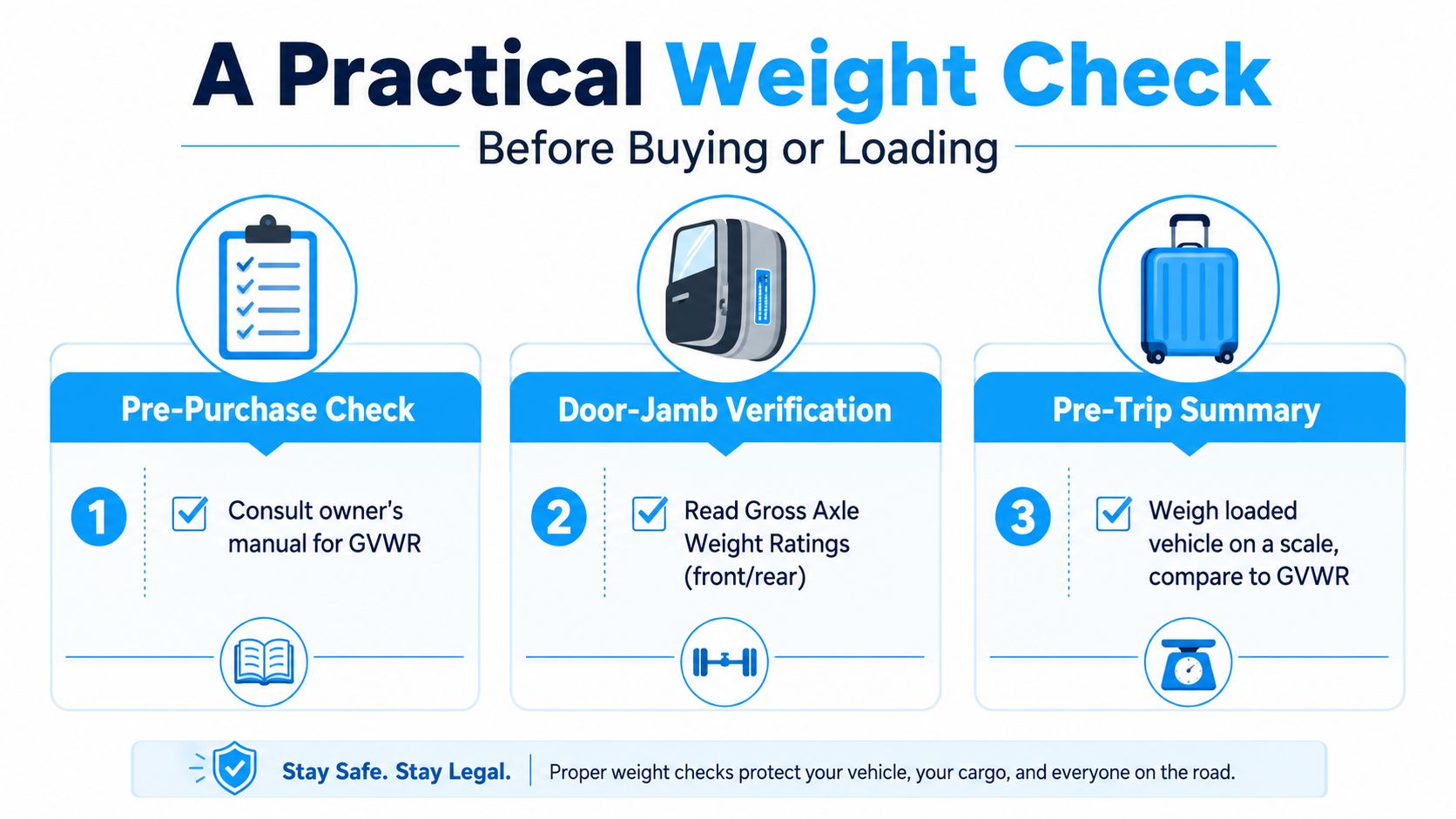
Before every significant change in load pattern, recheck tyre pressures using the manufacturer's guidance for loaded operation. Fleet managers should also record recurring payload patterns and inspect axle loading, while EV drivers should include the heavier trip condition when planning charging stops.
Choose the figure that matches the decision: curb weight for the baseline, gross weight for the current trip, and GVWR for the maximum allowed total. Then verify the label, calculate the payload, weigh the loaded vehicle when accuracy matters, and make sure the tyres, axles, suspension, hitch, and brakes are suited to the load.
EV Stats provides structured electric-vehicle specifications, comparison tools, efficiency information, and charging-planning resources that can help you evaluate weight alongside range and operating requirements. Visit EV Stats to compare models before buying and connect the vehicle's published specifications with the way you travel.